Healthcare API Security Best Practices for EHR Integration
Healthcare API security now decides whether an EHR integration protects patient data or hands it to whoever finds the gap first. Batch file transfers and custom point-to-point interfaces used to move that data overnight. APIs replaced them because real-time exchange between electronic health records, patient portals, medical devices, and third-party apps is what modern care actually needs.
Nobody priced in the cost of that speed, though. Every new connection is another door into protected health information, and healthcare cybersecurity threats have outpaced what most IT teams can patch on a normal release cycle. So secure EHR integration can’t be a step you bolt on after go-live; it has to be there from the first line of code, or the integration shouldn’t ship.
Why API Security Is Critical for EHR Integration
Moving protected health information from one system to another is the entire job of a healthcare API, and that’s exactly why healthcare API security isn’t optional. Misconfigure a FHIR endpoint, and lab results, medication histories, imaging reports, demographic data; all of it goes to any application cleared to call in.
Dozens. That’s roughly how many applications a mid-sized hospital’s EHR ends up connected to: patient portals, monitoring devices, referral platforms, billing systems, plus whatever specialty tool a department bought without looping in IT. Every one of those is a fresh set of credentials somebody now owns. EHR API security rarely fails in isolation either; a weak third-party integration hands an attacker a straight line into the core EHR.
Regulators don’t treat this as a gray area. The HIPAA Security Rule requires covered entities and business associates to run technical safeguards on any system touching electronic PHI: access controls, audit controls, transmission security. HIPAA API security obligations cover a FHIR endpoint the same way they cover a database, and reach HIPAA-compliant AI development too, since most AI tools pull PHI through that same API layer.
There’s a number people remember from 2024. The ransomware attack on Change Healthcare exposed roughly 192.7 million people’s health information and knocked connected systems offline for weeks. Call that a board-level failure, not an IT incident, with a body count measured in patient records.
Common Security Risks in Healthcare APIs
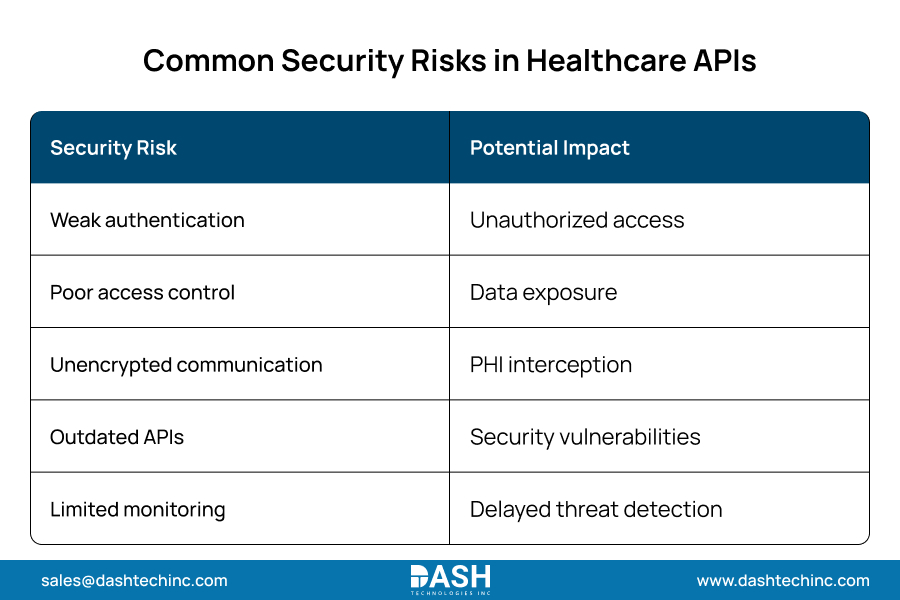
FHIR API security incidents trace back to a handful of repeat offenses. Same ones, over and over.
Weak authentication tops the list, and it’s not close. An API secured with a static key or shared credential, instead of standards-based healthcare API authentication, sits one leaked secret away from full access. OWASP’s API Security Top 10 ranks broken authentication as API2:2023, second on the whole list, and healthcare APIs don’t get a pass just because the data is clinical.
Excessive permission compounds fast. Grant an API more access than the calling user or application needs, and one stolen account exposes everything within reach, not just what it should have touched. A lot of that traces back to sloppy identity matching in EHR integration, where the system genuinely can’t confirm who is on the other end of the call.
The rest round out a familiar list. Unencrypted transmission: PHI moving over plain HTTP, or TLS nobody has touched since deployment, gets intercepted without much effort. Insecure third-party integrations bring risk in from outside the hospital’s own environment entirely. Poor monitoring means nobody’s watching. And outdated API versions sit there with known, published vulnerabilities long after a patch existed to fix them.
Five risks, one fix: close each of them before the API goes anywhere near production.
Is Your EHR Integration Secure Enough?
Whether you're securing FHIR APIs, HL7 integrations, or third-party EHR connections, our interoperability experts can help you build a secure, scalable API architecture that protects PHI and supports compliant data exchange.
Talk to Our EHR Integration ExpertsSix Best Practices for Securing Healthcare APIs
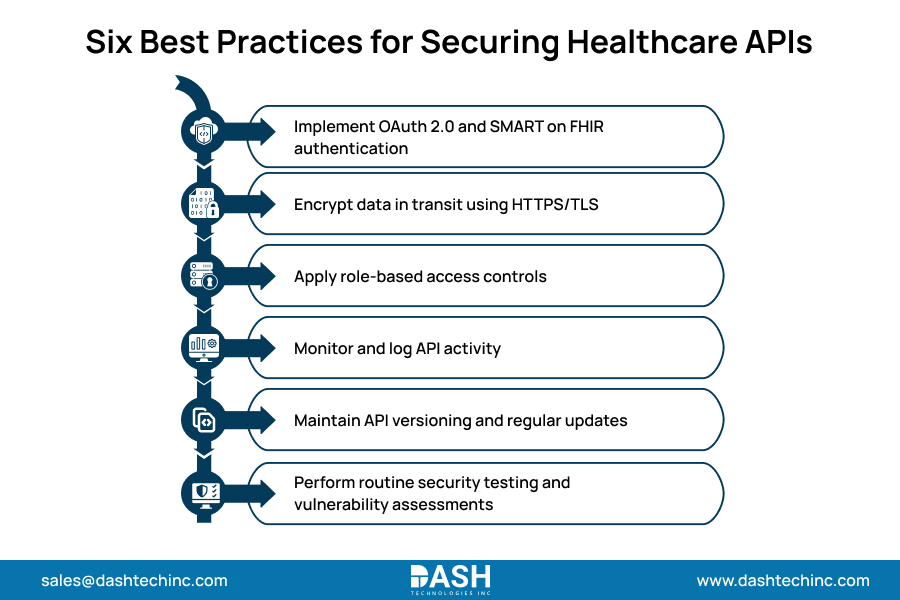
None of this gets solved with a security memo. API security in healthcare gets solved with six specific controls, applied to every EHR integration project without exception. Engineering teams rely on these core healthcare API security best practices to define deployment strategies.
- Implement OAuth 2.0 and SMART on FHIR authentication:
Deprecate static API keys entirely. SMART on FHIR security, HL7’s framework for layering OAuth healthcare authorization directly on FHIR endpoints, issues short-lived, explicitly scoped tokens. Leaked tokens expire automatically and strictly limit data exposure. Architects mapping a rollout must finalize FHIR API development specifications before writing any endpoint code. - Encrypt data in transit using HTTPS/TLS:
Every API call routing PHI executes over TLS 1.2 or higher with HTTP fallback permanently disabled. Engineering teams must subject certificates and cipher suites to continuous review calendars, bypassing static deployment checklists. - Apply role-based access controls:
RBAC limits each role to the access it actually needs, the direct fix for the excessive-permission risk above. A billing system doesn’t touch clinical notes; a properly scoped RBAC policy makes that a technical fact. - Monitor and log API activity:
Real-time monitoring catches the anomalies, a spike in call volume overnight, a run of failed logins, before any of it turns into a breach. Access logs double as proof of the audit controls the HIPAA Security Rule already requires. - Maintain API versioning and regular updates:
An old API version is a published list of vulnerabilities with your organization’s name on it. Retire deprecated endpoints on a fixed schedule instead of leaving them live because nobody wanted to touch the integration that still works. - Perform routine security testing and vulnerability assessments:
Teams must execute penetration testing and automated scanning on continuous & recurring cycles. NIST SP 800-204 defines this ongoing testing as mandatory baseline architecture rather than an optional compliance module.
Building Secure APIs Without Slowing Down Interoperability
Security and speed aren’t actually opposed. They just get treated that way when a team bolts security controls onto an API after the design is already locked. That’s what turns a control into a bottleneck, not the control itself.
Build security in at the first architecture decision, and it stops costing anything measurable. OAuth 2.0 validation and RBAC checks add milliseconds when they’re part of the request pipeline from day one, not retrofitted under deadline pressure. A secure EHR integration built this way absorbs new vendors without a redesign every time the network grows.
Governance makes that repeatable instead of lucky. Standardized authentication patterns, consistent scopes, documented access policies: every new integration follows the same path instead of someone reinventing the approach the night before a deadline. The healthcare API strategy an organization picks for a multi-EHR environment decides how much of that work gets reused versus rebuilt. Treat interoperability and security as one requirement, and the architecture moves faster over years, not slower.
How Dash Technologies Builds Secure EHR Integrations
Dash Technologies builds EHR integrations with security in the architecture from day one, not added after QA signs off. Our engineers deliver secure API development across HL7 v2, FHIR R4, and SMART on FHIR implementations, with OAuth 2.0-based authentication configured to match the access model each health system runs. Teams evaluating a broader FHIR implementation roadmap can see how that same architecture extends into AI-driven projects.
Every integration runs through structured integration testing before it touches production data: authentication flows, encryption configurations, and access controls validated against real usage, not a demo environment. Development practices build around HIPAA’s technical safeguard requirements at every stage, from design through whatever comes after go-live.
A one-time integration isn’t the goal. Health systems need EHR API security that stays current as EHR versions ship and threat models shift underneath them. Explore Dash Technologies’ EHR integration services for what a security-first architecture looks like in practice.
Conclusion
Get healthcare API security wrong, and interoperability stops protecting patients and starts exposing them. Regulatory compliance inherently fails under strict audit without these safeguards. OAuth 2.0, SMART on FHIR, end-to-end encryption, RBAC, & persistent monitoring dictate the core architecture. Health systems deploying these security baselines during initial development accelerate integrations and pass audits cleanly. Patient trust depends entirely on this exact foundational engineering.
Contact Dashtech to build EHR integrations secured from the first line of code.
Frequently Asked Questions
About Dash

Dash Technologies Inc.
We’re technology experts with a passion for bringing concepts to life. By leveraging a unique, consultative process and an agile development approach, we translate business challenges into technology solutions Get in touch.