Healthcare Provider Interoperability: Improving Clinical and Financial Workflows
Healthcare providers have invested heavily in EHRs, revenue cycle platforms, laboratory systems, patient engagement tools, imaging platforms, and other digital technologies. Yet adding more technology does not necessarily create a more connected healthcare organization.
The problem is often what happens between these systems.
When clinical, administrative, and financial platforms cannot exchange and interpret data efficiently, staff compensate with manual workarounds, duplicate documentation, delayed communication, and fragmented workflows. The impact extends beyond IT. Clinicians may lack the information they need at the point of care, revenue cycle teams may spend additional time correcting incomplete or inconsistent data, and organizations may delay realizing the operational value of their technology investments.
This makes healthcare provider interoperability more than an integration or IT initiative. It is becoming an operational capability that can influence care coordination, workforce efficiency, revenue cycle performance, and the ability to adopt new digital technologies.
What Is Healthcare Provider Interoperability?
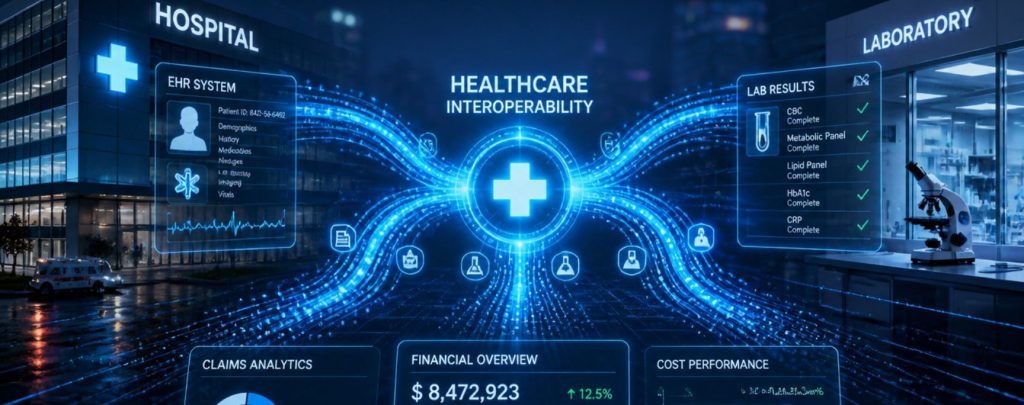
Healthcare provider interoperability is the ability of clinical, administrative, and financial systems to securely exchange and use data across EHRs, billing platforms, laboratories, pharmacies, payer systems, medical devices, and other healthcare applications.
It goes beyond simply moving data from one system to another. Effective interoperability ensures that information is exchanged in a consistent, usable format and reaches the right workflow at the right time, supporting coordinated care, operational efficiency, and more connected financial processes.
Why Interoperability Is Now a Business Priority for Healthcare Providers
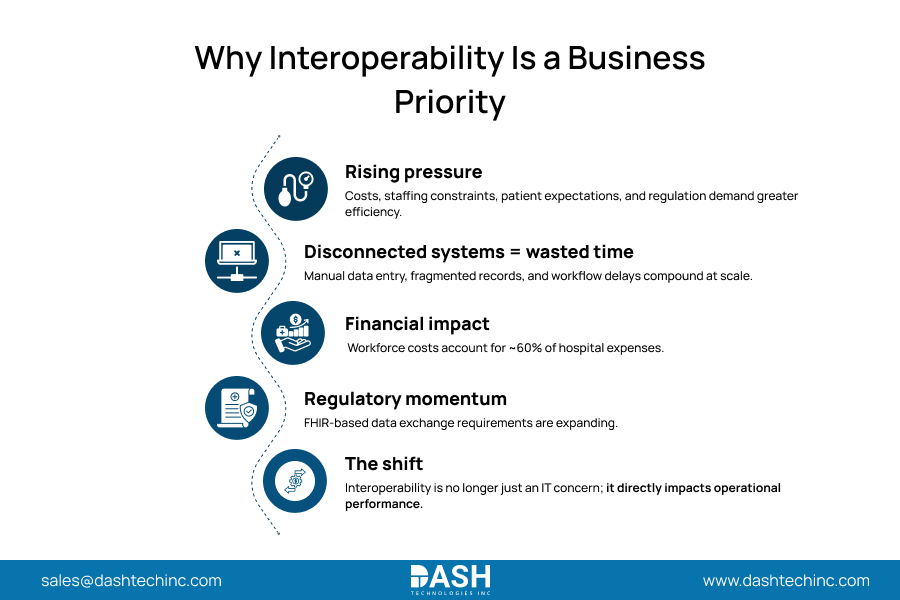
Healthcare organizations are operating under simultaneous pressure to improve patient experiences, manage rising costs, address workforce constraints, meet evolving regulatory expectations, and support new models of care.
Technology is expected to help solve these challenges. But technology can only deliver its full value when the systems supporting it can work together.
The financial pressure is particularly significant. The American Hospital Association reported that hospital expenses, including labor, drugs, and supplies, grew twice as fast as hospital prices in 2025. Workforce spending alone represented about 60% of total hospital expenses.
In this environment, operational inefficiency is becoming increasingly expensive.
A clinician spending additional time searching across systems, a revenue cycle employee manually entering information from one application into another, or a care team waiting for documentation from a disconnected system may each represent a small inefficiency. At enterprise scale, however, these delays compound.
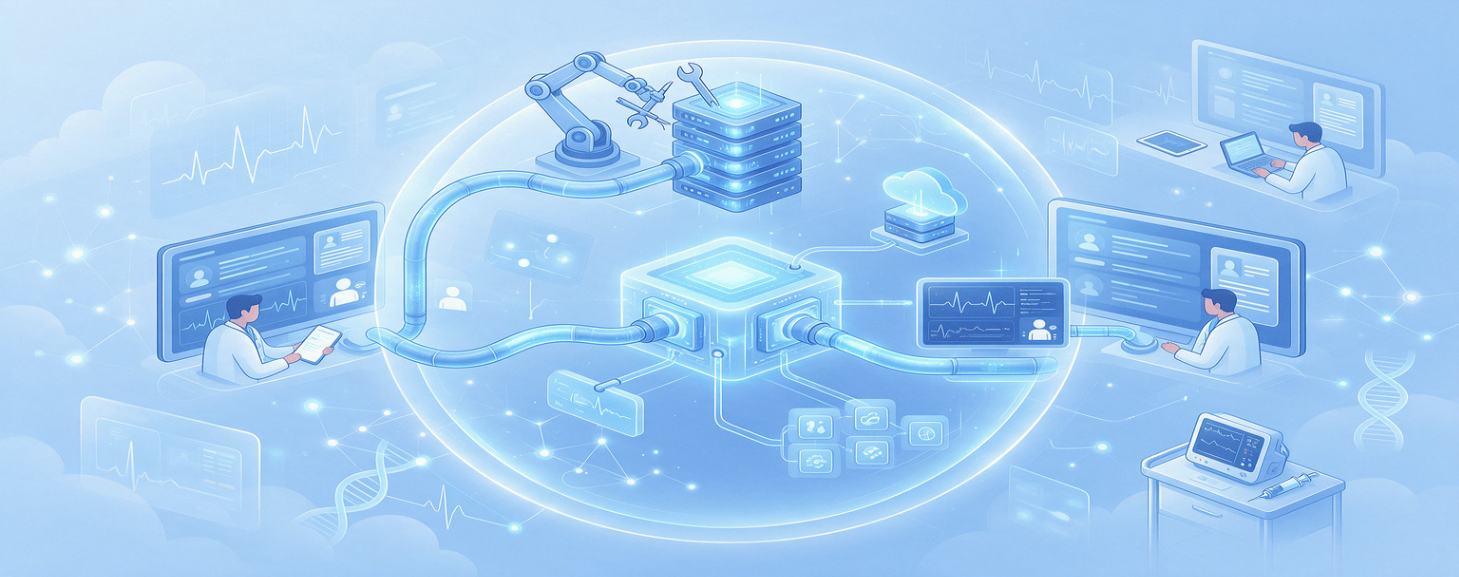
Interoperability can help address this problem by creating connected workflows instead of isolated technology environments.
Regulatory developments are also accelerating the need for better data exchange. CMS’s interoperability requirements are expanding the use of FHIR-based APIs to facilitate exchange among payers, providers, and patients. The 2024 final rule established requirements for Provider Access and Payer-to-Payer APIs, with key API compliance requirements generally beginning in 2027.
The message for provider organizations is clear: interoperability is increasingly tied to how healthcare organizations operate, not simply how their IT departments integrate applications.
The Hidden Cost of Disconnected Clinical and Financial Workflows
The consequences of disconnected systems are often visible as individual workflow problems rather than one large technology failure.
Clinical workflows
When patient information is fragmented across systems, clinicians and staff may encounter:
- Incomplete patient records
- Duplicate documentation
- Repeated tests because previous results are difficult to access
- Delays in obtaining clinical information
- Manual data entry between systems
- Additional administrative work during care transitions
These issues can create friction throughout the patient journey.
Consider a patient referred from one facility to another. If relevant clinical information does not move reliably between the referring and receiving systems, staff may have to request records manually, clinicians may spend time locating information, and patients may be asked to provide information they have already supplied elsewhere.
The technology may exist. The problem is that the workflow is not connected.
Financial workflows
The same fragmentation can affect the revenue cycle.
Billing and claims workflows depend on accurate information moving between registration, clinical documentation, coding, billing, clearinghouses, and payer systems. When those connections are weak, organizations may experience:
- Billing delays
- Incomplete or inconsistent claim information
- Increased manual intervention
- Claim denials
- Revenue leakage
- Higher administrative costs
Claim denials illustrate the financial consequences particularly well. According to data cited by HFMA, initial claim denial rate rose to 11.81% in 2024, up 2.4 percentage points year over year. Denials slow cash flow and require providers to devote additional resources to investigation, correction, and appeals.
Not every denial is an interoperability problem. But data quality, eligibility information, documentation, coding, and other information-dependent processes can all be affected by disconnected workflows.
That distinction matters. The goal is not simply to “integrate the billing system.” The goal is to make the entire information flow supporting the revenue cycle more reliable.
Modernize Healthcare Interoperability Without Starting From Scratch
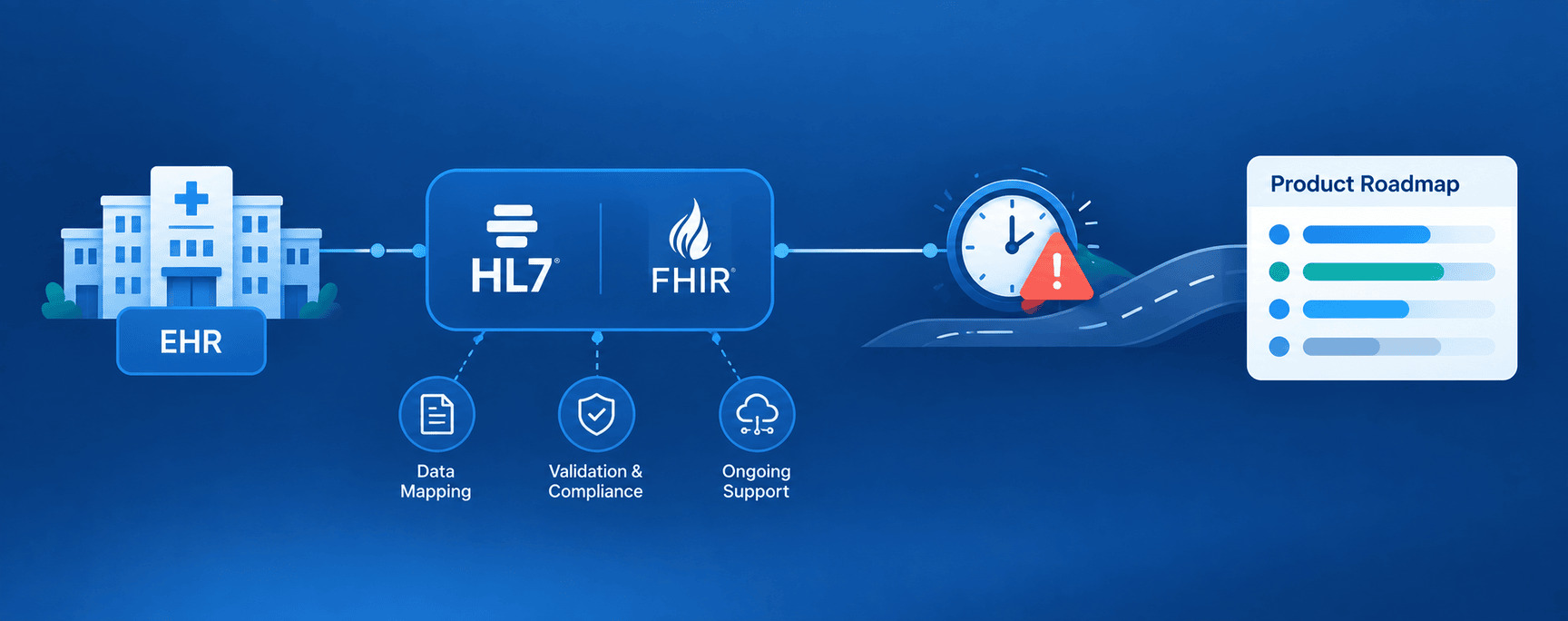
BridgeFast brings together DASH Technologies' healthcare integration expertise across HL7, FHIR, and healthcare data exchange with reusable implementation frameworks designed to reduce integration complexity and help providers modernize clinical and financial workflows.
Talk to a Healthcare Interoperability ExpertWhy Mid-Sized Healthcare Organizations Face Greater Interoperability Challenges
Mid-sized healthcare provider organization often have lean IT teams supporting a growing number of applications, vendors, interfaces, and business requirements. Their IT budgets are also much leaner.
At the same time, they are expected to modernize their technology environments, support new digital health capabilities, integrate with external partners, and respond to changing regulatory requirements, often without proportionally expanding their technical teams.
This creates a difficult equation:
More integration requirements + limited resources + growing complexity = increasing interoperability pressure.
Adding more technical staff is not always the answer.
A more sustainable approach is to reduce the amount of integration work that has to be reinvented for every new system, vendor, or workflow.
This is where reusable integration frameworks can become strategically important.
What Years of Healthcare Integration Experience Has Taught Us
Healthcare integration rarely becomes difficult because an organization has never heard of HL7 or FHIR.
The harder problems tend to appear during implementation.
Different vendors may interpret requirements differently. Data structures may not align cleanly. Workflows that appear similar across departments may contain important operational differences. Interfaces may need to support legacy systems alongside modern APIs. And integrations that work for one implementation may become difficult to maintain when an organization needs to replicate them across multiple facilities or applications.
Several lessons consistently emerge:
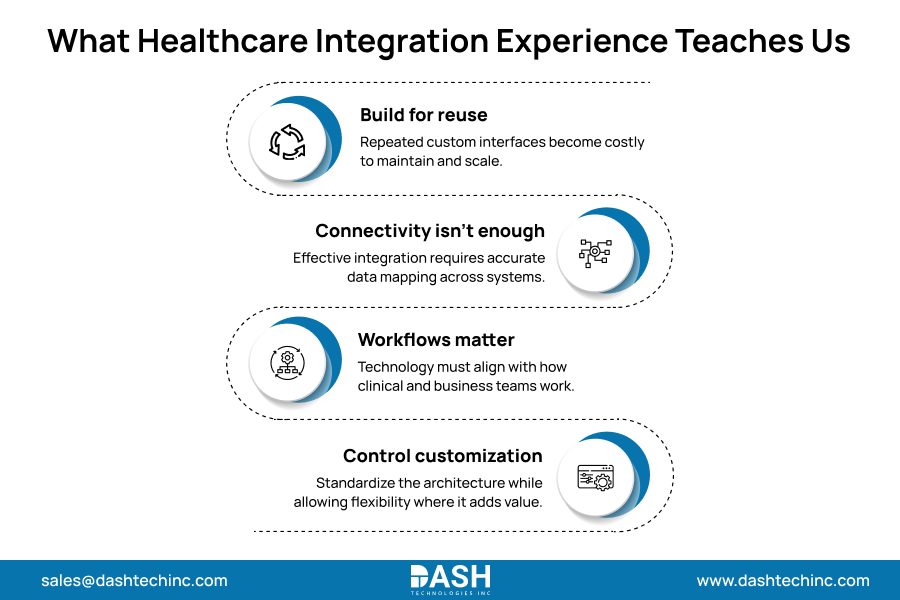
1. Rebuilding interfaces repeatedly does not scale
Creating a custom interface for every new system can solve the immediate requirement, but it also creates another asset that must be monitored, maintained, tested, and eventually modified.
A reusable approach shifts the focus from building one connection at a time to creating patterns that can be applied across multiple connections.
2. Data mapping is as important as connectivity
Connecting two systems does not automatically make their data interoperable.
Healthcare organizations must determine how information from one system maps to the structure, terminology, and workflow expectations of another.
This becomes especially important when integrating HL7 v2 messages, FHIR resources, APIs, and other healthcare data formats.
3. Workflow alignment matters as much as technical standards
A technically successful interface can still produce a poor operational outcome if it does not reflect how clinicians, administrators, billing teams, or other users actually work.
Interoperability programs therefore need both technical and operational governance.
4. Customization needs boundaries
Healthcare organizations inevitably require some customization. The challenge is preventing every implementation from becoming a completely unique solution.
Too much customization increases maintenance and makes future scaling harder.
The objective should be controlled flexibility: accommodate meaningful workflow differences while maintaining a standardized architectural foundation.
Expert Insight
Organizations rarely struggle because HL7 or FHIR standards are inadequate. The greater challenge is coordinating workflows, data mapping, governance, and system onboarding across multiple vendors and departments.
Successful interoperability programs therefore focus as much on operational alignment as they do on technical standards.
Healthcare Interoperability Is a Journey, Not a One-Time Project
Interoperability maturity does not happen by replacing every legacy system at once.
For many providers, a more practical strategy is to identify the workflows where better connectivity can create measurable value and improve them incrementally.
A useful way to think about this is through four stages:
- Connect
Establish reliable connections between the systems that support high-priority workflows.
This may involve EHRs, laboratory systems, imaging platforms, revenue cycle applications, payer systems, medical devices, or external healthcare partners. - Standardize
Create consistent approaches to data exchange, mapping, authentication, validation, monitoring, and interface management.
Standards such as HL7 and FHIR provide important building blocks, but organizations still need implementation patterns and governance around them. - Optimize
Once information can move reliably, organizations can begin improving the workflows around that information. - Scale
The final stage is making interoperability repeatable.
A successful integration should become a foundation for the next integration and not another isolated project.
This approach creates an interoperability roadmap that allows organizations to modernize progressively while maintaining operational continuity.
How BridgeFast Helps Healthcare Providers Modernize Interoperability?
For organizations dealing with growing integration requirements, the challenge is often not whether interoperability is necessary. It is how to implement it without continually rebuilding the same technical foundation.
BridgeFast approaches this problem through reusable healthcare integration frameworks designed to simplify and accelerate interoperability implementation.
Instead of treating every integration as a completely custom project, the approach emphasizes reusable patterns for connecting systems, implementing HL7 and FHIR workflows, standardizing integrations, and onboarding new applications.
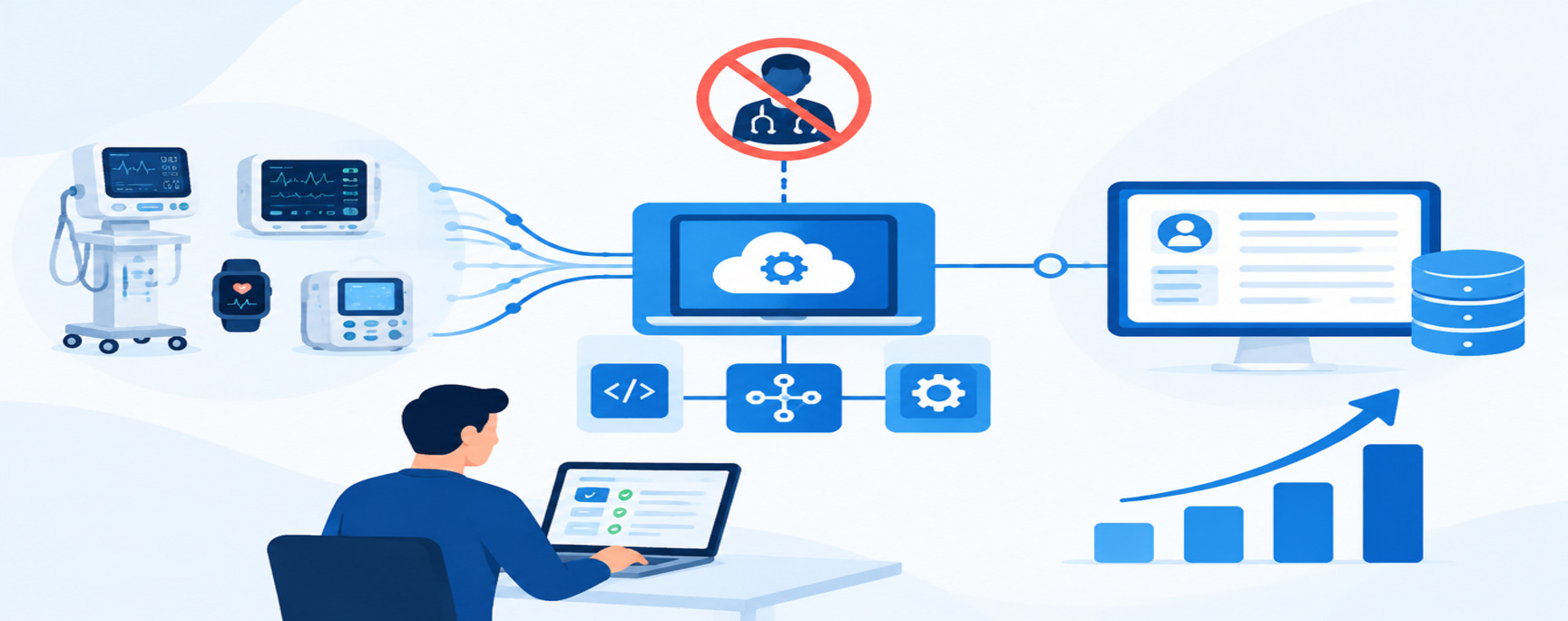
BridgeFast supports bidirectional exchange, extracting data from the EHR through FHIR, HL7, or custom interfaces, and writing results, documentation, and observations back into the chart where the workflow requires it.
This can support a phased modernization strategy where providers prioritize high-value workflows first and expand connectivity over time.
The distinction can be summarized as follows:
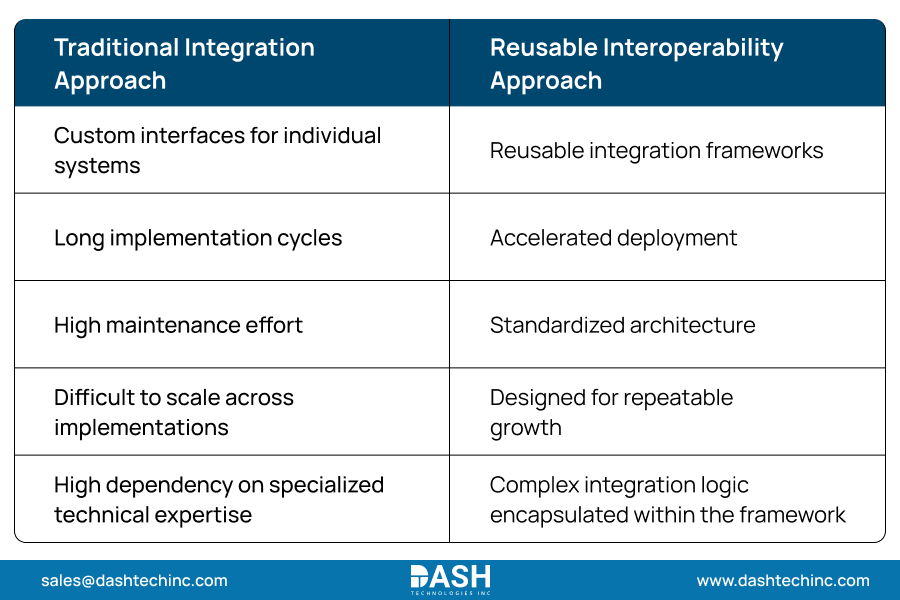
The objective is not to eliminate technical expertise. Rather, it is to make that expertise more reusable across implementations.
For healthcare organizations with limited integration resources, this can help shift interoperability from a sequence of isolated projects toward a scalable capability.
The Future of Provider Interoperability
Interoperability is also becoming the foundation for the next generation of healthcare technology.
AI-assisted clinical workflows, ambient documentation, predictive analytics, connected care models, and increasingly FHIR-based ecosystems all depend on timely access to reliable healthcare data.
- Consider ambient AI as an example.
An ambient documentation solution may capture information from a clinical encounter, but its value does not end when documentation is generated. That information needs to flow into the EHR, support downstream clinical workflows, contribute to coding or billing processes, and potentially interact with other systems. - The same principle applies to predictive analytics.
A predictive model is only as useful as the data available to it. If information remains trapped across disconnected systems or arrives inconsistently, the organization’s ability to operationalize that intelligence is constrained.
This is why interoperability is increasingly becoming an innovation prerequisite.
The American Hospital Association’s recent work on the smart hospital highlights this direction: digitally connected hospitals are bringing together interoperable systems, cloud infrastructure, virtual tools, and ambient AI to support more connected workflows.
Meanwhile, CMS continues to expand its interoperability strategy around FHIR-based APIs and standardized data exchange.
The future, therefore, is not simply about having more systems.
It is about having systems that can exchange information, understand it, and trigger the right workflow.
Conclusion
Healthcare provider interoperability has moved beyond the question of whether systems can connect.
The more important question is whether those connections are improving the way healthcare organizations operate.
When clinical, administrative, and financial systems exchange information reliably, providers can reduce unnecessary manual work, improve information availability, strengthen revenue cycle workflows, and create a stronger foundation for digital transformation.
The most effective strategy is rarely a single large-scale integration project. A phased, standards-based approach allows organizations to prioritize high-value workflows, establish reusable integration patterns, measure results, and scale over time.
Interoperability is ultimately not an IT destination. It is an organizational capability and one that will increasingly determine how effectively healthcare providers can adopt AI, connected care, automation, and other digital innovations.
Frequently Asked Questions
About Dash

Dash Technologies Inc.
We’re technology experts with a passion for bringing concepts to life. By leveraging a unique, consultative process and an agile development approach, we translate business challenges into technology solutions Get in touch.