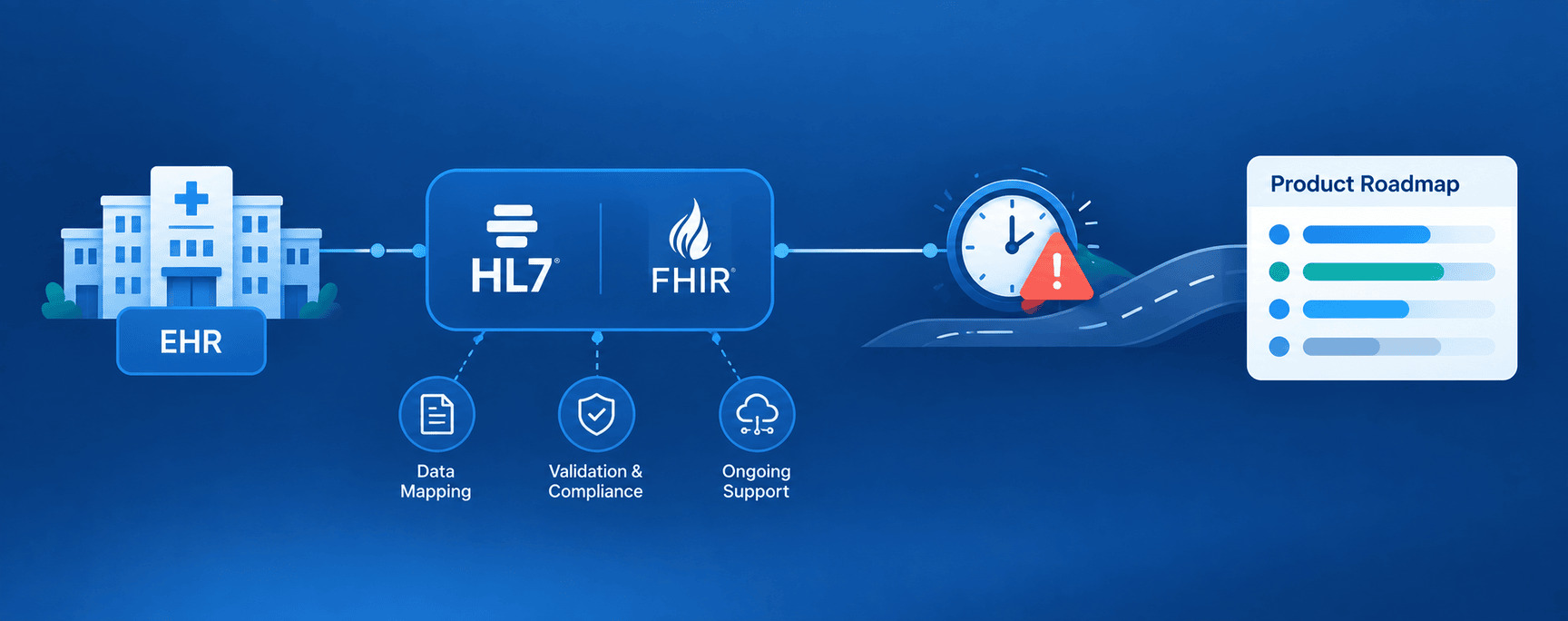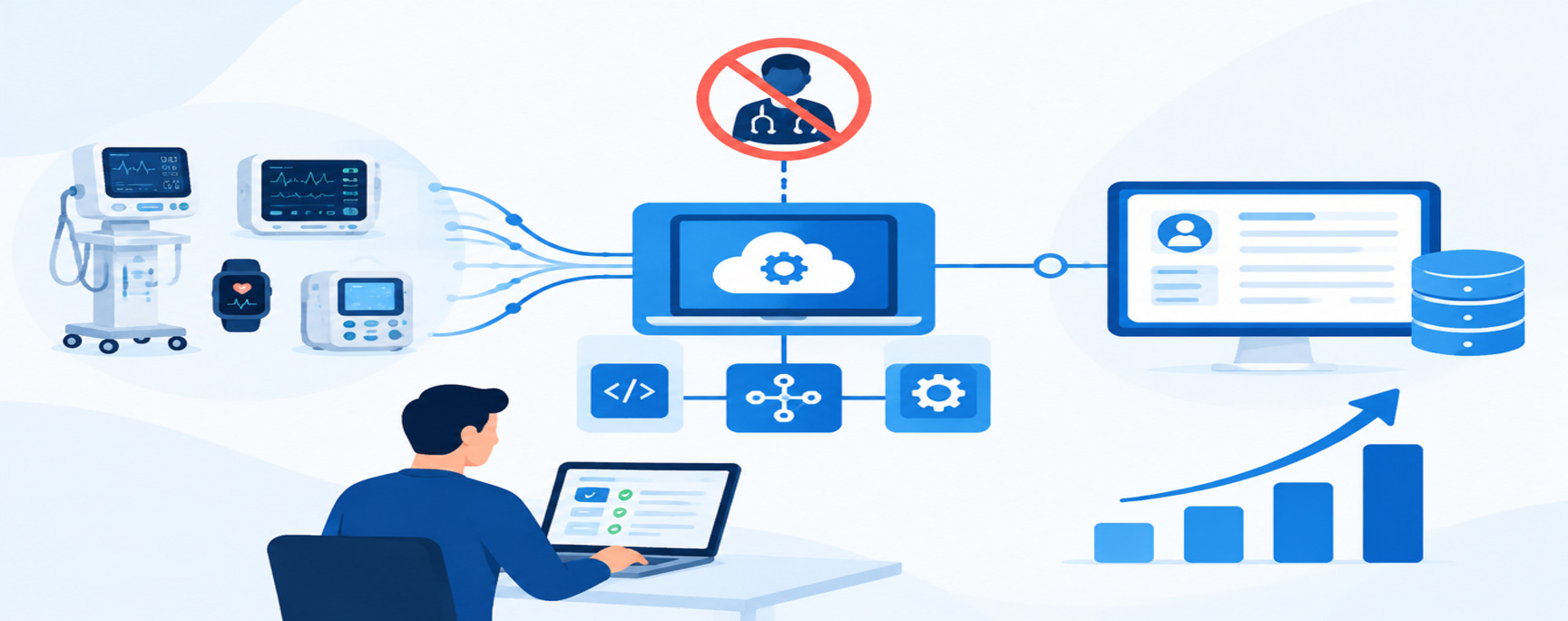
Build vs. Buy vs. Configure: Choosing the Right EHR Integration Strategy for Medical Devices
Medical device companies are no longer building products that operate in isolation. Connected devices, remote patient monitoring solutions, AI-enabled diagnostics, and digital health platforms increasingly need to exchange data with EHRs and fit into existing clinical workflows.
For providers, connectivity is becoming an expectation. A device may perform its intended clinical function exceptionally well, but if integrating it into the provider’s technology environment requires months of custom development, extensive IT involvement, or a dedicated integration team, adoption can become significantly more difficult.
This puts medical device companies in an increasingly important position: how should they approach EHR integration at scale?
The traditional options are familiar. Build integrations internally. Buy an enterprise integration platform. Or, increasingly, configure a purpose-built interoperability solution that provides reusable HL7/FHIR capabilities without requiring every integration to be developed from scratch.
The right choice, however, cannot be determined by upfront development cost alone. Engineering capacity, customer requirements, maintenance, scalability, implementation time, and total cost of ownership all shape the economics of an integration strategy.
Should Medical Device Companies Build, Buy, or Configure Their HL7/FHIR Integration Solution?
Build provides maximum control and flexibility but requires significant interoperability expertise and creates an ongoing maintenance responsibility.
Buy can provide mature enterprise integration capabilities, but may introduce licensing, implementation, and operational complexity that is difficult to justify for lean or mid-sized product teams.
Configure provides a middle path—combining standards-based HL7/FHIR interoperability with reusable components that can be adapted to specific EHRs, workflows, and customer requirements. For many medical device companies, this can reduce implementation effort while limiting dependence on specialized integration resources.
The important question is not simply which option is technically possible. It is which approach can support the company’s integration needs as its customer base and product portfolio grow.
Why EHR Integration Has Become a Strategic Priority for Medical Device Companies?
Healthcare is becoming increasingly connected.
Remote patient monitoring platforms generate continuous streams of patient data. Connected diagnostic devices produce information that can support clinical decision-making. AI-enabled technologies increasingly depend on clinical context. And devices used across hospitals, ambulatory settings, and home-based care are expected to fit into established digital workflows.
As a result, providers are asking medical device companies questions that extend beyond the device itself:
- Can the device connect to our EHR?
- Can device-generated data flow into existing clinical workflows?
- Does it support HL7 or FHIR?
- How quickly can we deploy it across facilities?
- How much integration work will our IT team need to perform?
- Can the integration be replicated across other customers?
These questions make medical device integration part of the product experience.
A device that is difficult to integrate can create friction for both the provider and the manufacturer. The provider may need to allocate additional IT resources, while the device company may have to support increasingly complex customer-specific implementations.
The broader healthcare ecosystem is also moving toward more connected, standards-based data exchange. HL7’s launch of the Caliper FHIR Accelerator in March 2026, for example, is focused specifically on advancing medical device interoperability and improving how data from medical and personal health devices can be exchanged and used across healthcare environments.
Most device data today still reaches the EHR through HL7 v2 ORU messages routed via device middleware, rather than through FHIR. FHIR is gaining ground for configuration and patient-facing data, but it remains a secondary path for live device streams. That gap is exactly what Caliper is trying to close, and it is also why a device company’s integration strategy still needs to account for HL7 v2 alongside FHIR, not replace one with the other.
At the same time, FHIR-based APIs are playing an increasingly important role in healthcare interoperability, including initiatives around provider access and standardized data exchange.
For medical device companies, the direction is clear: EHR connectivity is becoming an important part of how connected healthcare products are evaluated, deployed, and scaled.
That makes the integration strategy a business decision—not simply an engineering decision.
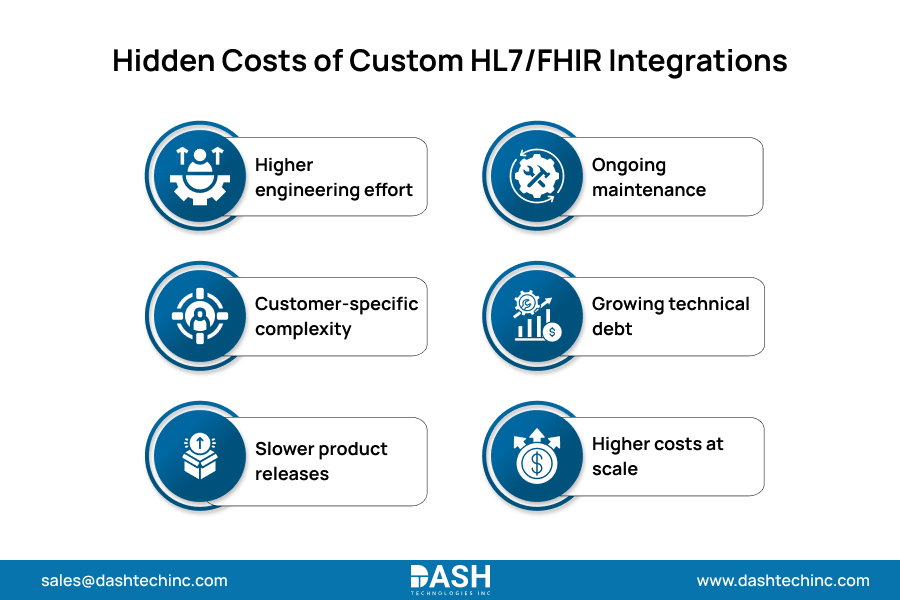
The Hidden Cost of Building Custom HL7/FHIR Integrations
Building integrations internally can initially look like the most straightforward option.
The company already has software engineers. The product team understands its own architecture. The first customer has a defined requirement. Why not simply build the interface?
The problem usually emerges later.
A company may begin with one customer, one EHR, and one workflow. Then another customer uses a different EHR. A third requires a different workflow. One implementation relies on HL7 v2 messaging while another requires FHIR APIs. Additional customers request custom mappings, authentication requirements, or workflow changes.
What began as a single integration gradually becomes an integration portfolio.
The cost goes beyond development
The initial engineering effort is only one part of the cost of custom integration.
Over time, teams also need to account for:
- Interface development and testing
- Data mapping and transformation
- EHR-specific requirements
- Security and authentication changes
- Interface monitoring
- Version updates
- Customer-specific customizations
- Troubleshooting and support
- Documentation
- Ongoing maintenance
This creates an important distinction between development cost and integration lifecycle cost.
Consider a medical device company that develops a custom HL7 interface for its first hospital customer.
The interface works. The customer goes live.
Six months later, that hospital changes a workflow. A second customer requires a different message structure. A new EHR needs to be supported. Meanwhile, the product team is working on the next release.
Now the engineering team has two competing priorities: continue building the core product and maintain an expanding integration environment.
Integration work becomes part of the product team’s permanent workload.
When customization becomes technical debt
Customer-specific requirements can make this problem even more pronounced.
A device company may reasonably accept a custom integration to secure an important customer. But if every new customer receives a slightly different implementation, the organization can eventually end up maintaining multiple variations of essentially the same integration logic.
Instead of maintaining a reusable integration architecture, engineers are maintaining exceptions.
The pattern becomes:
More custom code → more maintenance → more regression risk → slower product releases.
This does not mean custom development is inherently a bad choice. In some situations, it is exactly the right approach.
The issue is repetition at scale.
Custom integration becomes increasingly expensive when the same type of work has to be designed, developed, tested, and maintained for every new customer.
For a company whose core business is building medical devices or digital health products—not integration software—that can become a significant drain on engineering capacity.
Choose an Integration Strategy That Scales With Your Business
BridgeFast combines DASH Technologies' interoperability expertise with a configurable, HL7/FHIR-native architecture to help medical device companies accelerate EHR connectivity, reduce implementation complexity, and lower the long-term cost of supporting healthcare integrations.
Talk to a Healthcare Integration ExpertWhy Enterprise Integration Platforms Aren’t Always the Right Fit?
If building everything internally creates long-term maintenance challenges, the natural alternative is to adopt an integration platform.
Enterprise integration engines such as Mirth Connect and Rhapsody can support sophisticated healthcare integration requirements and can be valuable in complex integration environments.
But the most capable solution is not necessarily the best fit for every organization.
The question should be:
Does the organization’s integration strategy match the complexity of its business?
Licensing and implementation considerations
Enterprise integration environments can involve licensing, implementation services, infrastructure, configuration, monitoring, and ongoing operational support.
For a large health system managing hundreds of interfaces, that investment may be justified.
For a mid-sized medical device company trying to connect its product to an expanding list of EHRs, the economics can look very different.
The organization may need interoperability capabilities without wanting to build an entire integration operation around them.
Operational complexity matters too
Enterprise middleware can introduce another layer of technology that needs to be implemented, governed, monitored, and maintained.
Teams may need expertise across:
- Interface configuration
- Message transformation
- Routing
- Monitoring
- Error handling
- Deployment
- Integration governance
These capabilities are not inherently disadvantages. In a complex enterprise environment, they can be essential.
The challenge is one of fit.
A lean medical device engineering team may not have the resources—or the need—to operate a highly complex integration environment when its primary focus is developing and commercializing the device itself.
More technology is not always a better strategy
There is often a tendency to assume that the most comprehensive integration architecture is automatically the strongest option.
In practice, the right architecture is the one that solves the organization’s actual requirements without creating unnecessary operational overhead.
A medical device company may need standards support, scalability, repeatability, and control. It may not need the same integration infrastructure required by a large enterprise health system.
The goal should be fit-for-purpose interoperability.
Build vs. Buy vs. Configure: How Do the Approaches Compare?
The three approaches can be evaluated across the factors that matter most to medical device companies.
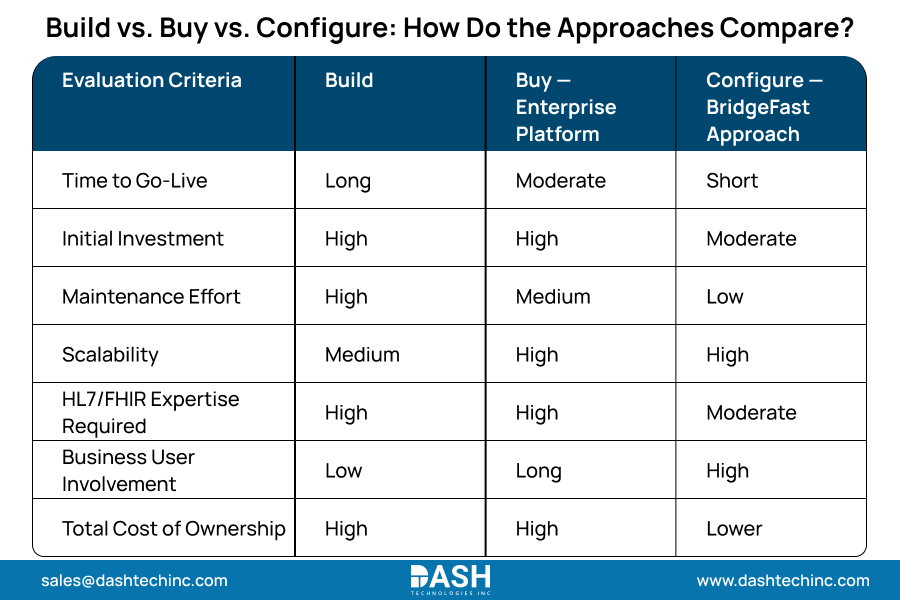
The trade-off becomes clearer when viewed through the lens of long-term ownership.
Build gives the organization control over the architecture, but also makes it responsible for developing, maintaining, testing, and scaling every integration.
Buy provides mature enterprise capabilities, but may require a larger investment in licensing, implementation, infrastructure, and specialized resources.
Configure aims to provide the interoperability foundation while allowing teams to adapt reusable components to specific workflows and integration requirements.
For medical device companies, that middle ground can be particularly relevant.
What Healthcare Integration Experience Reveals About Build vs. Buy vs. Configure?
One of the easiest mistakes to make when evaluating integration strategies is to focus too heavily on the first implementation.
The first integration may be relatively straightforward.
The real test comes when the organization needs to support the second customer, the fifth EHR, the tenth workflow, or a growing portfolio of connected products.
Several lessons consistently emerge.
Think about the integration portfolio—not just the first interface
A strategy that works well for one customer may become inefficient when repeated across dozens of implementations.
Instead of asking:
How quickly can we build this interface?
Organizations should also ask:
How efficiently can we build, deploy, maintain, and replicate integrations as our customer base grows?
That shift in perspective changes the evaluation.
Enterprise middleware can solve complexity while introducing another layer of complexity
Enterprise integration platforms can be extremely capable. But those capabilities come with operational responsibility.
If an organization does not have dedicated interoperability resources, the platform itself can become another system that engineering teams need to manage.
Time-to-market is an integration metric
Integration has a direct relationship with commercialization.
If onboarding a new healthcare customer requires weeks or months of custom engineering, integration becomes a constraint on implementation and potentially on sales.
A reusable approach changes that equation by turning integration from a recurring development project into a more repeatable onboarding process.
For medical device companies, that distinction can become increasingly important as customers expect products to integrate with existing healthcare IT environments.
Why Configurable Integration Platforms Are Emerging as a Strategic Middle Ground?
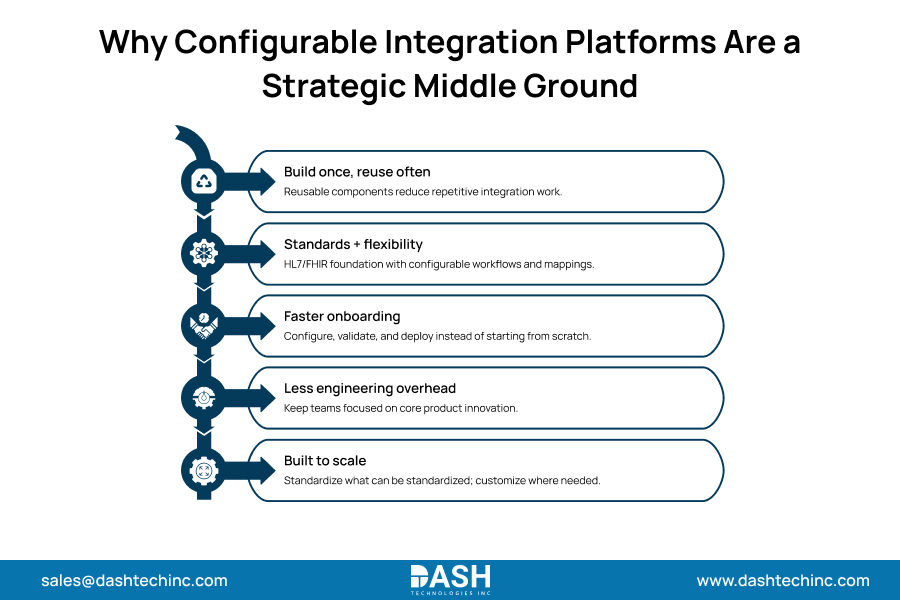
The appeal of configurable integration platforms lies in a relatively simple principle:
Don’t rebuild the interoperability foundation for every customer.
Instead, establish reusable integration components that can be configured around specific EHRs, devices, workflows, and data requirements.
Reusable integration components
Instead of developing every interface from the ground up, teams can work with established connectivity and transformation patterns.
This reduces repetitive engineering work and allows integration knowledge to become reusable across implementations.
A standards-first foundation
HL7 and FHIR provide important standards for healthcare data exchange, but standards alone do not make an integration successful.
Organizations still need to address data mapping, workflow requirements, authentication, validation, and implementation differences across systems.
A configurable platform can provide the standards-based foundation while allowing those requirements to be adapted to individual use cases.
Faster customer onboarding
With reusable integration components in place, a new customer does not necessarily have to start with a blank development environment.
Instead, teams can configure established patterns around the customer’s specific EHR and workflow requirements.
That can reduce implementation effort and shorten the path to deployment.
Repeatable implementation
The difference can be summarized simply:
Custom approach
Customer requirement → New development → New interface → New maintenance burden
Configurable approach
Reusable framework → Configure requirements → Validate → Deploy
The second model does not eliminate technical work. It makes more of that work reusable.
Less engineering effort on integration infrastructure
For lean product teams, this can have a significant business impact.
Engineering resources can remain focused on the device, application, AI capabilities, analytics, and other product differentiators instead of repeatedly rebuilding integration infrastructure.
Configuration does not mean sacrificing flexibility
Medical device workflows can be highly specialized. A useful configurable platform should therefore not force every implementation into an identical model.
The objective is to standardize what can be standardized while preserving flexibility where it is genuinely required.
That is what makes configurable interoperability more than a compromise between building and buying.
It is a strategic middle ground.
When Should You Build, Buy, or Configure?
There is no universal answer. The right approach depends on the organization’s product, customers, technical environment, available expertise, and growth plans.
Build when control and customization are the priority
Building may make sense when:
- Workflows are highly unique.
- Integration itself is a strategic differentiator.
- The organization has a dedicated interoperability engineering team.
- Existing infrastructure does not adequately support the required interoperability standards.
- The company is prepared to make a long-term investment in integration development and maintenance.
The advantage is control.
The trade-off is ownership of the entire integration lifecycle.
Buy when enterprise-scale capabilities justify the investment
An enterprise integration platform may make sense when:
- The organization operates at significant scale.
- It manages a large and complex integration ecosystem.
- High volumes of information are exchanged across many entities.
- Dedicated integration specialists are available.
- The organization has substantial implementation and operational resources.
- Complex routing, transformation, monitoring, and governance requirements justify the investment.
In these environments, the capabilities of an enterprise platform may outweigh its cost and complexity.
Configure when speed, scalability, and efficiency matter most
A configurable approach may be particularly attractive for:
- Medical device companies
- Digital health startups
- Mid-sized product organizations
- Lean engineering teams
- Companies prioritizing faster go-live
- Organizations with limited HL7/FHIR expertise
- Products that need to connect with multiple EHR environments
For these organizations, the objective is often not to become experts in operating integration infrastructure.
It is to get the product connected, deployed, and scalable without turning interoperability into a permanent engineering bottleneck.
How BridgeFast Helps Medical Device Companies Accelerate Integration?
BridgeFast takes the configurable approach to healthcare interoperability by combining DASH Technologies’ integration expertise with a configurable, HL7/FHIR-native architecture.
The goal is straightforward: help medical device companies establish EHR connectivity without requiring them to build and maintain every integration independently.
Rather than treating each customer integration as an entirely separate engineering project, BridgeFast uses reusable integration patterns that can be configured around specific healthcare workflows and connectivity requirements.
For medical device companies, that approach can translate into several practical outcomes.
Reduce implementation effort
Reusable integration components can reduce repetitive engineering work required for new connections.
Accelerate customer onboarding
A repeatable integration approach can simplify the process of connecting a product to new healthcare environments.
Lower total cost of ownership
Reducing repeated custom development and maintenance can help control the long-term cost of supporting multiple integrations.
Improve time-to-market
When teams do not have to start from scratch for every integration, interoperability can become less of a constraint on product deployment.
Scale connectivity
As the number of customers and EHR environments increases, a reusable integration architecture provides a stronger foundation for repeatable growth.
The broader idea is simple:
Medical device companies should not have to become integration companies simply because their products need to connect to healthcare systems.
Conclusion: Choose an Integration Strategy That Scales With Your Business
There is no universally correct answer to the build-vs.-buy-vs.-configure question.
The right decision depends on the organization’s business model, engineering capacity, integration complexity, customer expectations, and growth plans.
Building offers control and flexibility, but requires the company to own the full lifecycle of its integrations.
Buying an enterprise integration platform can provide extensive capabilities, but may introduce cost and operational complexity that is difficult to justify for lean product teams.
Configuring through a reusable, HL7/FHIR-native interoperability platform offers another path—one that can balance implementation speed, scalability, maintainability, and cost.
For many medical device companies, the more important question is not:
Can we build this integration?
It is:
Should our engineering team continue building the same type of integration every time we acquire another customer?
As connected medical devices become more deeply embedded in healthcare workflows, interoperability needs to evolve from a collection of one-off projects into a scalable product capability.
The companies that make that shift can spend less engineering effort reinventing connectivity and more time improving the products and experiences that differentiate them in the market.
Frequently Asked Questions
About Dash

Dash Technologies Inc.
We’re technology experts with a passion for bringing concepts to life. By leveraging a unique, consultative process and an agile development approach, we translate business challenges into technology solutions Get in touch.