Standardized quality operations
Defined processes, controlled documentation, and consistent approvals create a reliable quality baseline across teams.
HEALTHCARE REGULATORY COMPLIANCE
Quality and regulatory gaps often emerge when evidence, engineering workflows, and compliance responsibilities are disconnected. We help turn those gaps into controlled, traceable operations.
Different markets bring different standards, submission expectations, and evidence requirements. Early alignment helps avoid costly changes later.
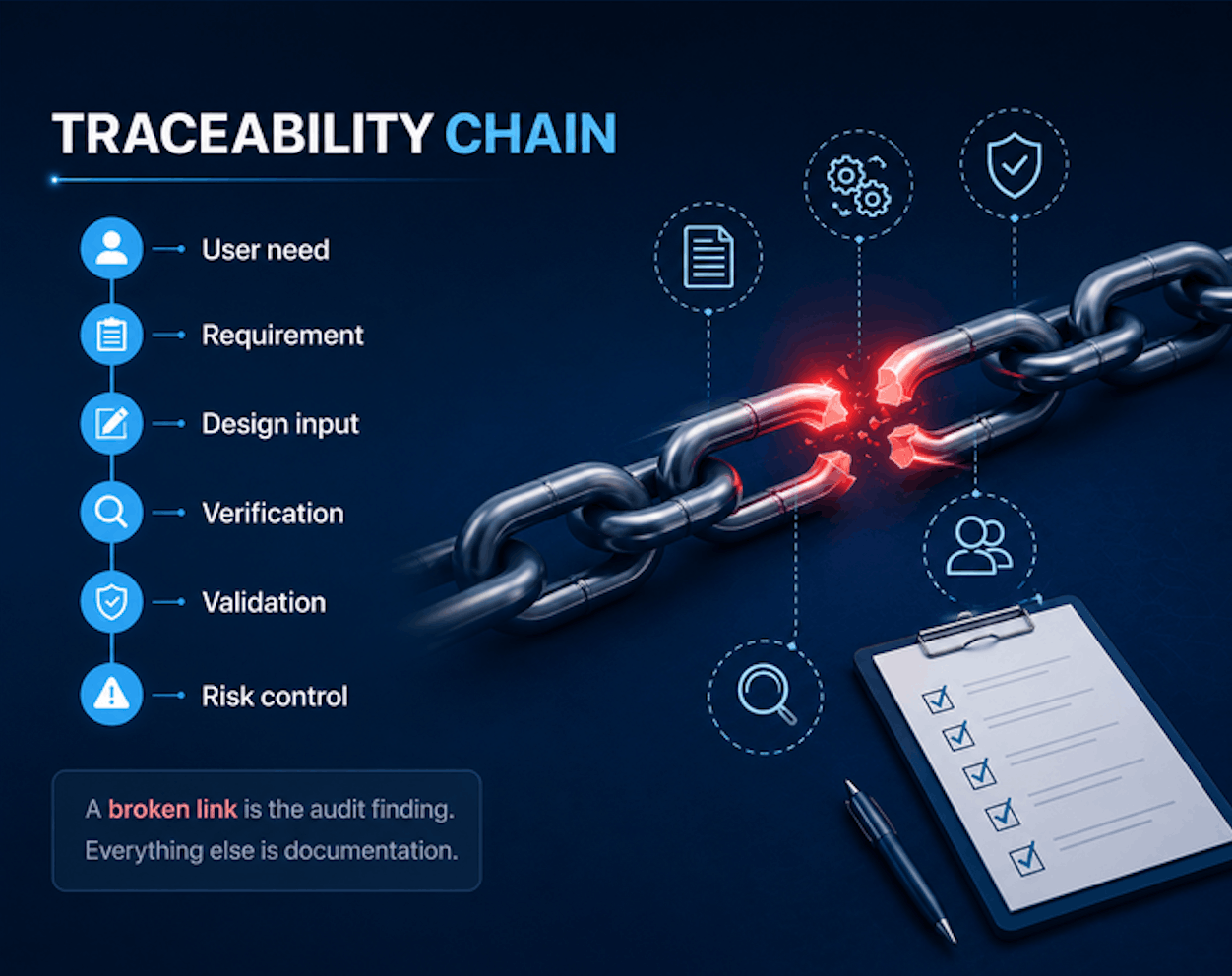
Requirements, test evidence, and risk records can exist in separate systems without a defensible chain connecting them.
Findings can trigger rushed root-cause analysis and repeat work when corrective actions are not tied to effectiveness evidence.
When engineering moves faster than the quality system, controls are applied retroactively, creating rework and revalidation.
AI-enabled and software-based medical products need lifecycle, change-management, risk, and data-governance structures that can evolve with the product
Evidence assembled at the end is harder to defend. Readiness improves when records are structured for retrieval from the start.
Why QMS matters
A controlled QMS creates a repeatable operating model for quality, evidence, risk, and change—helping teams stay prepared as products, systems, and regulatory expectations evolve.
Defined processes, controlled documentation, and consistent approvals create a reliable quality baseline across teams.
Connect user needs, requirements, design, verification, validation, and risk controls so evidence can be retrieved when needed.
Focus validation and quality effort where product and patient risk is highest rather than applying the same burden everywhere.
Maintain evidence as part of day-to-day operations instead of rebuilding the record immediately before an inspection.
Establish quality infrastructure that can support additional products, sites, workflows, and regulatory requirements.
Integrated Quality Management Framework
Five connected pillars bring regulatory alignment, quality processes, validation, risk management, and digital infrastructure into one operating model.
Defines controlled processes, SOPs, document management, design controls, change control, and CAPA practices that govern quality.
Maps product classification, applicable standards, submission expectations, and inspection requirements to the product lifecycle.
Applies software verification, validation, CSA, and protocol-based testing proportionate to actual product and system risk.
Connects hazards, risk controls, CAPA, gap assessments, and remediation activities to the engineering and quality record.
Operationalizes quality through eQMS, workflow automation, complaint handling, surveillance, and integration with clinical and engineering systems.
REGULATORY COMPLIANCE SERVICES
Integration strategies tailored to domain-specific clinical workflows.
We establish the regulatory pathway for your product and maintain it across the lifecycle — classification, applicable standards, submission strategy and inspection readiness. Engagements work best before the architecture is locked, when regulatory decisions are still cheap to make.
SaMD · Medical Device · Digital Health
We design and implement the quality system itself — process architecture, SOPs, design controls and change control — sized to your organization’s stage and risk profile rather than lifted from a template that fits nobody.
Any regulated healthcare organization, from first QMS to enterprise scale
We validate software and systems using a Computer Software Assurance approach — risk-based and critical-thinking-led, so high-risk functions receive deep evidence and low-risk functions don’t consume the validation budget.
SaMD · eQMS · LIMS · Cloud platforms
We operationalize quality — deploying and validating eQMS platforms, automating quality workflows, and integrating quality data with the clinical and engineering systems that generate it in the first place.
Scaling quality organizations · Multi-site operations
We build risk management files that function as engineering inputs rather than filing, and we recover programs that have already received findings — gap assessment, remediation planning and evidence rebuild against a response clock.
Post-audit remediation · Pre-submission gap closure
QUALITY MANAGEMENT SYSTEM LIFECYCLE
Seven connected elements form a continuous quality lifecycle. Each stage produces evidence and controls that support the next.
User needs and intended use are captured as testable requirements, each uniquely identified so downstream evidence can reference it.
Design inputs, outputs, reviews and transfers are governed by a controlled process with documented approval at each gate.
Verification confirms the product was built to specification; validation confirms it meets user needs in the intended environment of use.
Hazards are identified, controls are implemented as design requirements, and residual risk is evaluated against clinical benefit.
The design history file assembles the full development record as a controlled, retrievable set rather than a retrospective compilation.
Nonconformities and changes route through documented root cause analysis, impact assessment and effectiveness verification before closure.
Field data, complaints and performance signals are collected and fed back into risk management and design.
COMPLIANCE EXPERTISE
Our expertise spans the quality, validation, risk, audit, and interoperability controls that regulated healthcare organizations need to operate with confidence.
Lifecycle documentation, design controls, risk management, validation, and regulatory readiness for software-based medical products.
Risk-based validation and verification for regulated software, cloud platforms, eQMS, LIMS, and healthcare interfaces.
Risk files, hazard analysis, control implementation, remediation, and effectiveness verification.
Gap assessment, evidence rebuild, design-history remediation, and response support when findings already exist.
Quality and data-integrity controls across healthcare system boundaries, with interface validation built into the engagement.
IEC 62304 · ISO 14971 · FDA · HIPAA · IEC 82304-1 · HL7/FHIR
CMS · JCI · ISO 9001 · interoperability controls
CLIA · CAP · ISO 15189 · validated laboratory interfaces
Healthcare data governance and compliance requirements applicable to payer platforms.
QMS IMPLEMENTATION
Six stages. Each one takes a defined input, performs defined work, and produces an outcome that can be reviewed before the next stage begins.
Current processes, records, systems, product roadmap, and audit history.
Assess the current state and identify quality and regulatory gaps.
A prioritized view of gaps, risks, and requirements.
Gap register, product context, organizational scale, and regulatory pathway.
Design QMS processes, SOPs, controls, traceability, and governance.
An approved quality and compliance architecture.
Approved QMS design and platform or workflow requirements.
Implement processes, configure eQMS workflows, integrate systems, and train teams.
Controlled processes in operation with records being generated.
Implemented processes and systems.
Execute risk-based validation, verification, protocols, and traceability checks.
Documented evidence that supports intended use and compliance.
Controlled evidence and applicable regulatory pathway.
Prepare submission or inspection materials and support readiness activities.
Evidence organized for regulatory review or inspection.
Operating QMS, field data, complaints, and changing standards.
Run audits, CAPA, surveillance, change control, and standards monitoring.
Compliance maintained as an operating state.
USE CASES
Engagements can start with a new product, an existing quality system, a regulatory milestone, or a remediation need.
Use case 01
Build a right-sized quality foundation that supports product delivery, evidence generation, and health-system procurement requirements.
Use case 02
Establish lifecycle records, risk controls, validation, and a defensible regulatory pathway as software moves toward clinical use.
Use case 03
Strengthen quality governance and data integrity across clinical workflows, reporting, and connected healthcare systems.
Use case 04
Validate LIS, instrument, and interface workflows so result integrity and supporting evidence are demonstrable ahead of inspection.
Use case 05
Support quality and data-governance processes for platforms handling regulated healthcare information and operational workflows.
CASE STUDIES
A clinical decision support module had been developed without IEC 62304 lifecycle records. Requirements, test evidence and risk analysis existed but were unlinked and could not support a submission.
Retrospective requirements reconstruction, a full ISO 14971 risk management file, and a traceability matrix connecting user needs to verification evidence and risk controls.
The submission proceeded on the original timeline, and the traceability structure became the operating standard for subsequent releases.
Inspection findings cited inadequate design controls and unverified CAPA effectiveness across two product lines, against a fixed response deadline
Gap assessment, design history file remediation, and a rebuilt CAPA process with root cause methodology and mandatory effectiveness verification before closure.
A documented response was delivered within the response window, with the underlying process causes closed rather than the individual records patched.
Instrument and LIS interfaces had been implemented over several years without formal validation, leaving result integrity undemonstrated ahead of inspection.
Risk-ranked interface inventory, IQ/OQ/PQ protocol development and execution, and HL7 message-level verification with traceable evidence.
Result integrity became demonstrable on request, and the protocol set now serves as the template for new instrument onboarding.
Why DASH
DASH Technologies was founded in 2010 and is ISO 9001 and ISO 27001 certified, with MBE certifications through NMSDC and the State of Ohio.
Design controls, traceability, and validation evidence are produced as part of the engineering workflow.
Regulatory requirements and evidence expectations are addressed early, reducing avoidable downstream rework.
Controlled documentation and connected evidence make inspection preparation more predictable.
CSA and validation effort are proportionate to actual risk, with deeper evidence where it matters most.
Quality workflows can connect with the clinical and engineering systems that generate the underlying data.
Strategy, QMS, validation, remediation, and digital quality operations can be addressed as one connected program.
Compliance assessment
Whether you’re preparing FDA submissions, implementing enterprise QMS, validating regulated software, or modernizing digital quality operations, our experts help you build compliant, scalable, and audit-ready healthcare systems.
QMS and Regulatory Affairs services cover the design, implementation, validation and ongoing operation of the quality system and regulatory program a healthcare product requires. In practice that means process architecture and SOPs, design controls, risk management, software validation, submission support and post-market surveillance — delivered as an engineering discipline rather than a documentation exercise.
Because in healthcare the product claim and the evidence behind it are inseparable. A QMS is what allows an organization to demonstrate — to a regulator, an auditor or a health-system buyer — that its product was built safely and consistently and can be maintained that way. Without one, clearance, procurement and market access all stall.
FDA QMSR and 21 CFR Parts 820 and 11, ISO 13485, ISO 9001, IEC 62304, ISO 14971, EU MDR and IVDR, GAMP 5, HIPAA and HITECH, HL7 and FHIR, CLIA, CAP and ISO 15189, alongside SOC 2 and ISO 27001 for information security.
QMS implementation establishes the processes that govern how work is done — SOPs, design controls, change control, CAPA. Software validation is one activity performed within those processes: producing documented evidence that a specific system performs as intended for its use. You can validate software without a QMS, but the evidence won’t be defensible; and a QMS without validation has no proof behind its claims.
We start with a gap assessment against the applicable standards, then close findings in risk order — usually traceability and design control records first, since that is where inspections concentrate. Preparation includes mock audits with your own staff, so the people answering questions have done it once before the inspector arrives.
Yes, and it should. Quality data is generated inside clinical and laboratory systems, so an eQMS that doesn’t connect to them creates duplicate entry and version drift. We integrate quality workflows with EHR, LIS and LIMS platforms using HL7 and FHIR interfaces, and validate those interfaces as part of the engagement.
It depends on scope and starting state. A focused implementation for an early-stage SaMD product is commonly a matter of months; a full enterprise QMS across multiple product lines, or a remediation program under a response deadline, runs longer. We scope from the gap assessment rather than from a standard timeline, and sequence work so the highest-risk gaps close first.
Yes. SaMD is a core focus, including AI and machine-learning-enabled products where lifecycle and change management need additional structure — Predetermined Change Control Plans, Good Machine Learning Practice principles, and the data governance that supports both.
