Why Data Visibility Is the Biggest Challenge in Hospital Operations?
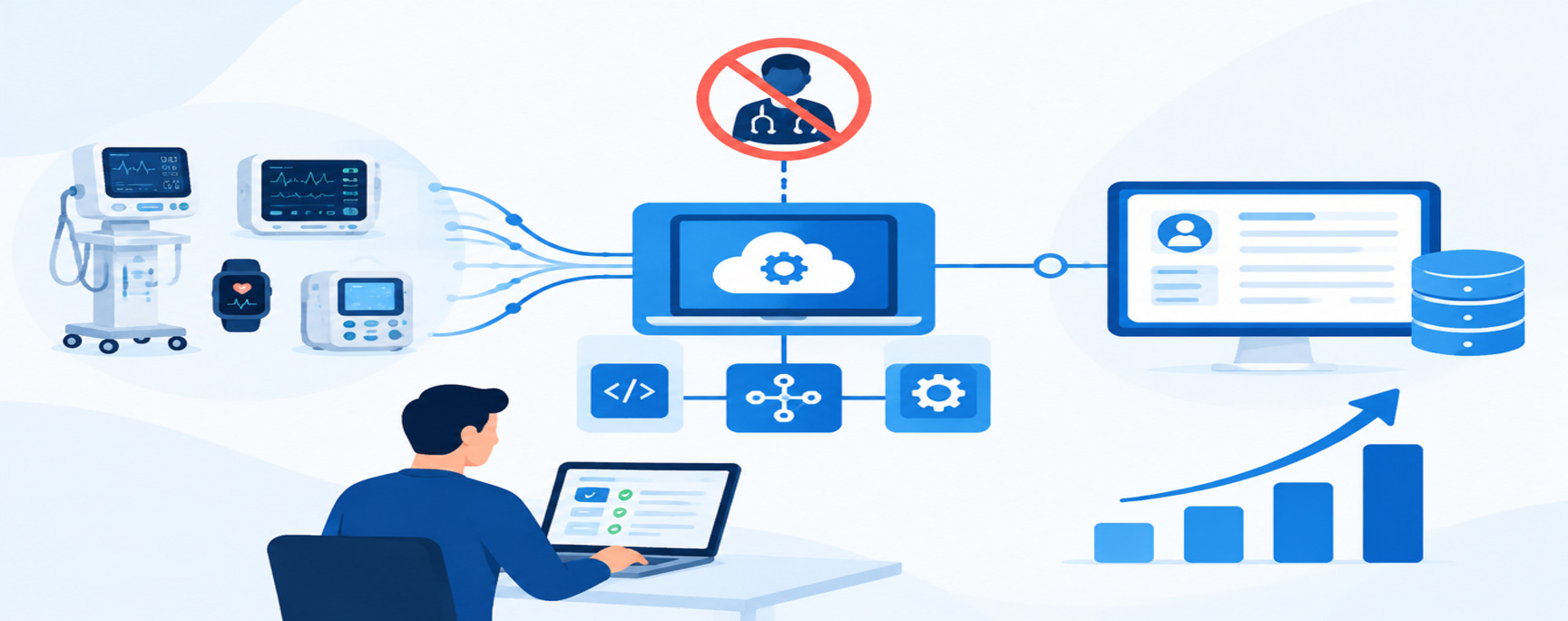
Securing uncompromising hospital data visibility remains the most critical operational vulnerability for enterprise health systems. Hospitals generate an unprecedented volume of clinical intelligence. Vitals stream continuously, imaging platforms output HD data, and electronic health records capture millions of distinct interactions. However, executives and frontline clinicians consistently operate blindly despite commanding terabytes of highly valuable data.
The industry faces a crippling paradox. Hospitals are massively data-rich but critically information-poor because vital metrics remain trapped within rigid healthcare data silos. For modern healthcare providers, simply purchasing more software applications to generate more data is no longer a viable strategy. True operational excellence demands the destruction of these legacy walls, forcing the creation of a strictly transparent digital ecosystem that instantly delivers critical intelligence to active decision makers.
What Data Visibility Means in Healthcare?
Healthcare analytics encompasses broad capabilities, but data visibility defines the foundational operational standard. It refers to the ability of decision-makers at every level of the organization to access accurate, timely, and contextually relevant information about what is happening in their domain, without requiring a data analyst, a custom report request, or a 48-hour wait.
The distinction between having data and having visibility is significant:
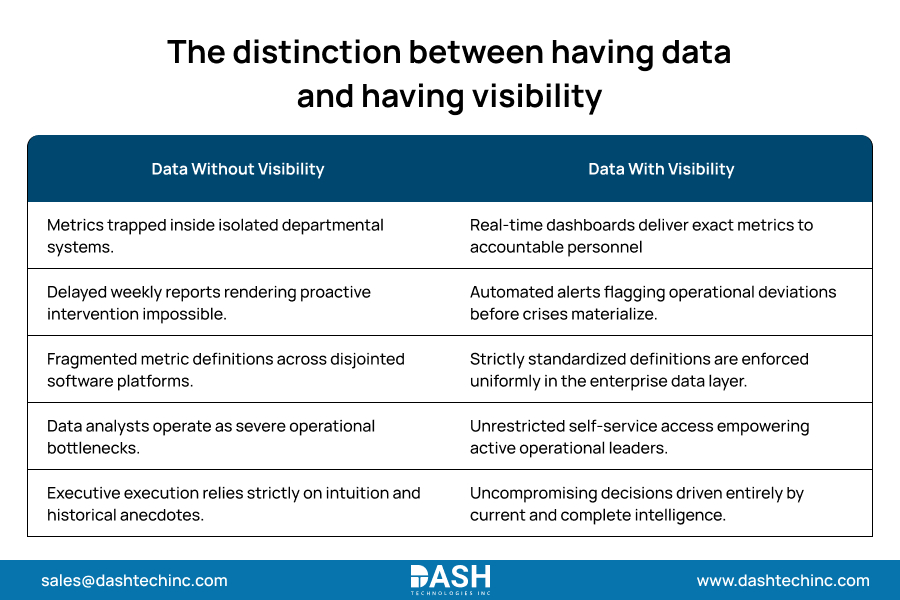
Data visibility is not an analytics sophistication problem. Health systems with minimal predictive modeling capability, but strong data visibility consistently outperform analytically sophisticated organizations that cannot surface insights to the right person at the right time.
Why Hospitals Struggle with Data Visibility?
Uncompromising hospital data challenges consistently stem from aggressive platform fragmentation. Health systems routinely implement highly specific applications to neutralize localized issues, resulting in isolated silos governing EHR documentation, enterprise scheduling, clinical imaging, and population health. While resolving immediate departmental needs, this disjointed IT procurement actively prevents the establishment of unified hospital data visibility.
This architectural chaos introduces four fatal operational barriers:
- Inconsistent Definitions: When distinct departments define critical metrics like case completion or care delays differently, accurate enterprise evaluation becomes structurally impossible.
- Reporting Lag: Executive reliance on manually compiled weekly performance decks ensures leaders respond to operational crises only after the viable intervention window has closed.
- Superficial Integration: Many hospitals link systems at the interface level. However, they do not connect to the visibility level. Data can transfer between systems, but it’s not normalized, modeled, or shown clearly. This makes enterprise decision-making difficult.
- Fractured Ownership: Data visibility often sits between departments. IT may manage the systems, operations may need the insight, finance may define part of the logic, and clinical teams may generate the source data. When no one owns visibility as a cross-functional capability, it remains underdeveloped.
This is why hospital analytics challenges are rarely caused by the absence of technology. More often, they come from fragmented systems, weak governance, and too much dependence on retrospective reporting.
Build a Reliable Data Visibility Foundation
Enable consistent, real-time operational insight through a well-architected integration and governance approach designed for complex healthcare environments.
Schedule a ConsultationImpact of Poor Data Visibility
When enterprise leadership lacks a unified operational view, the consequences instantly impact the IT department, devastating patient safety, staff morale, and financial viability. The operational inefficiencies of healthcare facilities endure due to systemic data blind spots dictate massive financial losses.
Without absolute visibility, patient throughput collapses. Emergency departments warehouse patients for hours simply because admission platforms fail to synchronize with environmental services. The bed is clean, but the enterprise remains blind. Inside the surgical suite, failing to capture precise orthopedic service line performance and KPIs guarantees administrators miss surgeons consistently blocking three hours for ninety-minute procedures. This single architectural failure vaporizes millions in unused operating capacity.
The clinical exposure is equally severe. Forcing physicians to execute rapid diagnostic decisions without complete historical context massively elevates adverse event risks. Deploying integrated cardiology dashboards is strictly mandatory to prevent interventional teams from operating without crucial outpatient stress test data. Furthermore, fractured workflow visibility engineers massive radiology reporting backlogs, directly stalling critical diagnoses for acute oncology and trauma populations. When data visibility fails, enterprise care delivery completely implodes.
How to Build a Data Visibility Layer?
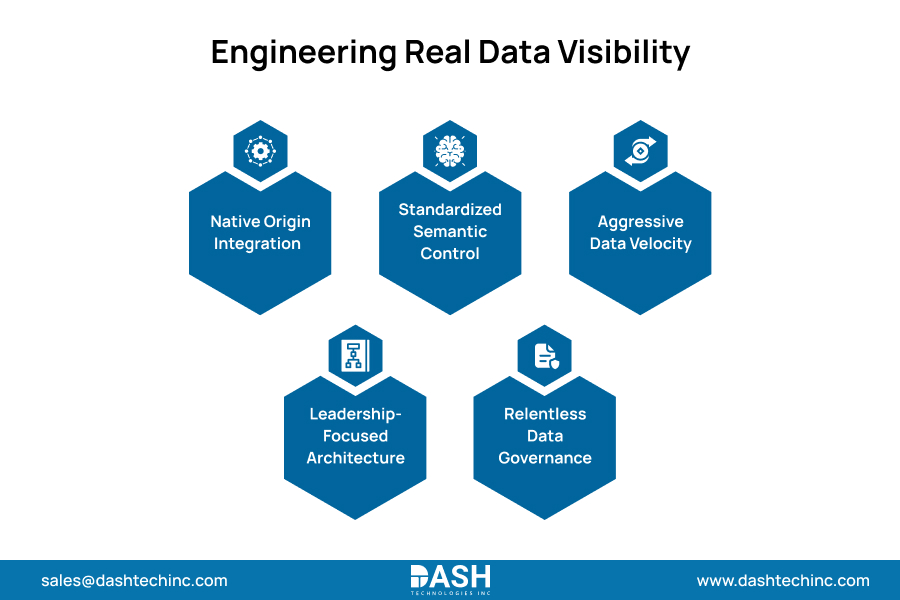
Solving systemic data blindness dictates a fundamental architectural overhaul, not another superficial dashboard deployment. Enterprise-grade healthcare analytics platforms achieve true operational visibility by strictly adhering to five core principles:
- Native Origin Integration
Visibility operations start exclusively at the data source. Facilities must bind EHR, billing, and clinical device data through a heavily governed integration layer using rigid FHIR APIs and ETL pipelines. Surfacing metrics from disconnected legacy exports produces visually appealing but operationally dangerous falsehoods. - Standardized Semantic Control
Establishing a strictly governed master data model is the absolute prerequisite for multi-system visibility. This layer enforces unified metric definitions, rigid terminology mapping, and total data consistency, guaranteeing that fragmented systems finally speak a singular operational language. - Aggressive Data Velocity
Not all data requires instantaneous delivery, but high-stakes operational metrics demand it. Monitoring immediate bed capacity, surgical turnover velocity, and emergency wait times requires highly aggressive real-time data pipelines. Establishing precise latency rules dictates the entire underlying infrastructure. - Leadership Focused Architecture
Visibility tools engineered strictly by data scientists generate powerful but completely unusable interfaces. Effective infrastructure is deliberately architected around the exact operational questions of active department heads and clinical executives’ demand. The system must present intelligence in formats designed exclusively to drive immediate executive decisions. - Relentless Data Governance
A visibility layer exposing inaccurate data inflicts more damage than total blindness. Persistent data quality tracking, automated anomaly detection, and absolute lineage tracing are strict operational prerequisites for any platform influencing enterprise clinical decisions.
Role of Real-Time Dashboards and Analytics
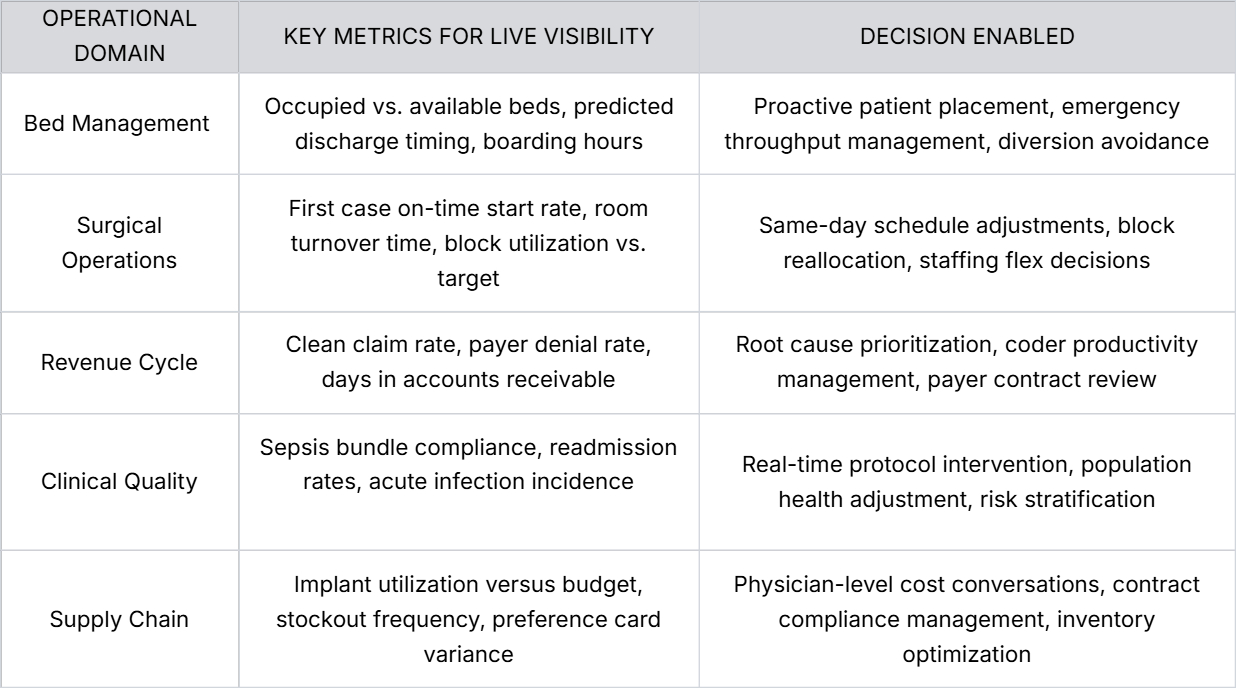
Enterprise healthcare dashboards serve as the absolute interface, connecting the data visibility layer directly to executive operational decisions. Deployed correctly, they rapidly compress the feedback loop, separating facility events from leadership action. Built poorly, they merely overlay visual complexity onto the exact same underlying confusion.
Conclusion
The fundamental operational failure inside modern hospitals is not missing data. The failure is the absolute absence of a hospital data visibility infrastructure required to transform raw information into active executive intelligence. Though data exists, true visibility remains completely absent. This exact gap actively breeds massive operational inefficiency, severe clinical risk, and compounding financial erosion.
Facilities closing this gap secure the uncompromising decision quality necessary to force total operational dominance. Performance management, clinical quality improvements, and service line growth strictly demand absolute visibility. Artificial intelligence deployment requires this exact foundational architecture.
Organizations investing in an integrated data-driven healthcare architecture today establish the exact governance frameworks required to scale indefinitely. Competitors relying on fragmented retrospective reporting will permanently fail.
Ready to learn how providers are turning fragmented hospital data into actionable operational intelligence? Contact us today!
Frequently Asked Questions
About Dash

Dash Technologies Inc.
We’re technology experts with a passion for bringing concepts to life. By leveraging a unique, consultative process and an agile development approach, we translate business challenges into technology solutions Get in touch.