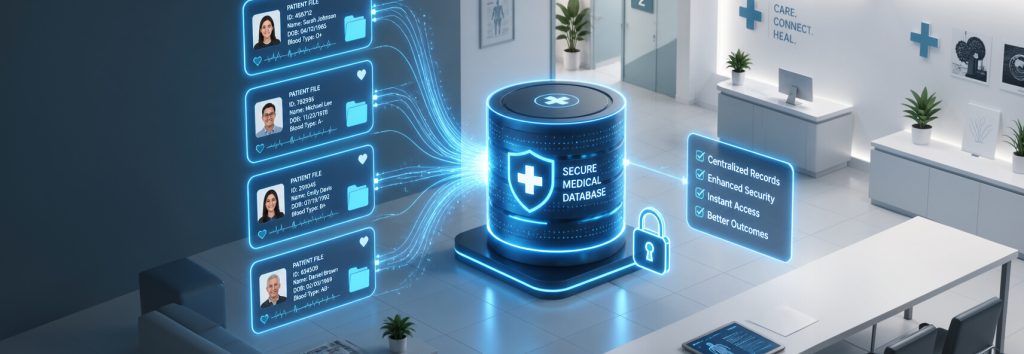
Identity Matching in EHR Integration: Preventing Duplicate Patient Records
Identity matching in EHR integration answers a blunt question: when a patient shows up in five different systems, does the hospital see one person or five? Probably not, if nobody built the matching logic first. Health systems integrate data across specialty clinics, imaging endpoints, external labs, and acquired facilities faster than IT departments can map the architecture. Each new network connection introduces a high-risk vector for a single patient profile to fragment into duplicate database identities.
Nobody sets out to create a duplicate. A birth date gets typed wrong at 2 am. A maiden name sticks in one system and vanishes in another. Small stuff, until it isn’t: clinical histories fragment; diagnoses get delayed, and billing teams spend hours untangling a mess they didn’t cause. Patient identity matching is what keeps EHR integration from becoming just a faster way to move bad data around.
Why Duplicate Patient Records Continue to Challenge Healthcare Organizations?
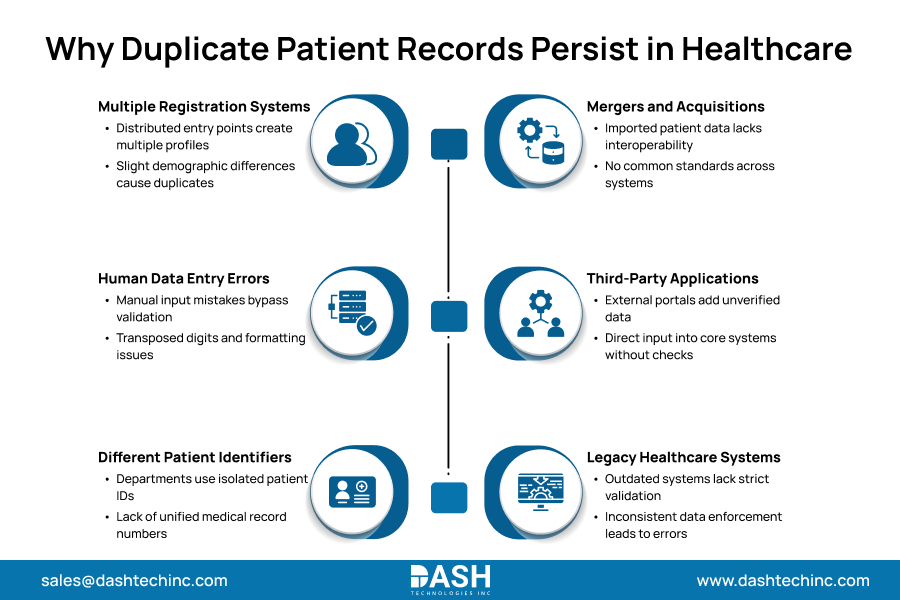
Duplicate patient records consistently corrupt healthcare databases due to structural pipeline disconnects. When auditing patient identity management failures, IT directors trace this data fragmentation to six core architectural vectors:
- Multiple registration systems: Patients enter networks via distributed front ends, generating concurrent profiles containing slightly varied demographic payloads.
- Human data entry errors: Manual input flaws bypass validation logic. Transposed digits and formatting inconsistencies directly corrupt databases during high-volume clinical shifts.
- Different patient identifiers: Departments execute workflows using isolated primary keys, relying on disparate medical record numbers, which prevents automatic database alignment.
- Mergers and acquisitions: Enterprise consolidation imports patient populations from acquired environments that fundamentally lack baseline healthcare interoperability standards.
- Third-party applications: External endpoints, such as patient portals, introduce unverified data-entry pathways directly into the core routing infrastructure.
- Legacy healthcare systems: Outdated environments operate entirely without the strict data validation protocols natively enforced by modern clinical platforms.
None of these stays are contained. Connect two systems, and an organization inherits two identifier conventions; connect ten, and it inherits ten, each with its own quirks. Skip a deliberate identity matching strategy and healthcare interoperability work ends up moving duplicate records faster instead of cleaning them up.
The Pew Charitable Trusts found that as many as 1 in 5 patients get matched incorrectly within a single facility’s own records, a number that climbs toward 50 percent once records cross organizational lines. Patient identity management has to grow at the same pace as the integration work.
How Identity Matching Supports Successful EHR Integration?
Every downstream EHR integration capability rests on one thing: accurate identity matching. Get patient identity right at the point of connection, and six operational areas improve almost immediately.
Clinical decision-making comes first. A physician looking at a complete, correctly matched record catches drug interactions and allergy history that a fragmented chart hides. Care coordination across specialists and post-acute providers only works if every party sees the same record, not half of it. Lab and imaging result sharing depends on a result attaching to the correct patient across systems; get the identity wrong, and the result lands on the wrong chart, or nowhere. Patient portals built on shaky matching show a patient an incomplete history or, worst case, someone else’s. Population health analytics needs a clean, deduplicated patient base, since fragmented records undercount disease prevalence. Revenue cycle efficiency takes the hit too. A Black Book Research survey found that inaccurate patient identification accounts for roughly a third of denied claims and costs the average hospital $1.5 million a year.
Identity matching is the trust layer sitting underneath every data exchange. Organizations pursuing FHIR implementation define a Patient resource to hold demographic and identifier data in a structured, queryable format. That standard only pays off once identity has already been resolved. Build EHR integration on unresolved identity conflicts, and bad data moves faster, not good data. Healthcare data integration works only when the connected systems agree on who the patient is before they agree on anything else.
Best Practices for Improving Patient Identity Accuracy
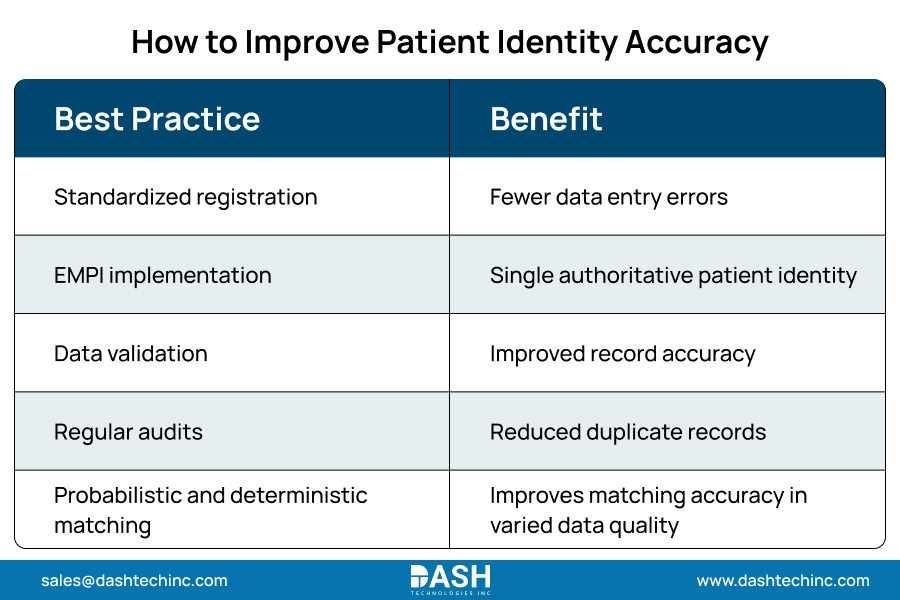
Preventing duplicate patient records is a program, not a one-time cleanup job. Five practices consistently lower duplicate rates and protect EHR data quality.
- Standardize patient registration: Every registration point, in person, online, or inherited through a merger, should capture the same core fields in the same format. Inconsistent capture is where most duplicates start.
- Validate demographic data at the point of entry: Address verification, name-parsing logic, and real-time duplicate checks to catch errors before they reach the record.
- Deploy a Master Patient Index or Enterprise Master Patient Index: An MPI resolves identity inside a single system. An EMPI does the same across every connected system; acquired facilities included, giving multi-platform health systems one authoritative identity.
- Combine probabilistic and deterministic matching: Deterministic architecture requires an exact field match, executing optimally when reliable primary identifiers exist. Probabilistic algorithms score the probability that two distinct records maps to the identical patient via weighted demographic fields. This pipeline is critical when identifiers remain missing or corrupted. Enterprise MPI healthcare deployments execute both models concurrently.
- Establish ongoing data governance: Identity matching accuracy decays without maintenance. A governance committee that owns matching thresholds and updates rules as new systems join keeps patient identity management functional past its first deployment.
Build Reliable EHR Integrations
Improve patient identity accuracy with secure, scalable EHR integration solutions from Dash Technologies.
Explore EHR Integration ServicesCommon Identity Matching Mistakes to Avoid
Enterprise environments investing heavily in identity matching routinely sabotage their own pipelines by ignoring core EHR integration best practices.
- Single-Identifier Dependencies: No primary key functions reliably in isolation. Demographic data shifts constantly, and manual numeric transpositions occur far more frequently than administrators estimate.
- Ignoring data quality issues upstream: Algorithmic matching cannot parse consistently corrupted inputs. Malformed registration payloads fundamentally break even highly tuned data models.
- Skipping duplicate record monitoring: Engineering teams treating identity resolution as a closed ticket post-deployment immediately lose visibility into pipeline drift. Database duplication aggressively scales as infrastructure expands.
- Operating without governance: Matching thresholds set once and never revisited stop reflecting the organization’s actual data.
- Treating identity matching as a one-time project: The biggest mistake is scoping identity matching as a deployment task with an end date. Patient populations and systems keep changing, so matching logic needs the same ongoing ownership as security programs get. Duplicate patient records reappear in organizations that stop watching for them.
Building Reliable EHR Integrations with Accurate Patient Identity Management
Dash Technologies treats identity matching as part of the architecture, not something bolted on after the interfaces go live. Multi-EHR integration work across Epic, Oracle Health, and other major platforms starts with data mapping that reconciles identifier schemes before a connection launches. HL7 and FHIR integration standardize the format; identity resolution decides whether that data lands on the right patient. Teams handling Oracle Cerner integration, or planning an EHR data migration, run into this hardest, since legacy identifiers rarely carry over cleanly.
Patient data synchronization, identity management support, and integration testing round out the work that keeps patient data integration accurate as systems change. Treat identity matching as core scope from day one. Dashtech’s EHR integration services build that resolution into the architecture from the start.
Conclusion
Connecting systems isn’t enough. Every patient must also be accurately identified across every system that stores or exchanges their records. Even the most sophisticated FHIR APIs can’t prevent fragmented data if patient identity matching falls behind the integration strategy.
Identity matching, governance, and data quality work together to cut clinical risk and deliver the reliable EHR integration patients need. Contact Dashtech to build identity matching into your next EHR integration from day one.
Frequently Asked Questions
About Dash

Dash Technologies Inc.
We’re technology experts with a passion for bringing concepts to life. By leveraging a unique, consultative process and an agile development approach, we translate business challenges into technology solutions Get in touch.