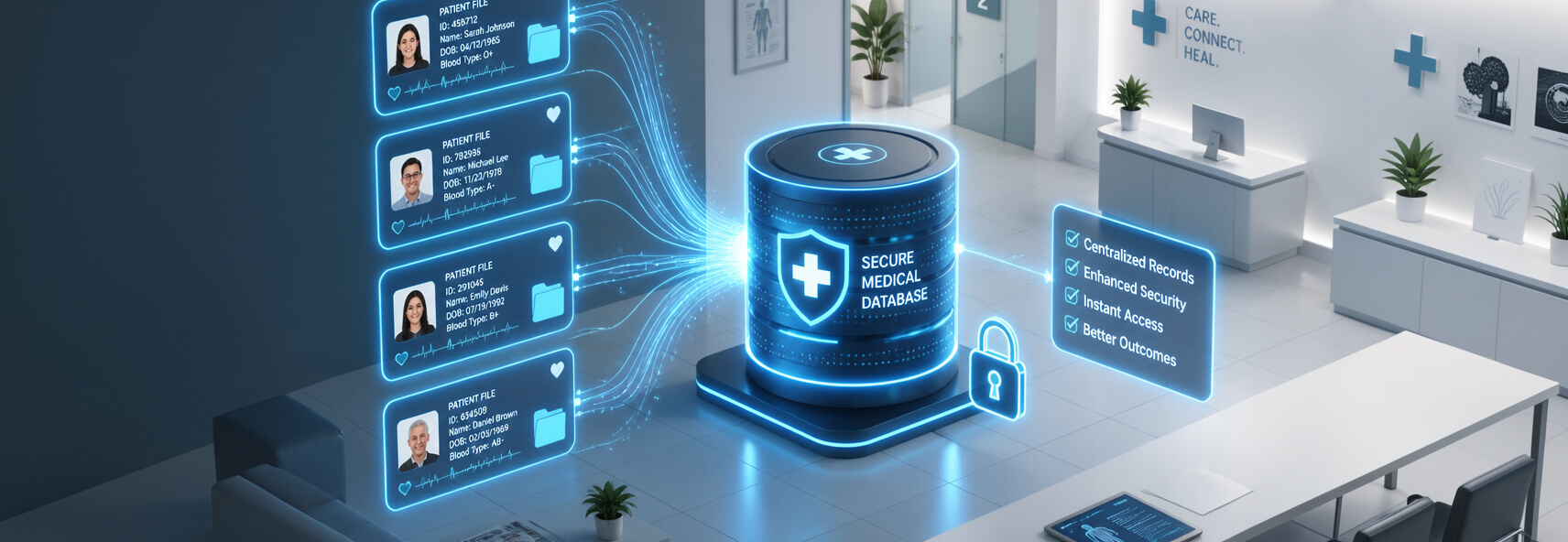
PACS, RIS, and EHR Integration: Building a Connected Radiology Ecosystem
PACS RIS EHR integration exists because radiology results still reach most referring physicians through a fax, a phone call, or a separate viewer they’d rather not open. That is the status quo it is built to dismantle. Radiology generates the data, but getting it to the care team requires manual steps that slow everything down. Turnaround times stretch. Duplicate orders pile up. Clinical decisions go forward on incomplete information. Every consequence of that fragmentation falls on the health system that allowed it to persist.
Understanding the Imaging Technology Stack
Radiology runs on three interdependent platforms, and none of them was originally designed to talk to the others.
- PACS
PACS is where medical images live. Every CT, MRI, X-ray, and ultrasound lands in the Picture Archiving and Communication System, which killed film-based radiology and made digital imaging the operational standard. The problem is isolation. Disconnected from downstream systems, PACS holds images that nobody outside the radiology suite can easily reach. Captured but never contextualized. - RIS
The RIS is the operations layer that radiology depends on: orders come in, the worklist goes out to the scanner floor, and reports get distributed. RIS integration is what connects the referring physician’s imaging order to everything that happens after. Strip the connection to PACS and the EHR, and that order goes into a silo. Results stay there without a manual intervention to move them. - EHR
A radiologist’s findings belong in the same system that the ordering physician uses to make treatment decisions. Connecting radiology to the EHR puts the signed report in that workflow the moment it is ready. Strip that connection, and it sits in a separate viewer nobody consistently opens. Treatment decisions move forward on incomplete information.
Why Integration Matters?
Fragmented radiology workflows carry a measurable cost. Unnecessary imaging costs the U.S. healthcare system $12 billion annually, driven largely by the absence of prior imaging at the point of ordering. The operational case for radiology EHR integration breaks down across three dimensions:
- Report Turnaround: Manual steps in result routing disappear. Automated notification replaces phone calls and fax chains, compressing turnaround from hours to minutes.
- Image Accessibility: Clinicians stop chasing images. Every specialty pulls imaging studies from within the EHR instead of calling the radiology department or logging into a separate viewer.
- Duplicate Exam Reduction: Ordering a study without seeing prior imaging is how duplicates happen. Integration makes prior imaging visible at the point of ordering, so physicians order what the patient actually needs.
Dashtech’s radiology workflow solutions deploy integration architectures that lock in these gains as structural operational baselines, not one-time improvements.
Build a Connected Radiology Ecosystem
Partner with interoperability experts to seamlessly integrate imaging systems, EHRs, and healthcare applications.
Talk to Our ExpertsHow Data Flows Between PACS, RIS, and EHR?
Integration failures have one cause: something in the data chain snapped. A fully connected radiology platform moves information without interruption.
Patient registration populates the RIS. From there, a structured worklist goes to the imaging modality. The modality captures the study and transmits it to PACS. The radiologist pulls up the images and documents findings. That report routes automatically into the EHR, timestamped and linked to the original order, available to the referring physician before the patient leaves.
Every manual handoff substituted into this chain is a point where information degrades and errors surface. Integration enforces the chain. It eliminates every substitution.
Standards Enabling Radiology Integration
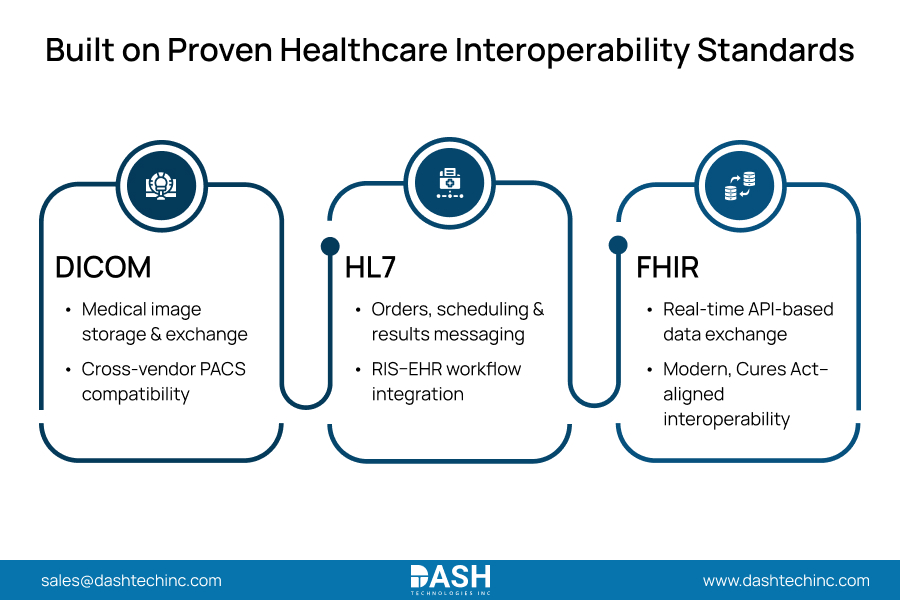
Three interoperability standards govern PACS RIS EHR integration. Radiology leaders must mandate all three in every vendor procurement.
- DICOM
Digital Imaging and Communications in Medicine (DICOM) standardizes medical image storage and transmission. DICOM guarantees that images from any manufacturer’s modality transfer correctly to any compliant PACS and display accurately in any certified viewer, regardless of vendor origin. - HL7
Health Level Seven (HL7) messaging handles the transactional layer between RIS and EHR. Order messages, scheduling confirmations, and radiology result notifications flow via HL7 across institutional systems. Legacy v2.x deployments remain common, but demand migration as health systems modernize. - FHIR
Batch messaging moved data on a fixed schedule regardless of clinical need. FHIR replaced that model: any authorized system requests exactly what it needs, the source responds in real time, and data moves through a standardized API call. The radiologist closes a report and it hits the ordering physician’s EHR immediately. The 21st Century Cures Act made FHIR compliance a regulatory floor, removing it from the list of things health systems can defer. Health systems building interoperability infrastructure make FHIR a hard requirement for every new platform.
| Standard | Primary Function | Data Type |
| DICOM | Image storage and transmission | Medical images |
| HL7 | Clinical messaging and transactions | Orders, reports, ADT events |
| FHIR | Real-time API data exchange | Structured clinical data |
Top Integration Challenges
PACS integration initiatives fail for predictable reasons. Identifying these barriers before deployment prevents timeline and budget failures.
- Vendor Compatibility
Enterprise environments typically run PACS, RIS, and EHR stacks from different vendors. These proprietary architectures actively resist interoperability. Bridging these endpoints requires dedicated interface engines and API gateways to execute format translation. - Legacy PACS
Older PACS environments predate modern interoperability standards, entirely lacking native FHIR support. These legacy platforms demand expensive custom integration loops while introducing security vulnerabilities that strict governance frameworks prohibit. Facilities operating outdated PACS must budget for immediate migration. Building on an unstable foundation guarantees system failure. - Image Accessibility
High-resolution DICOM studies severely tax available bandwidth and local storage capacity. Deploying reliable content delivery infrastructure often exceeds initial health system estimates. Routing these images to remote clinicians and distributed teleradiology platforms exponentially increases hardware requirements. - Security Concerns
Every integration node spanning PACS, RIS, and EHR infrastructure widens the attack surface for PHI exposure. Architectural baselines dictate strict end-to-end encryption paired directly with role-based access controls. Comprehensive audit logging must secure the entire integration stack. - Data Silos
Departmental ownership structures generate strict technical barriers against enterprise integration. Radiology departments running isolated PACS instances outside central IT governance actively create data silos. No technical architecture solves this fragmentation without a direct executive mandate.
Best Practices for PACS, RIS, and EHR Integration
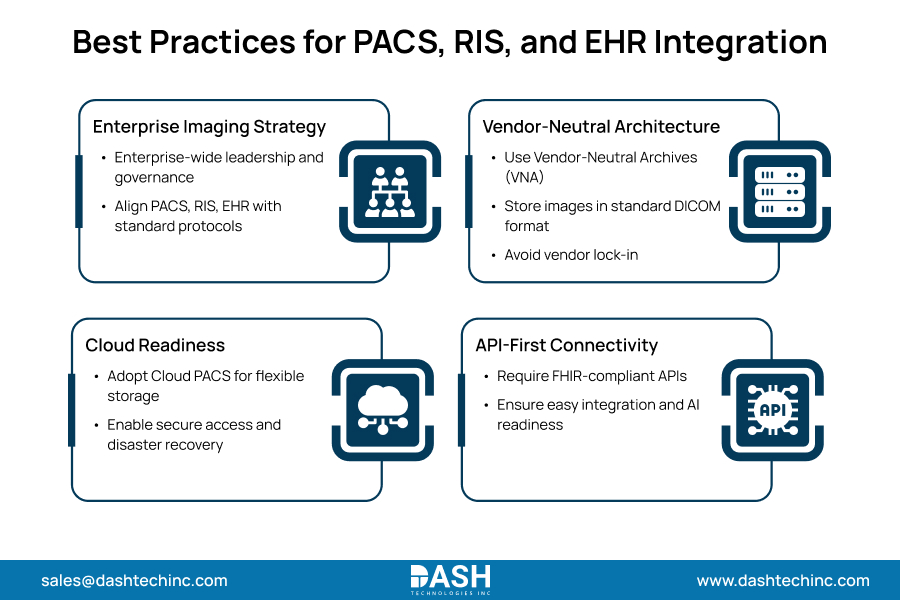
- Enterprise Imaging Strategy
Radiology integration strictly requires health system leadership to deploy it as an enterprise-wide initiative. A unified imaging strategy connects PACS, RIS, EHR, and external platforms. It does this through central governance and standard data protocols. - Vendor-Neutral Architecture
Vendor-neutral archives (VNA) store images in standard DICOM format accessible to any compliant system, eliminating proprietary lock-in. Health systems can replace individual components, including PACS itself, without dismantling the integrated platform around them. - Cloud Readiness
Cloud PACS eliminates on-premise storage overhead while extending image access to any credentialed clinician. Health systems that delay cloud adoption delay the scalability and disaster recovery modern radiology requires. - API-First Connectivity
Every new system procurement must carry an API-first requirement. FHIR-compliant APIs future-proof connectivity, accelerate third-party integrations, and position radiology infrastructure to absorb AI-powered tools entering clinical deployment.
The Future of Connected Imaging
Radiology integration’s next phase is already in motion. AI routing engines direct specific studies to the correct specialist. These models independently flag critical findings for immediate escalation and process preliminary diagnostic reads. Enterprise infrastructure natively fuses pathology, cardiology, and core radiology databases into a unified clinical architecture. Predictive analytics catch operational failures before they hit throughput.
Health systems that build connected radiology infrastructure now own the foundation that every emerging imaging technology requires. Those that defer spend years retrofitting what competitors already run.
Our radiology workflow solutions deliver the architecture, interoperability engineering, and implementation depth to build a fully connected imaging platform from the ground up. Contact us to eliminate imaging fragmentation permanently.
Frequently Asked Questions
About Dash

Dash Technologies Inc.
We’re technology experts with a passion for bringing concepts to life. By leveraging a unique, consultative process and an agile development approach, we translate business challenges into technology solutions Get in touch.