Healthcare API Strategy for Multi-EHR Environments: A Practical Guide
Multi-EHR hospital networks live or die by their healthcare API strategy. Get it right, and patient data moves at the speed of clinical decision-making. Get it wrong, and every workflow drowns under duplicate interfaces. Health systems grow through acquisition. They expand across specialties. They partner with digital health vendors. Almost none of them settle on one EHR. Epic sits next to Oracle Health next to a legacy MEDITECH instance, and each platform exposes data on its own terms.
Healthcare API integration used to mean point-to-point connections, solved one at a time. Now they multiply into hundreds of brittles, unmonitored interfaces. Regulators have made a coherent strategy non-negotiable, too. CMS now mandates four FHIR-based APIs from every impacted payer, with compliance beginning January 1, 2027. The healthcare API strategy used to be an IT preference. It’s a board-level business necessity now.
Why Multi-EHR Environments Require a Different API Strategy
Here’s the whole problem in one line: no two EHR platforms expose data the same way. Epic runs its own documentation, its own auth rules, its own data model. Oracle Health does too. So does MEDITECH, and every connection means rebuilding logic instead of reusing it.
Hospital consolidation doesn’t help. It makes things worse. Why? Acquisitions. The top three EHR developers grew their combined market share from 35% in 2010 to more than 80% by 2024, mostly by buying each other. A merger doesn’t retire from the acquired EHR. It just adds a second one, or a third, running alongside the first.
FHIR adoption varies by vendor. It varies by module, even inside the same vendor’s product. One system exposes a mature FHIR R4 endpoint for clinical data. Its billing module still runs HL7 v2. Authentication compounds the gap: SMART on FHIR and OAuth 2.0 on one platform, a proprietary token exchange on another. The national numbers reflect it. Only 43% of U.S. hospitals routinely engage in all four domains of interoperable exchange as of 2023. Inconsistent EHR API integration is a big reason why. Hospitals need healthcare interoperability architecture that isolates each EHR’s quirks behind a standardized layer. Not another interface bolted onto an already fragile stack.
Four Pillars of a Successful Healthcare API Strategy
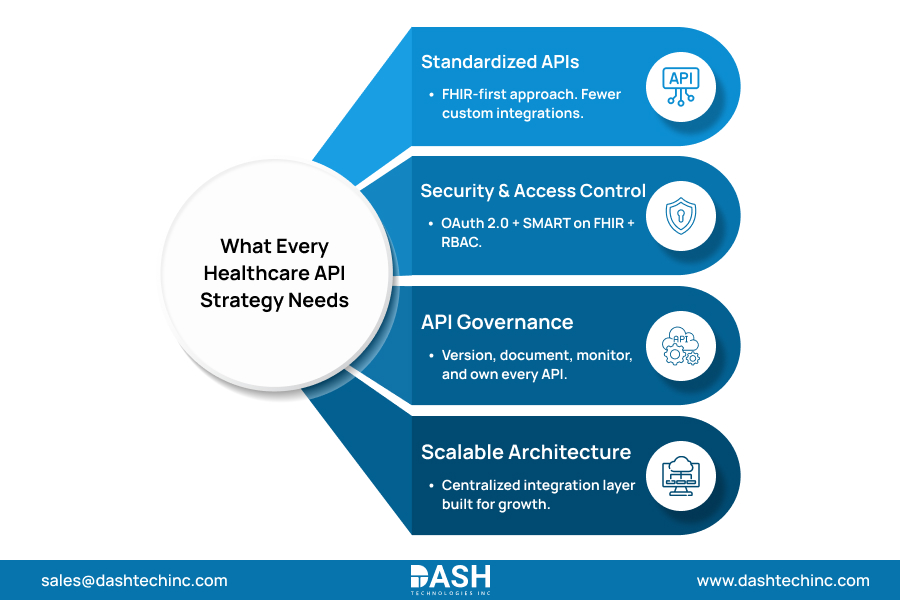
A healthcare API strategy stands on four pillars. Skip any one of them, and the integration sprawl returns within a year.
- Standardized APIs: FHIR API development becomes the default. Custom builds get reserved for the narrow set of legacy endpoints with no FHIR equivalent. That single choice removes the separate data-mapping layer for every EHR pairing would otherwise demand.
- Security & Access Control: OAuth 2.0 for every endpoint. SMART on FHIR for every clinical data connection. No exceptions carved out for “temporary” integrations. Temporary connections rarely get decommissioned on schedule. Role-based access control keeps each application locked to the exact data scope its use case requires, nothing wider. Weak authentication on a single integration compromises the entire network.
- API Governance: What does governance actually look like day to day? Version control. Documentation. Monitoring. Applied to every API, without exception. Integrations stop behaving like one-time projects and start behaving like managed assets: a published version, a change log, an owner on the hook for uptime. A defined FHIR implementation plan assigns ownership before the first outage and not during it.
- Scalable Integration Architecture: Treat every EHR connection as a reusable service, not a one-off point solution. Put a centralized integration layer between clinical systems and the applications that consume their data. The next EHR acquisition plugs into that one governed layer. No brand-new integration project required.
Skip any one of these four, and the sprawl this article opened with comes right back. Done right, this is healthcare API management. Done badly, it’s a string of emergency fixes.
Common Mistakes That Slow Down Multi-EHR Integrations
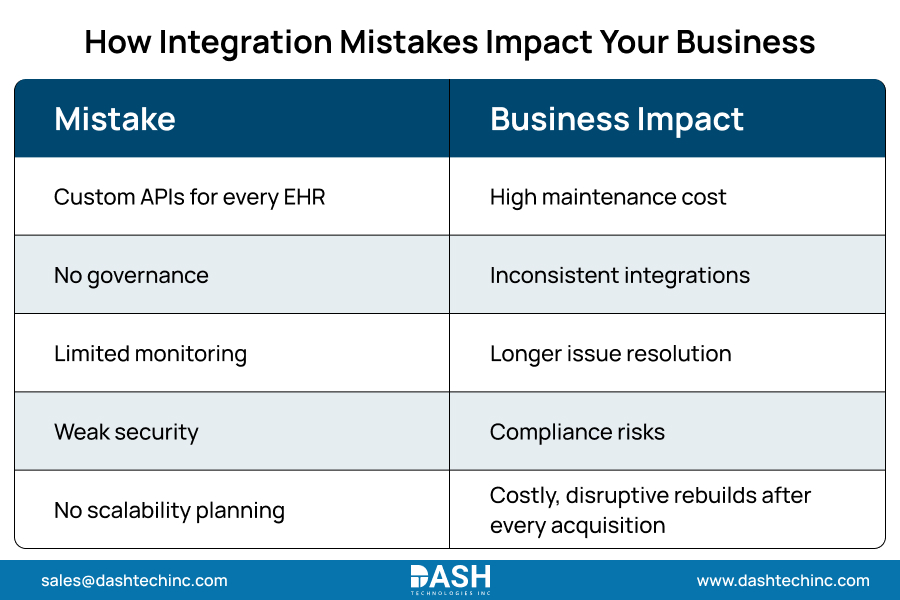
- Building vendor-specific APIs. An Epic EHR integration project and an Oracle Cerner integration project end up sharing zero reusable logic, even though both move the same clinical resources.
- Governance gets ignored. No one owns the decision to version an endpoint, so it turns into documentation busywork instead of an operational requirement.
- Monitoring stops at “is the interface up.” That misses the slow data-quality failures eroding clinician trust long before an outage does.
- Documentation lags months behind actual API behavior. Every new integration starts with reverse engineering instead of a reference.
- Nobody plans for scales. The architecture handling two EHRs on day one has no path to five after the next acquisition.
These mistakes compound each other. Weak governance leads to weak monitoring, and weak monitoring is why a security gap turns up during an audit instead of a code review.
Planning a Multi-EHR Integration Project?
Whether you're integrating Epic, Oracle Health, athenahealth, or other EHR platforms, our interoperability experts can help you develop a scalable API strategy tailored to your healthcare ecosystem.
Talk to Our EHR Integration ExpertsBest Practices for Building a Future-Ready Healthcare API Strategy
Six architectural practices convert a healthcare API strategy from a static document into an active operating discipline.
- Standardize FHIR whenever possible: Default every new integration to FHIR R4, and reserve custom builds for systems with no FHIR equivalent.
- Design APIs for reuse: Create each connector as a shared service. Downstream applications must query this infrastructure directly, bypassing single-use bridges.
- Secure endpoint: Apply OAuth 2.0 and SMART on FHIR uniformly. No exceptions for pilots.
- Monitor API performance: Continuously track endpoint latency and data-quality drift. Strict observability requires monitoring payload error rates alongside basic uptime.
- Plan for EHR upgrades: Version every integration so a vendor’s API change updates one governed layer, not every downstream consumer.
- Document integrations thoroughly: Maintain a live record of every endpoint: its owner, its consumers, its data scope.
These EHR integration best practices work for one reason. They treat interoperability as infrastructure the organization owns, not a project it finishes once. A hospital network running four EHRs after a merger needs every one of these practices in place before the next upgrade. Not after an outage exposes the gap.
Building a Scalable Multi-EHR Integration Strategy with Dash Technologies
Dash Technologies builds the governed integration layer that makes a multi-EHR strategy operational, not theoretical. Our teams design multi-EHR connectivity across Epic, Oracle Health, MEDITECH, and other major platforms. HL7 and FHIR integration. API development. All of it follows the pillars above from the first architecture diagram. None of them get bolted afterward.
Every engagement includes EHR integration architecture planning, data mapping, and testing and validation before go-live. Not as an afterthought once an interface fails in production. Health systems rebuilding their EHR integration strategy around FHIR and centralized governance start with Dash’s EHR integration services to scope the architecture their environment actually needs.
Conclusion
A successful multi-EHR integration strategy comes from standardization, governance, security, and scalable architecture. Not from writing one more custom interface for the next EHR, the organization inherits. Organizations that treat their healthcare API strategy as infrastructure, governed like any other critical system, cut integration costs. They eliminate the compliance risk of ad hoc connections, too. The organizations still building point-to-point bridges in 2026 aren’t behind technology. They’re behind strategy. Talk to us about architecting a healthcare API strategy built to scale.
Frequently Asked Questions
About Dash

Dash Technologies Inc.
We’re technology experts with a passion for bringing concepts to life. By leveraging a unique, consultative process and an agile development approach, we translate business challenges into technology solutions Get in touch.