Medical Device Software Development: Key Considerations for Scaling Digital Products
Medical Device Software Development is one of the few software disciplines where a regulatory failure at scale is also a patient’s safety failure. Products stall, get recalled, or never expand past a single care site. Not because clinical logic is wrong. Because the underlying architecture and compliance infrastructure were built for a pilot, not a production system, that gap delays deployment timelines and burns capital that should have gone into clinical adoption.
What Is Medical Device Software Development?
Not all healthcare software is medical device software. The distinction is legally significant. Medical Device Software Engineering ensures that every component meets clinical and regulatory demands.
Four product categories define the field:
- Embedded software: Sits inside the hardware itself. Pacemakers, infusion pumps, imaging systems.
- Connected devices: Sit on top of hardware and communicate with clinical platforms over networks.
- SaMD (Software as a Medical Device): Skips hardware entirely, performing a medical function in software alone. Diagnostic algorithms and clinical decision support tools land here.
- AI-powered devices: Layer machine learning on top of SaMD for diagnosis and risk prediction.
Each category faces different FDA expectations and different architecture requirements. A team that treats SaMD development like a standard software build has already made the mistake that will cost them during premarket review. Our medical device software development services address all four categories, from embedded firmware through AI-powered SaMD.
Ready to Scale Your Medical Device Software?
From regulatory readiness to high-volume device data management, we help teams build solutions that perform in real-world clinical environments.
Schedule a ConsultationWhy Scalability Defines Product Success?
Most digital health products die at scale, not launch. The pressures that compound during expansion are predictable: user growth across distributed care sites, exponential increases in device-generated data volumes, new regulatory jurisdictions as the product enters new markets, and the technical debt that accumulated when the team was moving fast in early development. All of that arrives at once. Products built without scalability as an architectural principle hit these walls and require costly rebuilds of mid-deployment, often while already in clinical use. Digital Health Product Development must therefore treat scalability as a non-negotiable foundation, not an afterthought.
Regulatory complexity also grows. Products cleared for one indication to face new compliance postures when expanded. Healthcare Software Development teams that treat compliance as a late activity spend years unwinding early decisions. The more successful the product, the more expensive that reckoning becomes.
Key Considerations When Scaling Medical Device Software
-
Regulatory Compliance
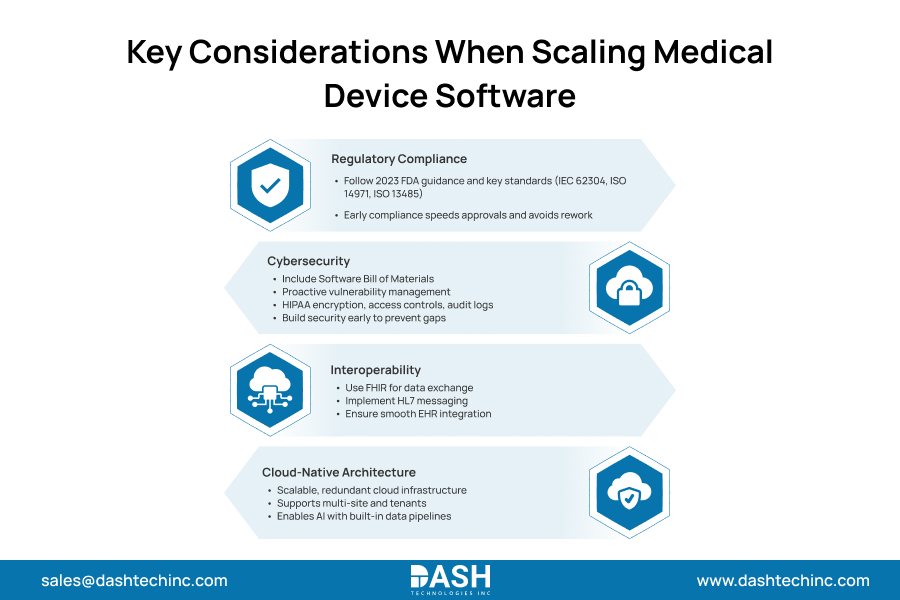
The 2023 FDA guidance on content of premarket submissions for device software functions established materially new documentation expectations across 510(k), De Novo, and PMA pathways. IEC 62304 governs the software lifecycle; ISO 14971 mandates risk management, and ISO 13485 covers quality management.
These are not optional documentation exercises. Teams that build this into their pipeline from day one executes regulatory submissions in weeks. Teams that retrofit it spend quarters. Medical Device Product Development that aligns with these standards avoids costly rework. -
Cybersecurity and Device Security
FDA’s 2023 cybersecurity guidance requires a Software Bill of Materials and proactive vulnerability management across the full device lifecycle. Cybersecurity documentation is part of the premarket submission. Understanding FDA Medical Software expectations around security is critical for any connected device.
HIPAA adds another layer. Software touching patient health information requires encryption, access controls, and audit logging at every layer: application and infrastructure both. Retrofitting those controls after deployment never quite works. The gaps show up in audits and breach of investigations, and the liability is real. -
Interoperability
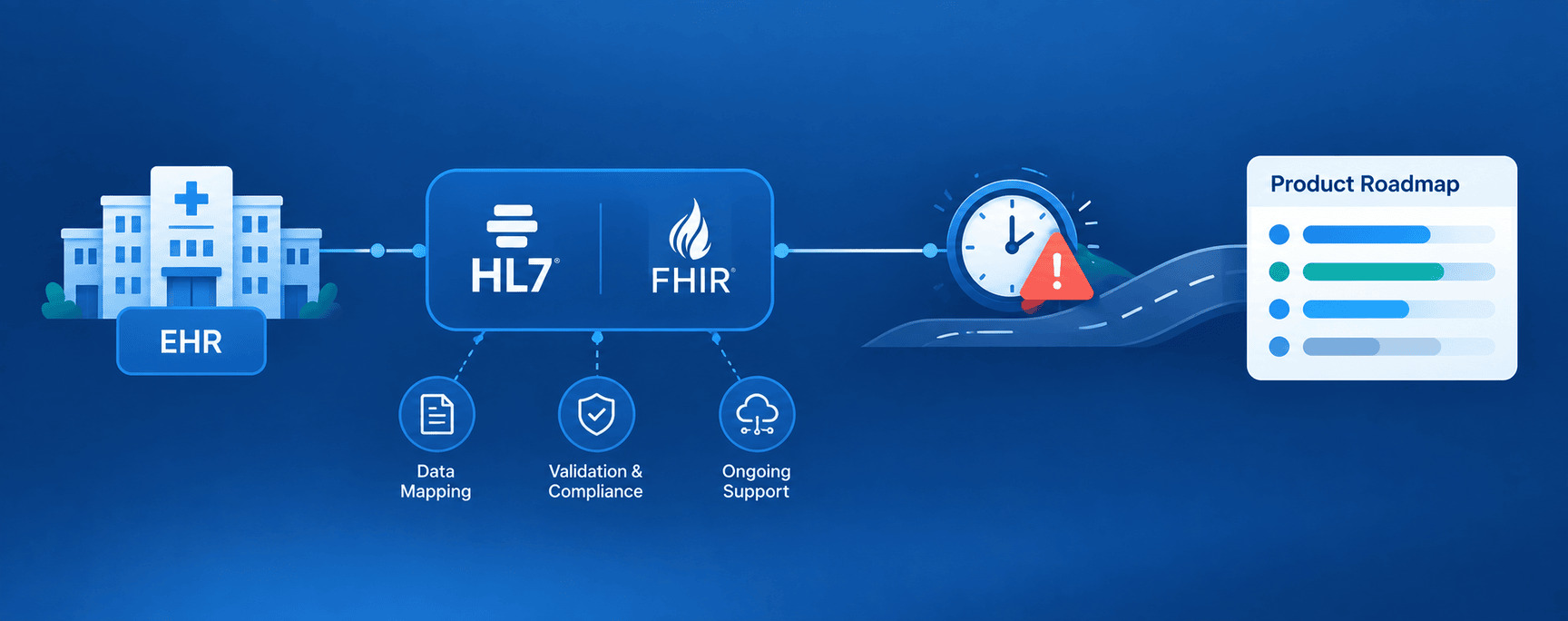
FHIR is what clinical data exchange runs on. Skip it, and device data never touches a workflow. HL7 messaging handles the connectivity layer. Products that arrive at deployment without this architecture stall at go-live. Clinical performance in healthcare software development does not matter if the data cannot reach the clinician.
Our EHR integration services clear that bottleneck. Interoperability is not an enhancement layer. It is a precondition for clinical utility. -
Cloud-Native Architecture
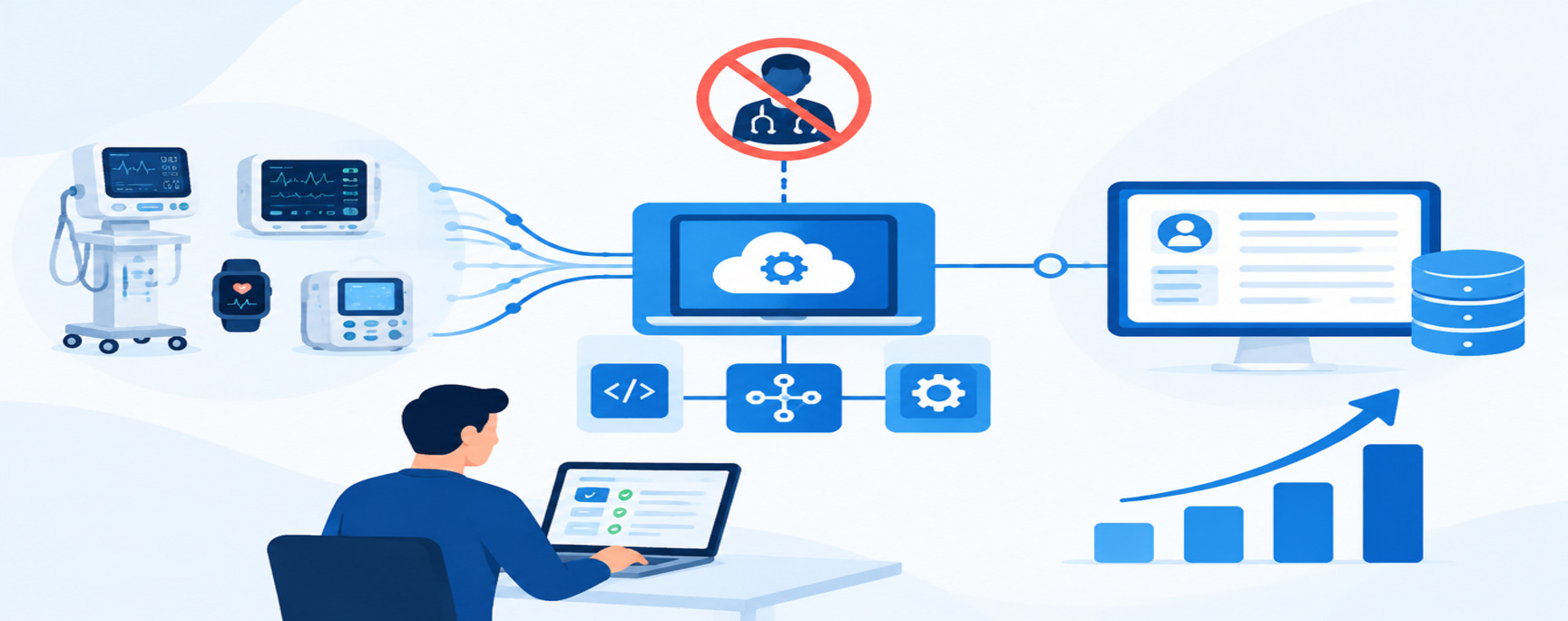
On-premises infrastructure does not scale for device data. Cloud-native architecture scales horizontally, is redundant, and costs less based on use. It should support multiple sites and tenants from the start.
Cloud-native also prepares the product for AI capabilities. Predictive models, computer vision, and continuous learning systems all require data pipelines and model serving infrastructure that cloud architecture supports natively. SaMD development teams that defer this planning discover the constraint at the worst possible time.
Top Challenges in Medical Device Software Development
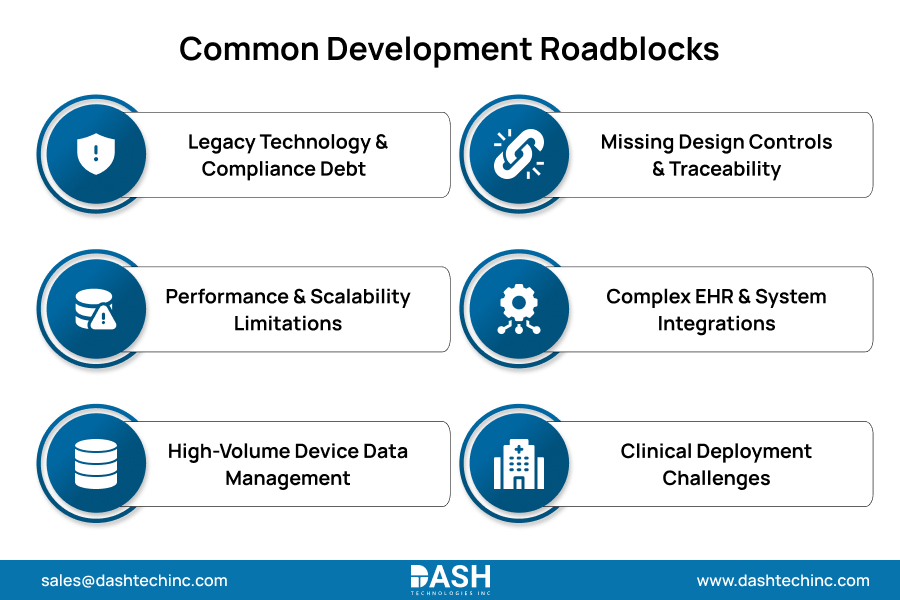
Legacy technology accumulates compliance debt with every update cycle. Systems built on outdated stacks face an increasing validation burden as functionality evolves. Regulatory submissions for those products require disproportionate documentation effort for changes that should be routine.
Teams that skipped design controls during development discover the cost during submission. Review cycles stretch when evidence is missing. There is no shortcut back to a compliant foundation. Medical Device Software Engineering practices, including traceability and risk management, must be embedded from the first sprint.
Performance bottlenecks surface at device data scale. A network monitoring of 500 connected devices generates data loads that expose every architectural shortcut taken during early development. What ran cleanly at 50 devices collapsed at 5,000.
Integration complexity blocks clinical adoption from a different direction. EHR environments, imaging archives, and workflow systems each impose their own API patterns. Medical device software that ignores integration architecture delivers a product that works in a demo and fails in deployment.
Device data explosion is the least discussed challenge. Continuous monitoring devices generate orders of magnitude more data than periodic reporting devices. Organizations that did not design high-throughput data management face infrastructure rebuilds at the worst possible moment: during active clinical deployment, under contract, and under pressure.
The Medical Device Software Development Lifecycle
The lifecycle is not complicated. Executing it in sequence is.
- Discovery: Intended use, risk classification, regulatory pathway.
- Design Controls: Architecture and risk documentation under ISO 14971.
- Development: IEC 62304-structured work with version control.
- Verification: Traceability, testing, static analysis.
- Validation: Confirms intended use in clinical environments.
- Post-Market Monitoring: Complaint handling and vulnerability monitoring.
Each phase generates submission evidence. Working phases sequentially compress the path to clearance. Successful Medical Device Product Development follows this sequence rigorously.
What Sustainable Scale Actually Requires?
- Modular architecture isolates changes within bounded units, making post-market change management viable.
- Continuous validation integrates verification into the pipeline, catching regressions early.
- Risk-based development applies to rigor where clinical risk is highest. Class B and C components under IEC 62304 carry more documentation than Class A, deliberately.
- Security-by-design is an architectural decision made in the first sprint, not retrofitted after deployment. Digital health product development that prioritizes security and modularity avoids expensive failure modes.
Future Trends in Medical Device Software
AI-powered devices are moving to continuous learning systems. FDA’s predetermined change control framework now accommodates post-market model updates. Keeping pace with the FDA Medical Software guidance on AI is essential.
Connected care platforms are the deployment environment most SaMD products will enter. Device data flows to hospital networks, cloud platforms, and population health infrastructure. Products built to participate in those environments from day one capture clinical adoption faster than products retooled after the fact.
Digital therapeutics represent a distinct regulatory pathway under the FDA’s Software Precertification principles. Products in this category face unique evidence of generation requirements and deploy alongside or instead of pharmaceutical interventions. Teams building in this space need a regulatory strategy that reflects the evidence standards specific to that category.
Edge computing dictates latency limits for continuous monitoring devices. Processing data locally cuts round-trip times, directly enabling real-time alerting and closed-loop control architectures. Hardware requiring sub-second response times cannot rely on cloud transit for core functionality.
Conclusion: Build Medical Device Software That Scales
Medical device software development that delivers clinical utility at enterprise scale requires regulatory infrastructure, security architecture, and engineering discipline operating together. Treating any secondary investments produces products that clear premarket review but fail during deployment.
DASH engineers compliant, scalable medical device software from initial design through post-market operations. Contact us to discuss how we can build your digital health product to scale.
Frequently Asked Questions
About Dash

Dash Technologies Inc.
We’re technology experts with a passion for bringing concepts to life. By leveraging a unique, consultative process and an agile development approach, we translate business challenges into technology solutions Get in touch.