Healthcare Interoperability Isn’t Broken – Why Information Exchange Still Remains a Challenge
Healthcare interoperability doesn’t fail because of missing standards—it slows down because of implementation complexity. Integrating medical devices with EHRs requires more than HL7 and FHIR compliance; it demands scalable architecture, secure APIs, workflow orchestration, and reusable integration patterns. This article explores the challenges behind healthcare data interoperability and the best practices for reducing integration time, cost, and complexity.
Medical Device Interoperability: Connecting Device Data to Healthcare Systems Faster
Today’s connected medical devices continuously capture vital signs, diagnostic measurements, imaging results, and treatment data across hospitals, clinics, homes, and virtual care settings. From bedside patient monitors and infusion pumps to wearable ECG monitors and remote patient monitoring (RPM) devices, the volume of clinical data being generated continues to grow at an unprecedented pace.
Despite this explosion of connected medical devices, healthcare organizations continue to face a fundamental challenge: making device data available where clinicians actually need it.
Too often, valuable patient information remains isolated within proprietary device platforms, vendor portals, or standalone applications instead of flowing directly into EHRs and clinical workflows. Clinicians switch between multiple systems, manually enter readings, or wait for information to be transferred before making treatment decisions. The result is fragmented care, operational inefficiencies, and delayed access to critical patient information.
The challenge is no longer collecting data. Healthcare organizations have largely solved that problem.
The real challenge is exchanging these health data—connecting devices, applications, and healthcare systems in a way that enables secure, standardized, and scalable data exchange across the entire care ecosystem.
While interoperability standards such as HL7, FHIR, SMART on FHIR, and X12 have transformed the industry’s approach to integration, implementing these standards consistently across hundreds of medical devices, data platforms and multiple EHR vendors remains significantly more complex than many organizations anticipate.
At Dash Technologies, years of building healthcare interoperability solutions have revealed a common pattern. The organizations that succeed aren’t necessarily those with the largest engineering teams—they’re the ones that adopt repeatable integration strategies instead of treating every implementation as a brand-new project. That experience ultimately shaped BridgeFast, our interoperability accelerator designed to simplify and standardize healthcare connectivity.
Before exploring how organizations can accelerate interoperability, it is worth understanding why medical device integration continues to present challenges despite the availability of mature interoperability standards.
Why Medical Device Data Still Lives Outside the Clinical Workflow?
Medical devices have become increasingly intelligent. Healthcare systems, however, have become increasingly diverse.
A typical healthcare organization operates dozens, sometimes hundreds of clinical applications alongside multiple EHR platforms, imaging systems, laboratory information systems, pharmacy applications, and specialty software. Medical devices must exchange data with this broader ecosystem while maintaining accuracy, security, and regulatory compliance.
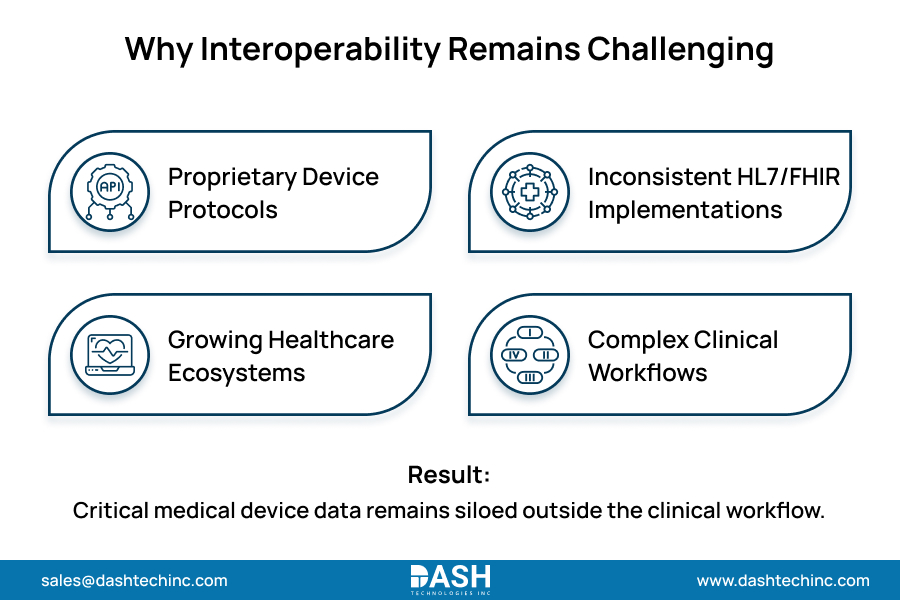
Unfortunately, every layer of this ecosystem introduces additional complexity. Several challenges continue to prevent seamless interoperability.
- Proprietary Device Ecosystems
Many medical devices still rely on proprietary communication protocols or vendor-specific APIs that require custom middleware before they can communicate with healthcare applications. - Inconsistent Standards Implementation
Supporting HL7 or FHIR doesn’t necessarily guarantee interoperability. Different vendors often implement the same standards using different resource profiles, authentication methods, APIs, and workflows, making every integration unique. - Expanding Healthcare Environments
As organizations grow through mergers, acquisitions, and multi-site expansion, the number of systems requiring connectivity increases exponentially. Without a scalable integration strategy, custom interfaces quickly become difficult to maintain. - Clinical Workflow Complexity
Moving data between systems is only one part of interoperability. Device data must be matched to the correct patient, validated, incorporated into clinical workflows, trigger alerts when necessary, and remain available for downstream analytics and decision support.
Ultimately, disconnected systems don’t just slow technology teams—they slow clinical teams as well.
The Business Cost of Poor Medical Device Interoperability
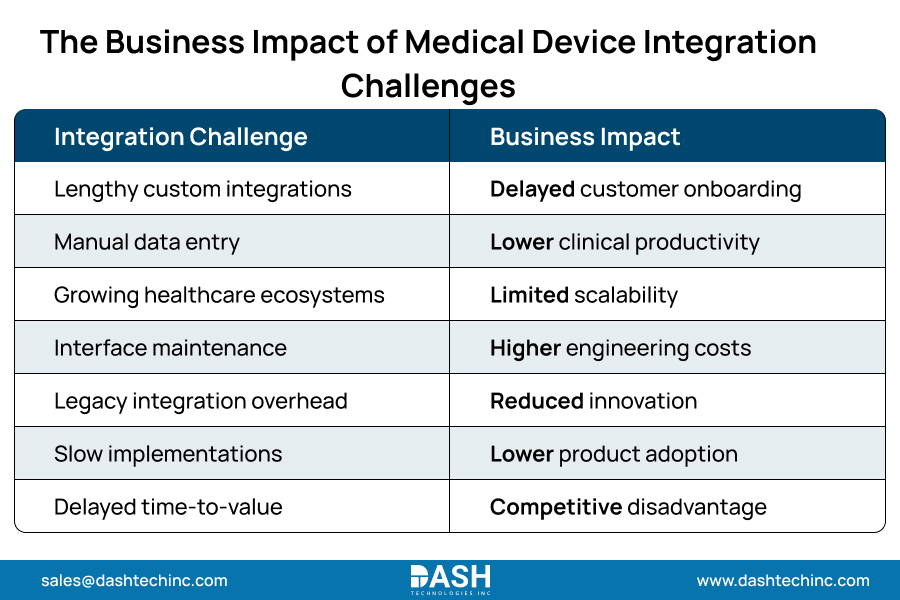
For medical device manufacturers and digital health companies, lengthy integration cycles can significantly delay customer onboarding. A product may demonstrate exceptional clinical capabilities, but if connecting it to hospital systems requires months of custom development, implementation quickly becomes a competitive disadvantage.
Healthcare providers face similar challenges. Manual data entry remains one of the most visible consequences of poor interoperability. Clinical staff spend valuable time transferring information between systems instead of focusing on patient care.
Scalability presents another major business concern. Organizations that build every integration independently often discover that success becomes increasingly difficult to replicate. Supporting one EHR may be manageable. Supporting five EHR vendors across multiple hospitals while integrating dozens of medical devices introduces exponentially greater complexity.
Each additional interface requires ongoing maintenance, security updates, regression testing, API version management, and troubleshooting. Over time, engineering resources have become dedicated to sustaining existing integrations rather than developing new capabilities that differentiate the business.
These inefficiencies also influence product adoption. Healthcare organizations increasingly evaluate digital health platforms based not only on functionality but also on implementation speed. Solutions that integrate quickly with existing infrastructure reduce deployment risk and accelerate time-to-value, making interoperability a critical purchasing consideration.
The implications become even more significant as healthcare shifts toward value-based care and continuous patient monitoring.
In other words, interoperability has evolved from a technical requirement into a strategic business capability.
Need a faster approach to EHR integration?
BridgeFast Accelerator combines proven interoperability frameworks with prebuilt EHR connectors to help organizations reduce custom development and accelerate healthcare integrations.
Talk to an Integration ExpertDifficulties in Using HL7 and FHIR for Medical Device Integration
HL7, FHIR, SMART on FHIR, and CDS Hooks provide a common language for exchanging healthcare information. They define how data should be structured, accessed, and shared across healthcare applications. What they don’t define is how every healthcare organization, EHR vendor, medical device manufacturer, and digital health platform will implement those standards in practice.
That distinction is where many interoperability projects encounter unexpected complexity.
For example, two healthcare organizations may both support FHIR APIs, yet expose different resource profiles, authentication mechanisms, terminology mappings, and workflow requirements. Similarly, medical device vendors often implement proprietary extensions or vendor-specific APIs alongside industry standards, requiring additional transformation and orchestration before data can flow seamlessly into clinical systems.
- Data mapping is another significant challenge.
Medical devices generate information in formats optimized for device functionality, while EHRs expect structured clinical data that aligns with standardized terminologies and workflows. Converting raw device data into clinically meaningful observations often requires more than simple field-to-field mapping. Organizations must normalize terminologies, validate data quality, preserve clinical context, and ensure compatibility with downstream applications. - Security introduces another layer of complexity.
Healthcare APIs must balance accessibility with strict compliance requirements. Authentication, authorization, token management, audit logging, encryption, and role-based access controls all become essential components of an interoperability strategy. As organizations integrate more devices and applications, managing secure access consistently across the ecosystem becomes increasingly challenging. - API lifecycle management is equally important.
Healthcare systems continuously evolve through software upgrades, regulatory changes, and new feature releases. Without governance, version control, monitoring, and proactive maintenance, integrations become fragile over time. A seemingly minor API update can disrupt multiple downstream applications if dependencies are poorly managed.
Perhaps the greatest misconception is that implementing interoperability standards eliminates custom work altogether.
In reality, standards reduce variability—but they do not remove the need for implementation expertise. Ultimately, HL7 and FHIR provide the foundation for interoperability. Delivering reliable, scalable healthcare connectivity depends on how effectively those standards are implemented, governed, and maintained across the broader healthcare ecosystem.
What Years of Healthcare Integration Have Taught Us About Device Connectivity?
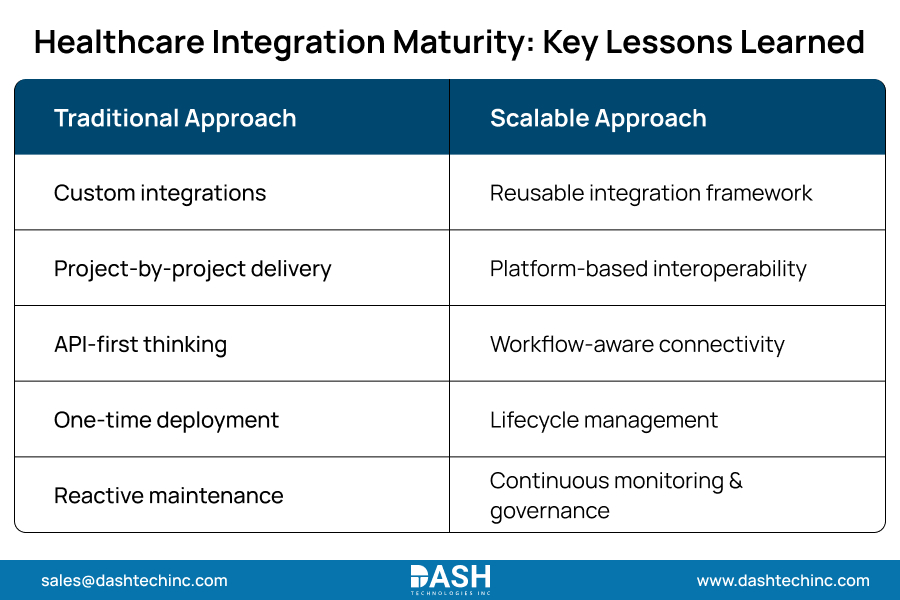
Over time, patterns begin to emerge—not just in the technologies involved, but in the decisions that consistently influence project success.
One of the most important lessons is that custom integrations rarely scale.
Building a unique integration for every customer, device, or EHR may appear practical during the early stages of product growth. However, as organizations expand into new health systems, support additional device types, or integrate with multiple EHR vendors, maintaining hundreds of independent interfaces quickly becomes unsustainable.
Successful organizations shift from project-based integrations to platform-based integration strategies.
Instead of repeatedly solving the same connectivity problems, they establish reusable integration patterns that standardize authentication, data transformation, validation, monitoring, and error handling. New implementations build upon proven frameworks rather than starting from scratch.
Another recurring lesson is that interoperability extends far beyond technology.
Healthcare workflows differ significantly between hospitals, specialty clinics, ambulatory practices, and virtual care providers. Integration strategies must account for clinical processes, regulatory requirements, operational policies, and organizational governance—not simply API connectivity.
Organizations also benefit from treating integrations as long-term operational assets rather than one-time development projects.
Every interface should have defined ownership, monitoring, version management, documentation, and measurable service levels. This operational mindset improves reliability, simplifies maintenance, and reduces disruption as healthcare environments evolve.
Accelerate Healthcare Connectivity with BridgeFast
Reduce integration complexity with reusable HL7, FHIR, and API frameworks that help medical device companies connect to healthcare systems faster.
Explore BridgeFastHow BridgeFast Helps Medical Device Companies Accelerate Healthcare Connectivity?
The lessons learned from years of healthcare integration ultimately shaped the design of BridgeFast.
Rather than approaching every implementation as an independent engineering effort, BridgeFast applies reusable interoperability frameworks that simplify how medical device companies connect with healthcare systems.
The platform combines pre-built connectivity capabilities with standardized implementation patterns to reduce the complexity traditionally associated with HL7 and FHIR integration projects. Instead of repeatedly developing authentication workflows, API orchestration, data transformation logic, and monitoring capabilities, organizations can build proven components that have already been designed for healthcare interoperability.
This approach helps medical device companies accelerate onboarding across multiple healthcare organizations while reducing ongoing development efforts.
The result is shorter implementation timelines, greater consistency across deployments, and a more sustainable path to scaling healthcare interoperability.
More importantly, engineering teams can focus on advancing product innovation instead of repeatedly solving the same integration challenges.
Interoperability becomes an accelerator for business growth-not a bottleneck.
Preparing for the Next Generation of Connected Healthcare
Healthcare interoperability will become even more important as connected care continues to evolve.
Remote patient monitoring, AI-powered clinical decision support, digital therapeutics, hospital-at-home programs, wearable technologies, and predictive analytics all depend on reliable access to complete clinical information.
Organizations that continue relying on isolated integrations will face increasing operational complexity as healthcare ecosystems expand.
Those that invest in scalable interoperability today will be better positioned to adopt emerging technologies while maintaining security, compliance, and operational efficiency.
In the future, interoperability won’t be a competitive advantage—it will be an expectation.
Conclusion
Medical device interoperability is no longer just about connecting systems. It’s about enabling secure, reliable, and scalable information exchange that supports better clinical decisions, faster implementations, and long-term business growth.
While standards like HL7 and FHIR provide the foundation for healthcare connectivity, meaningful interoperability requires reusable integration frameworks, strong governance, and implementation expertise.
BridgeFast combines Dash Technologies’ healthcare interoperability experience with proven integration frameworks to help healthcare organizations and medical device companies reduce implementation complexity, accelerate customer onboarding, and scale connectivity without rebuilding every integration from scratch.
Ready to simplify healthcare interoperability? Connect with our experts to learn how BridgeFast can accelerate your next integration project.
Frequently Asked Questions
About Dash

Dash Technologies Inc.
We’re technology experts with a passion for bringing concepts to life. By leveraging a unique, consultative process and an agile development approach, we translate business challenges into technology solutions Get in touch.