Preparing Orthopedic Programs for Bundled Payment Models
The bundled payment models that orthopedic programs now navigate represent a strict departure from legacy fee-for-service billing. Payers now issue a single payment covering the entire surgical episode through post-acute recovery.
This shift toward episode-based payment of healthcare defines the current public and commercial payer strategy. Executing orthopedic value-based care requires facilities to simultaneously hit strict clinical metrics and control total episode costs.
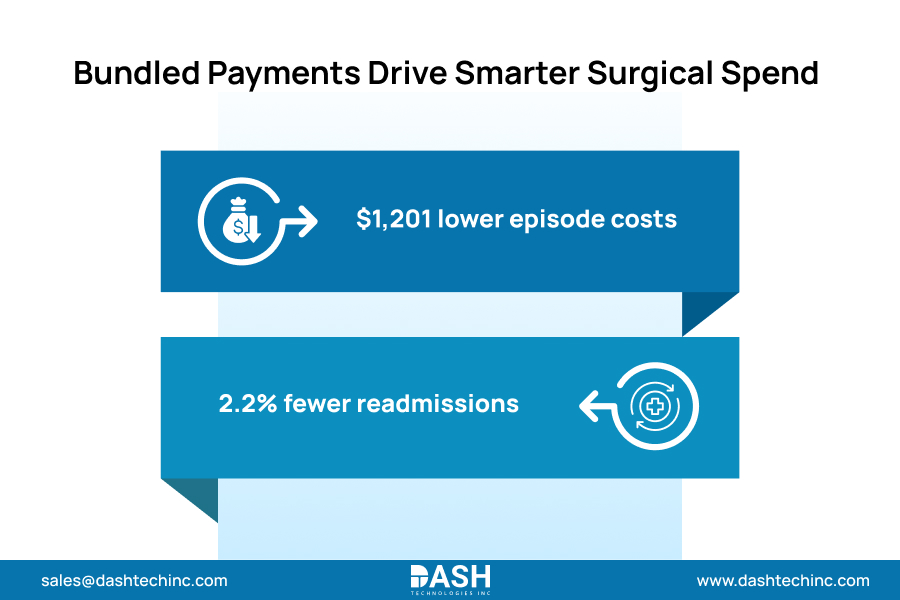
These models consistently reduce overall surgical spending. In a study, it was found that participating in bundled payments for outpatient spine surgery drove $1,201 lower total episode costs and reduced inpatient readmissions by 2.2 percentage points compared to non-participating facilities.
Executives need to actively align clinical pathways. They should also standardize implant spending and manage post-acute care coordination. Facilities executing these structural changes ahead of mandatory value-based contracting secure immediate market leverage. Reactive organizations simply guarantee future financial penalties.
Understanding Bundled Payment Models in Orthopedics
Orthopedic bundled payment programs provide a single reimbursement covering an entire surgical episode. Instead of isolated billing for surgeon fees, facility stays, and physical therapy, all services are consolidated into one target price. Facilities keep savings below this target but directly absorb financial losses.
Episodes of Care in Orthopedic Procedures
Episode-of-care payments typically cover the surgical admission through 90 days of post-discharge. This financial bundle includes:
- Inpatient care & physician fees
- Skilled nursing facility (SNF) stays
- Home health, rehabilitation, & readmissions
How Bundled Payments Differ from Fee-for-Service
Legacy fee-for-service models reward pure volume while ignoring downstream clinical costs. Bundled frameworks strictly reverse this structure. Efficient care management directly generates shared savings, while avoidable readmissions immediately erode program profitability.
Examples of Orthopedic Bundled Payment Programs
CMS established this standard through the voluntary BPCI and mandatory CJR initiatives. Today, lower-extremity joint replacements function as the primary template for scaling value-based orthopedic strategies.
Why Orthopedic Procedures Are Ideal for Bundled Payment Models?
Patients don’t choose orthopedics randomly. The specialty fits the exact profile required for a successful orthopedic episode-of-care financial model, making orthopedic surgical cost management highly achievable.
- High Procedural Volume: Millions of joint replacements are performed annually. This high volume gives payers the statistical power needed to set accurate target prices.
- Predictable Care Pathways: Elective joint arthroplasty executes a strict, linear clinical trajectory from surgical admission through post-acute recovery.
- Standardized Surgical Procedures: Uniform surgical mechanics allow facilities to benchmark clinical quality directly against established national standards.
Payers consistently bundle total joint replacements, major spine procedures, and certain acute fracture treatments to drive these value-based financial models.
Manage Orthopedic Episodes with Real-Time Visibility
Turn predictable procedures into predictable financial outcomes—by tracking costs, standardizing pathways, and reducing variation across every episode.
Connect with our ExpertsChallenges Orthopedic Programs Face Under Bundled Payments
Adopting these financial models introduces severe operational risk. Overcoming the core bundled payment challenges orthopedics programs face requires stabilizing three primary failure points:
- Variability in Implant Costs
Implant price and choice variation remain a major source of orthopedic cost variation. In several orthopedic bundled payment contexts, high implant cost variability has been identified as a key driver of total episode cost, especially when surgeons have broad autonomy to select devices. - Post‑Acute Care Management
Post-discharge services routinely consume over one-third of total episode costs. Because CMS models mandate 30 to 90 days of financial accountability, facilities must establish strict operational partnerships with skilled nursing and home health centers to control downstream utilization. - Lack of Data Visibility Across Care Episodes
Facilities frequently track inpatient costs accurately while losing all visibility into post-acute spend and readmissions. Lacking dedicated episode analytics, executives cannot distinguish between genuine workflow efficiency and the dangerous practice of cherry-picking lower-risk patients.
Key Data and Analytics Needed to Succeed in Bundled Payment Programs
Mitigating acute operational risk demands deploying precise orthopedic episode analytics. Securing margins under these financial contracts relies entirely on executing advanced bundled payment analytics.
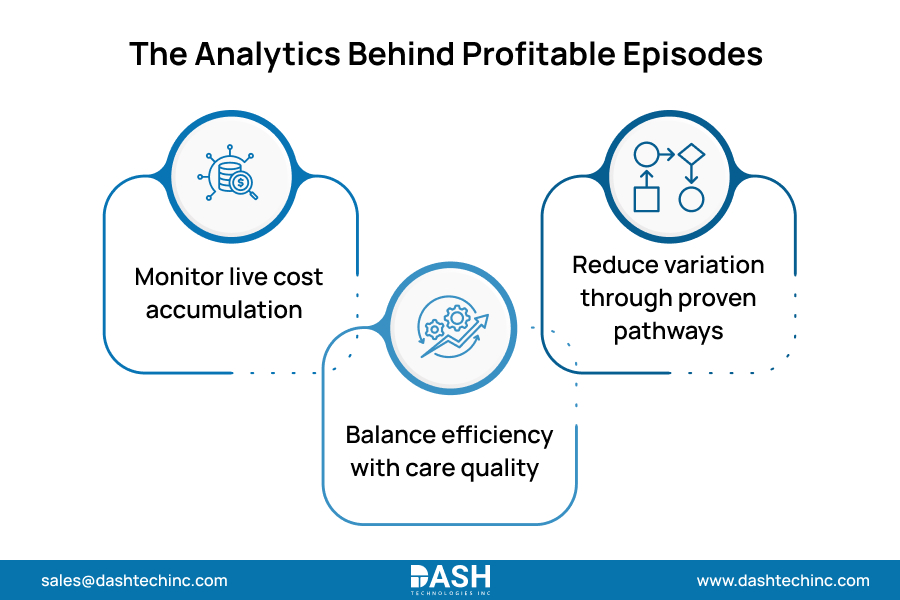
A successful data strategy supports the program in three specific ways:
- Episode Cost Tracking: Continuous visibility into accumulating clinical expenses alerts care coordinators at the exact moment a patient approaches the financial break-even threshold. This requires continuous orthopedic episode analytics to isolate live spending bottlenecks.
- Outcome Measurement: Tracking Patient-Reported Outcome Measures (PROMs) and complication rates to ensure that cost-cutting measures, like earlier discharges, aren’t negatively impacting the quality of care.
- Care Pathway Optimization: Leveraging historical bundled payment analytics isolates the most efficient surgical trajectories, allowing executives to standardize these strict clinical pathways across all practicing physicians.
Managing Costs Across the Orthopedic Care Episode
True orthopedic cost optimization requires a comprehensive strategy for orthopedic episode cost management that attacks expenses at every stage of the journey.
- Standardizing Implant Costs: Deploying unblinded vendor pricing and outcomes data eliminates surgeon-level variation. Transparency can move the needle to standardized, lower-cost implants with excellent value.
- Decreasing Length of Stay (LOS): Each day spent in the hospital exponentially increases the cost of the episode. Aggressively and safely mobilizing patients on the day of surgery can cut days off average LOS.
- Rationalizing Post-Acute Care: Health systems must construct exclusive networks of top-tier SNFs and home health partners. Deflecting eligible patients from high-cost SNF beds to home-based therapy fundamentally protects episode profitability.
Technology and Analytics That Support Bundled Payment Success
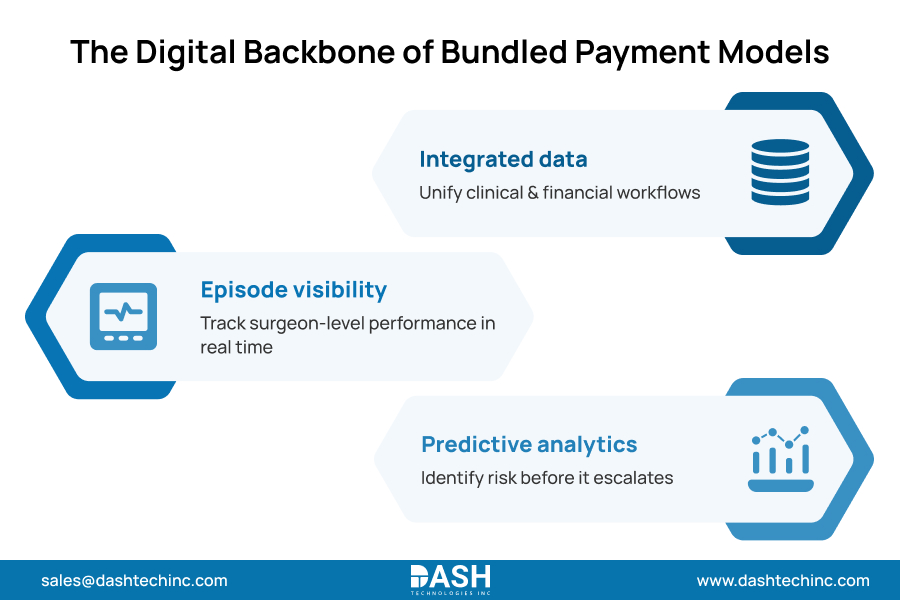
Advanced technology directly dictates bundled-payment readiness. Executing these contracts requires three core digital capabilities:
- Integrated Data Environments: Deploying orthopedic analytics platforms unifies isolated clinical and financial workflows, effectively eliminating manual data reconciliation ahead of executive performance reviews.
- Episode-of-Care Visibility: Dedicated healthcare performance dashboards isolate exact surgeon-level metrics. Tracking live readmissions and implant spend triggers immediate executive intervention before clinical variances escalate.
- Predictive Risk Analytics: Predictive modeling flags high-risk patients prior to admission, directly mitigating prolonged facility stays and excessive post-acute utilization.
Best Practices for Leaders Preparing for Orthopedic Bundled Payment Strategy
To provide value-based orthopedic care, facility leaders must follow a strict, phased readiness plan:
- Map the Full Orthopedic Care Episode: Review your current steps from pre-op clearance to day 90 post-discharge. Identify exactly where communication and data handoffs break down.
- Standardize Care Pathways: Partner with surgical leadership to enforce strict, evidence-based protocols. This directly eliminates workflow variation across procedural execution and discharge planning.
- Monitor Performance Metrics: Mandate weekly executive reviews of total episode costs and skilled nursing facility (SNF) utilization to immediately flag financial variances.
- Isolate Surgeon-Level Cost Variation: Track implant expenditures and OR throughput directly to the individual physician. This granular data forces accountability and standardizes baseline clinical performance.
Conclusion: Bundled Payments Require Data-Driven Orthopedic Programs
The future of orthopedic reimbursement is bundled. As commercial payers follow the government’s lead, an effective orthopedic value-based care strategy is no longer optional for hospital survival.
Succeeding under bundled payment models requires facilities to strictly align clinical outcomes with baseline cost management. Orthopedic programs executing targeted data strategies to control entire episodes of care, directly capture shared savings, and establish market dominance in value-based musculoskeletal care.
Are you ready to optimize your episodes of care? Partner with our team to deploy the advanced orthopedic analytics platforms and performance dashboards required to execute your value-based care contracts.
Frequently Asked Questions
About Dash

Dash Technologies Inc.
We’re technology experts with a passion for bringing concepts to life. By leveraging a unique, consultative process and an agile development approach, we translate business challenges into technology solutions Get in touch.