
How Real-World Data (RWD) Is Transforming Clinical Trials?
Real-world data clinical trials are not a workaround but are a design upgrade. The traditional controlled trial model: controlled populations, site-based enrollment, manual review, built clear evidence slowly and at high cost, from populations that represented a narrow slice of those who take the drug, and the FDA recognized that gap. Pharma organizations building evidence programs around RWD generate faster data, at lower cost, from populations that look like the real patient population. The ones still running site-only trials are paying for constraints they no longer have to accept.
The cost difference is not marginal. Site-based enrollment for a Phase III program runs on years of referral chains, travel requirements, and geographic exclusions that systematically underrepresent rural and minority populations. RWD cuts those constraints. The trial runs on patients who already exist in the health system data.
What Is Real-World Data in Healthcare?
Real-world data originates directly from patient records generated during standard care delivery. The core inputs include:
- EHR data: Diagnoses, medications, procedures, lab results, and clinical notes
- Claims files: Treatment patterns and resource utilization mapped across complete care episodes
- Wearables and remote monitoring: Biometrics captured between visits, sometimes daily
- Disease registries: Condition-specific cohorts with follow-up periods, no controlled trial matches
- Payer datasets: Population-level data from health systems and public health agencies
Real-world evidence represents the actual clinical findings computationally derived from this raw information. The FDA now accepts real-world evidence for regulatory choices. This includes label expansions and post-market surveillance. RWD healthcare programs leverage existing system architecture. The actual engineering bottleneck is data integration and pipeline quality, since raw data generation happens automatically.
Ready to Modernize Your Clinical Trial Strategy?
Discover how real-world data can support smarter trial design, faster decision-making, and more meaningful outcomes across the development lifecycle.
Talk to Our ExpertsWhy Pharma Organizations Are Investing in RWD?
Clinical trial innovation through RWD addresses the two biggest cost drivers: timelines and late-stage failures. Pharma analytics programs using real-world patient populations for candidate identification compress enrollment timelines from years to months in many programs. Observational data on untreated patient outcomes replace or supplement a placebo arm. Every trial component that RWD eliminates closes faster and costs less.
The failure of the cost case is the harder argument to ignore. A Phase III failure runs hundreds of millions per program. RWD-informed trial design: right population, right endpoints, realistic baseline, reduces the probability of that outcome. Better design at the start changes what the back end looks like.
Regulatory agencies have moved in this direction faster than most pharma organizations anticipated. The shift shows up in the registration data. Decentralized hybrid designs now account for a growing share of active studies on ClinicalTrials. Waiting for full regulatory certainty is not a safe strategy. It just means building the pipeline later, against competitors who started earlier.
Sources of Real-World Data
RWD aggregates from every digital system that patients navigate across the care continuum.
- EHR data for clinical trials require extracting structured diagnoses, lab results, and exact procedure records. This pipeline delivers the complete longitudinal history that controlled enrollment processes completely miss.
- Patient-generated data originates directly from remote monitoring hardware and mobile health apps. These endpoints produce continuous biometric telemetry between physical visits. This expands the analytical observation window far past site attendance.
- Healthcare datasets fuse payer claims and disease registries to establish strict population-level coverage. This data maps the precise demographics and geographies routinely excluded by physical site-based trials.
Individual source types isolate specific variables. Fused within a governed data infrastructure, they generate the exact regulatory-grade evidence required for compliance.
How RWD Improves Clinical Trial Efficiency?
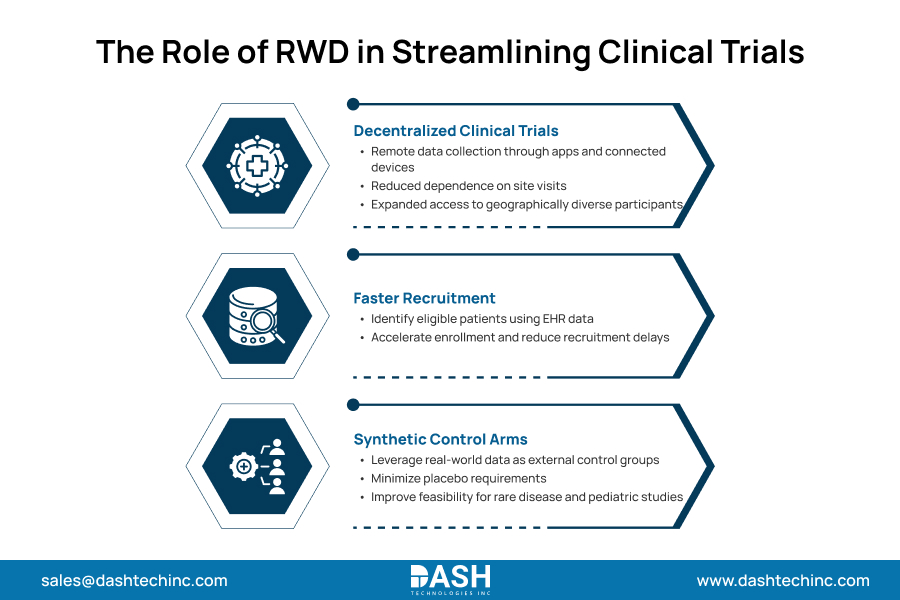
Decentralized clinical trials built on RWD infrastructure to remove the site attendance requirement for most data points. Participants submit readings through apps and connected devices. Sites become less central to data collection. The enrolled population stops being constrained by geography, which is where site-based trials systematically fail: they exclude patients who cannot travel.
Trial recruitment optimization changes the enrollment timeline more than any other RWD application. EHR data clinical trials run candidate identification models against structured patient records before the study opens, finding eligible candidates inside existing health system populations. Eighteen months of site referral-based enrollment compress when computational identification runs first.
Synthetic control arms are a separate efficiency gain. Where an untreated comparator population exists in real-world data, running a full placebo arm becomes optional. Single-arm trials with synthetic controls are not right for every indication. But for rare diseases and pediatric populations where enrollment is inherently constrained, the RWD-derived comparator changes what is feasible. That is a different trial architecture, not an incremental improvement.
Challenges in Integrating and Standardizing RWD
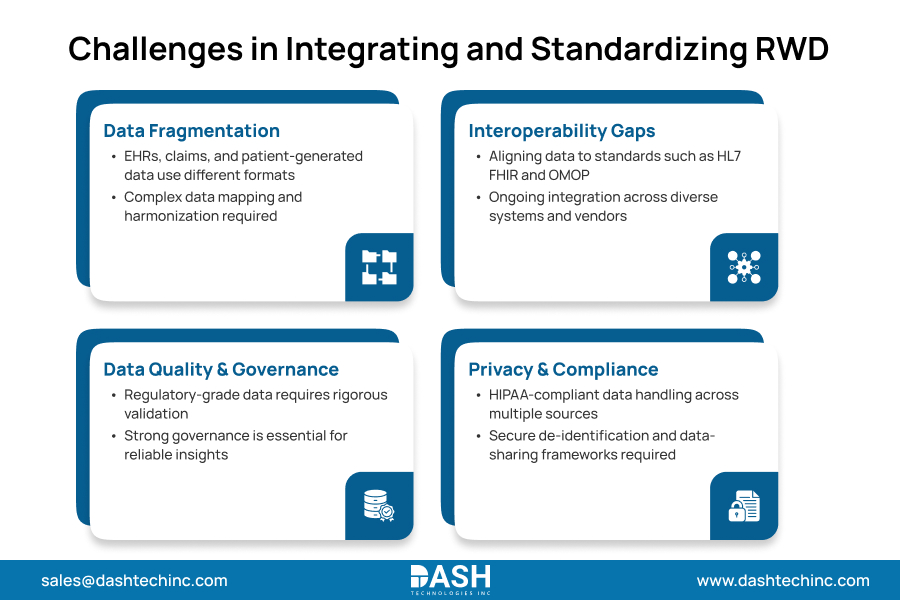
Healthcare data integration challenges in RWD programs come from source heterogeneity that is hard to overstate:
- EHR systems: Run on different coding standards across vendors
- Claims identifiers: Do not map directly to clinical identifiers; probabilistic linkage is required
- Patient-generated data: Arrives in proprietary formats that require harmonization before any analysis runs
Life sciences interoperability frameworks exist to solve this. HL7 FHIR and OMOP define the target data model. Getting there takes years of engineering. Each vendor runs on its own update schedule. That alignment is a continuous project, not a migration that finishes.
Regulators do not treat data quality as optional. FDA is explicit: organizations must meet quality standards before findings to support a regulatory decision. Clinical trial analytics programs built on uncurated source data generate findings that regulators reject regardless of analytical sophistication. Data governance is the prerequisite and not a follow-on.
Patient privacy adds another layer. HIPAA-compliant data handling across multi-source environments requires de-identification of pipelines and data use agreements at every source. Pharma organizations build multi-system RWD programs without legal and technical privacy infrastructure in place to find those gaps at the worst possible moment: when the data is needed for a regulatory submission.
Future of RWD in Drug Development
AI clinical trials running on RWD pipelines are in the near-term direction. Continuous patient population monitoring, outcome tracking, and safety signal detection without waiting for periodic review cycles. Predictive analytics pharma programs using longitudinal RWD identify responder subgroups, collapsing Phase III targeting work that currently takes years.
Life sciences data platforms that aggregate, harmonize, and query EHR, claims, and patient-generated sources in a single analytical environment are what this requires. Our life sciences data solutions build RWD integration platforms, trial analytics infrastructure, and data harmonization pipelines for pharma and life sciences organizations running RWD-based evidence generation programs.
Organizations building that infrastructure now have a window. The regulatory framework is moving in the same direction. FDA has been consistent: it reviews RWE submissions that meet quality standards. Regulators have set up the bar. The question is whether the data infrastructure clears it.
As more competitors build operational RWD pipelines, the early-mover advantage in trial design efficiency, biomarker identification, and post-market surveillance narrows. The question is not whether to build, but how long the organization can afford to wait.
Conclusion
RWD leads to quicker and more reliable trials. This happens when the data infrastructure manages integration, quality, and scale. Integration and analytics do not support functions. They determine whether a program produces regulatory-grade evidence or expensive noise. The organizations running mature RWD programs today started building the infrastructure before they needed it for a submission.
Latest-stage trial failure is not just expensive. It resets the program clock. RWD-informed design reduces the odds of that outcome. Not to zero, but enough to change the risk calculus at budget time.
Real-world data clinical trials run on connected infrastructure: EHR integration, claims linkage, patient-generated data pipelines, and harmonized analytics environments. Dashtech’s provider and life sciences engineering team builds RWD integration platforms, trial analytics infrastructure, and data harmonization pipelines for pharma and life sciences organizations at every stage of evidence program development.
Frequently Asked Questions
About Dash

Dash Technologies Inc.
We’re technology experts with a passion for bringing concepts to life. By leveraging a unique, consultative process and an agile development approach, we translate business challenges into technology solutions Get in touch.