
Automation in Claims Processing: Reducing Costs and Improving Accuracy
Claims processing automation is no longer optional. Payers who built operations around lower enrollment volumes are now running those same manual processes with significantly larger claim volumes, and the results are clear: higher processing costs per claim, slower turnaround times, and denial rates that lead to more appeals work downstream. Closing this gap is a smart financial decision, not a technology one.
The administrative cost of a manually processed claim is not just the labor to review it. It is the labor to re-route it when it stalls, follow up when it pends, and rework it when it denies it. Every manual touchpoint adds cost that automation removes. The question is not whether to automate. It is how fast it is to sequence the rollout.
Why Claims Processing Remains a Major Operational Challenge?
Healthcare claims challenges build at every step in the adjudication cycle. Each handoff is a queue. Each queue is delayed. The administrative cost of resolving a delayed claim covers follow-up, re-routing, and exception handling. It regularly exceeds the cost of the original processing. Payer operational inefficiencies from manual claims processing compound this faster than most organizations budget for.
Rule variability is the second pressure. Coding revisions, plan design changes, regulatory updates: every change requires manual teams to retrain and realign. HIPAA transaction standards govern the format, but the rules inside the transactions change constantly. Automated systems apply the updated rule immediately. Manual teams reach consistency weeks later. That window is where healthcare claims challenges turn into denial rate problems.
At scale, these dual operational pressures aggressively compound. Surging claim volumes crush static headcounts. Constant regulatory rule changes completely overload manual training cycles. An enterprise processing 500,000 monthly claims operates a fundamentally distinct infrastructure compared to a facility handling 50,000. This exponential scaling immediately drives up structural costs and permanently paralyzes the system with massive denial backlogs.
Modernize Claims Processing
Reduce costs, improve accuracy, and speed up claim decisions with automation.
Request an AssessmentTraditional Claims Workflows and Their Limitations
Manual claims processing has a scale ceiling. It hits it predictably: review queues lengthen, healthcare workflow bottlenecks stack, and exceptions loop back through the same understaffed cycle. Headcounts grow proportionally with volume. Accuracy stays flat or declines as reviewers handle more claims with the same cognitive load.
The consistency problem is structural. Two reviewers, same policy, same claim, two outcomes. That variation shows up as appeals volume and provider friction. Payer automation eliminates the variation. The same rule, applied identically, on every claim that fits the pattern. Rather than being an incremental improvement, it is a different operating model.
Denial management compounds the problem. Manual review that misses a coding issue before adjudication creates a denial. The denial creates an appeal. The appeal creates more manual review. That cycle runs on a delay of weeks and absorbs staff capacity that should be working on current claims. Automation breaks the cycle at the front end.
How Automation Is Transforming Claims Operations?
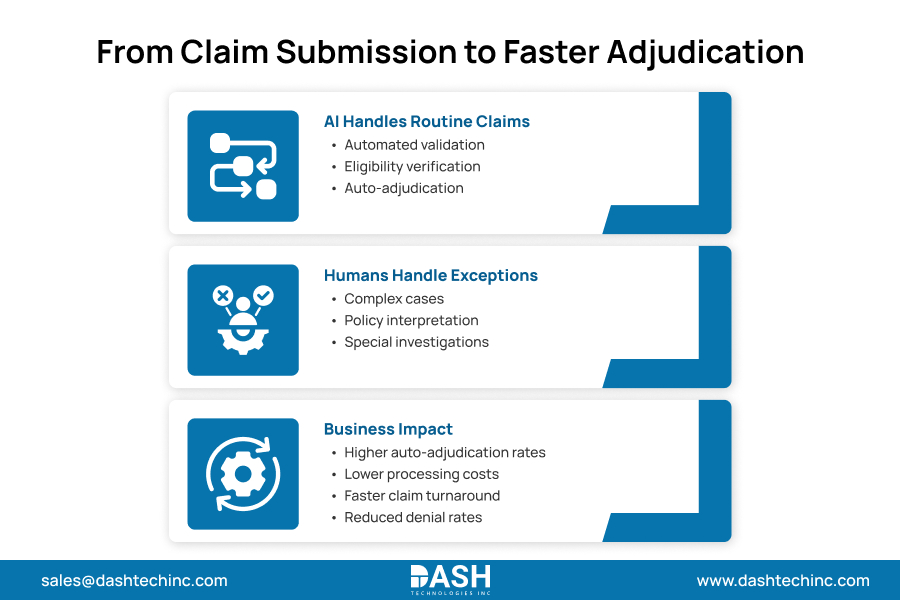
Claims processing automation works by separating the claim population. AI claims workflows handle clear, rule-conformant cases automatically and route everything else to human review. The result: reviewers spend their time on claims that need judgment, not on ones that follow established patterns. That reallocation is where cost and accuracy gain actually come from.
Auto-adjudication rates climb as payer automation models train on historical decisions. The automated path absorbs more claim types over time. Each percentage point of improvement in auto-adjudication is a direct reduction in the manual review of headcount requirements. Organizations with 60% auto-adjudication rates and those with 85% auto-adjudication rates are not running the same financial model.
Real-time eligibility verification dictates front-end operational success. Claims executed against inaccurate eligibility databases automatically fail during adjudication. Intercepting these eligibility errors prior to submission permanently prevents the exact denials that force expensive, full-scale manual rework cycles across the enterprise.
Technologies Driving Claims Automation
Two layers run the full claims workflow:
- RPA in healthcare: Rules-based automation covering claim intake, eligibility verification, prior authorization status, and payment posting. RPA healthcare tools handle the high-volume, low-judgment tasks that do not require clinical review
- AI in payer operations: Machine learning claims requiring clinical review, outlier detection against historical norms, and denial likelihood scoring before submission. AI in claims processing directs reviewer attention before claims enter a queue
Claims workflow optimization requires both layers working together. AI routes what needs human attention, and RPA processes the rest. CMS electronic claims requirements define the baseline transaction standards every payer works within. The automation layer runs on top of that foundation. Healthcare claims automation built on machine learning improves over time because the model adapts as claim patterns shift.
Imaging and radiology claims represent some of the highest-volume, most structured claim types in any payer portfolio. Our radiology workflow solutions connect imaging documentation to claims workflows, reducing the manual reconciliation that drives cost in high-volume radiology billing.
Benefits of Automated Claims Processing
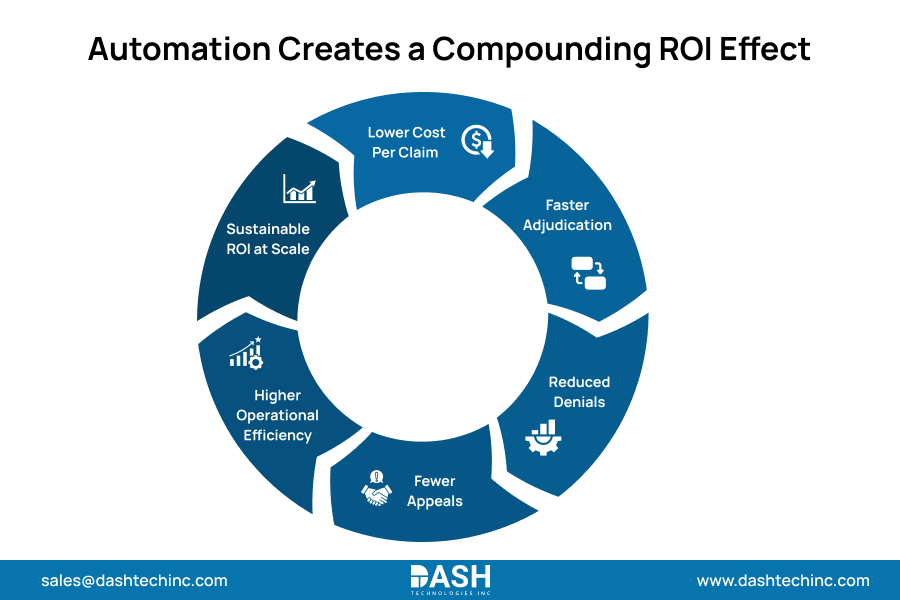
Claims automation delivers across four dimensions that compound over time:
- Payer cost optimization: Lower cost per claim, reduced manual review overhead, and smaller headcount requirement at the same claim volume
- Healthcare claims accuracy: One rule applied one way eliminates reviewer-to-reviewer variation
- Turnaround: Automated adjudication closes claims in hours rather than business days
- Denial rate reduction: AI-flagged issues surface before submission, so the denial never happens
Downstream effects build on each other. Faster adjudication shrinks the outstanding inventory. Lower denial rates shrink the appeals workload. Higher auto-adjudication rates for free reviewers for complex cases. The compounding is where the long-run ROI lives.
The appeal burden reduction is the benefit that most organizations undercount at budget time. OIG audit data on Medicare Advantage appeals document how denial and appeals volumes have grown consistently year over year. Each prevented denial is a prevented appeal. At scale, that is not a secondary benefit. It is a core component of the automation ROI case.
Best Practices for Implementing Claims Automation
Payer workflow modernization that holds together follows a specific order:
- Audit every queue before selecting any tool: Volume, exception rate, and error rate at each step, identify where automation creates real value versus where it does not
- Target high-volume, low-exception workflows first: Execute routine adjudication pipelines before engineering complex clinical routing.
- Establish strict baselines before deployment: Track tracking cost per claim, exact denial rates, cycle times, and auto-adjudication metrics
- Validate telemetry post-launch: A scalable automation strategy strictly requires hard data to justify any infrastructure expansion
Programs that skip measurement cannot justify ROI or identify where models need improvement. The baseline is not paperwork; it is the evidence that supports the program.
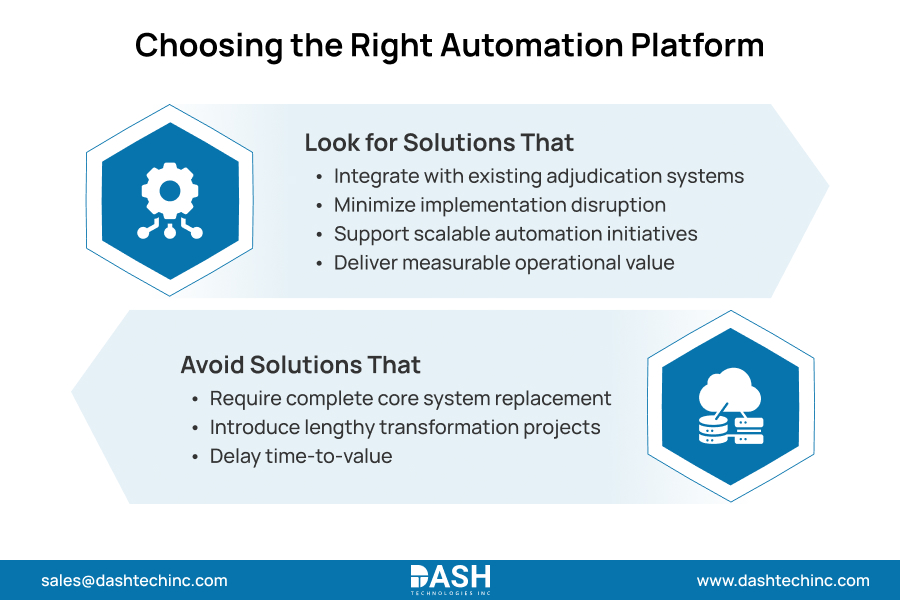
Vendor selection is where most programs make their first mistake. The right question is not which platform has the best demo. Which platform integrates with the existing adjudication system without a multi-year replacement project? Any automation infrastructure demanding a complete core system swap operates strictly as a massive legacy replacement project carrying a minor automation benefit.
Conclusion
The payer organizations closing the automation gap are not running a technology experiment. They are rebuilding their cost structure. Manual operations at high claim volume are not just expensive. They produce inconsistent outcomes, longer turnaround, and a denial backlog that compounds quarterly. Automation fixes all three simultaneously.
Automation delivers claims accuracy, speed, and cost reduction that manual operations cannot produce at scale. AI and RPA take the volume. Human reviewers handle judgments. Dashtech’s provider and payer engineering team builds claims processing infrastructure, AI adjudication workflows, and healthcare claims automation programs for payer organizations ready to close the gap.
Frequently Asked Questions
About Dash

Dash Technologies Inc.
We’re technology experts with a passion for bringing concepts to life. By leveraging a unique, consultative process and an agile development approach, we translate business challenges into technology solutions Get in touch.