How Digital Health Platforms Are Transforming Care Coordination?
Care coordination platforms solve strict routing problems. Critical clinical information exists but fails to reach the correct provider. Preventable readmissions and duplicate diagnostic procedures trace directly back to this architectural gap. Connected care delivery eliminates this disconnect entirely. Manual processes fundamentally cannot execute this data distribution at an enterprise scale.
Discharged patients work through five or more care settings before an episode closes. Most of those transitions run on fax machines or phone calls. Some never happen at all. The platform is not an upgrade. It is the only architecture that makes coordination work at that volume.
Why Care Coordination Is a Growing Challenge in Healthcare?
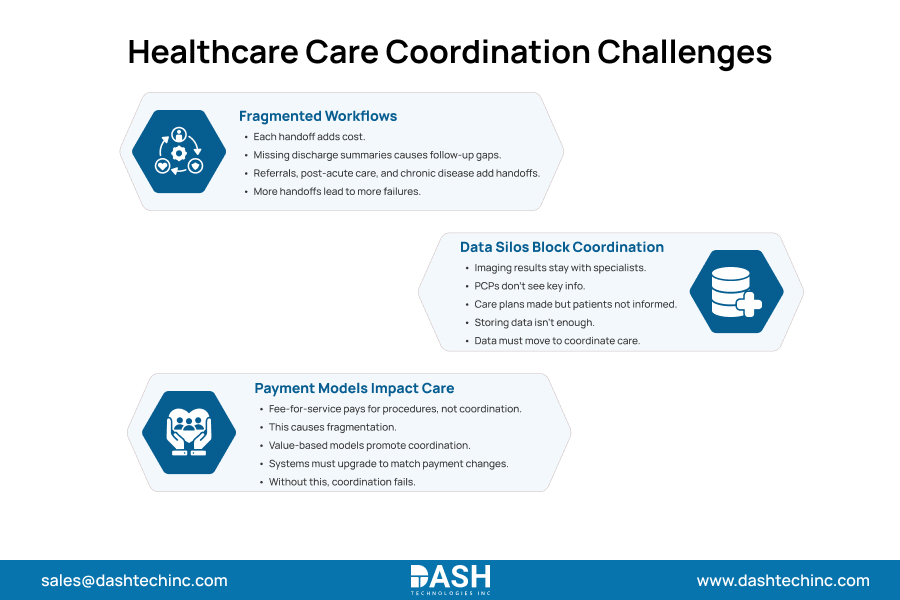
Fragmented healthcare workflows generate cost at every transition point. No discharge summary reaching the PCP means a follow-up gap opens on day one. Healthcare coordination challenges increase at each specialty boundary. These include referrals. They also cover post-acute care and chronic disease management. Each adds another handoff. Each handoff is another failure point.
Healthcare care coordination also fails when data exists but stays put; the Imaging results stay in the specialist system. The PCP sees nothing. Care plan written; patient is never notified. Storage without routing is not coordination. The platform must move the data, not just hold it.
Fee-for-service models do not pay for coordination. They pay for procedures. That built the fragmentation. Value-based models change the payment logic, but the operational infrastructure must catch up first. Without it, the intent to coordinate produces no actual coordination.
Ready to Modernize Care Coordination?
Leverage interoperable digital health platforms to enhance collaboration, improve operational efficiency, and enable value-based care delivery.
Schedule a ConsultationWhat Modern Digital Health Platforms Enable?
Digital health platforms replace manual handoffs with automated routing. Connected healthcare systems move the right information to the right provider at each care step without anyone chasing it. What that requires:
- Shared patient records: The full care team sees the same record in real time
- Automated transition alerts: Fire up when a patient moves between care settings
- Workflow queues: Tasks route to the right role without manual assignment
- Healthcare workflow integration: EHR, specialist systems, and post-acute facilities in a single data flow
On a shared platform, coordination is a system function. Not a task someone has to initiate.
The shift from manual coordination to platform coordination is structural, not incremental. A platform that routes automatically handle exceptions. A manual process handles the average case and misses the edge cases. That difference shows readmission rates and the administrative cost buried in chasing records that should have arrived automatically. When the system handles routine coordination, care managers focus on clinical exceptions. That shift is measurable.
Core Features of Care Coordination Platforms
Care management platforms include capabilities that standalone tools skip:
- Patient engagement tools: These tools send care plans. They also send medication reminders and follow-up surveys directly to patients.
- Two-way data flow: Patient responses go back to the clinical record. They don’t end up in a portal that no one checks.
- Care team messaging: Tied to the patient record, not a separate application
- Population dashboards: Overdue follow-ups, risk score deterioration, and care gaps in one view
Patient engagement systems outside the clinical workflow generate data no one sees. Survey in a portal no one checks. App data with no EHR connection. It is just reporting and not the actual coordination that you need.
Care management platforms built into the EHR give the care team one system instead of two. Engagement data feeds back into the clinical record. Follow-up tasks route to the provider’s queue. That integration is not a feature. It determines whether engagement data becomes a clinical action or accumulates in a portal nobody opens.
How Interoperability Improves Coordinated Care?
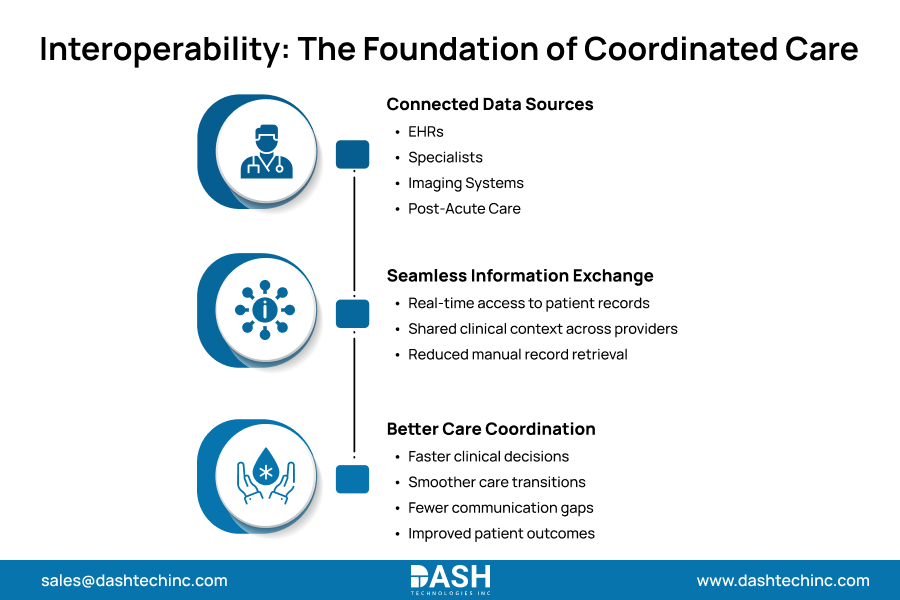
Healthcare interoperability is the difference between care coordination that works and care coordination that is planned. Integrated patient data across EHR, specialist, and post-acute systems gives every provider the full picture. No gaps and no phone calls for records that should already be there.
A PCP managing a post-surgical patient needs surgical notes, anesthesia record, and post-acute updates in one place. Without that data connection, coordination is fax requests and days of lag. FHIR-based standards make the exchange possible. Most health systems are still mid-implementation. The gap between standard and execution is where care coordination programs actually live.
The gap is sharpest at specialty boundaries. Imaging data, pathology results, and specialist notes stay in separate systems long after the exchange standards exist to move them. Our radiology workflow solutions close one of those gaps, connecting imaging data to the referring provider’s workflow without manual retrieval.
Operational and Clinical Benefits of Care Coordination
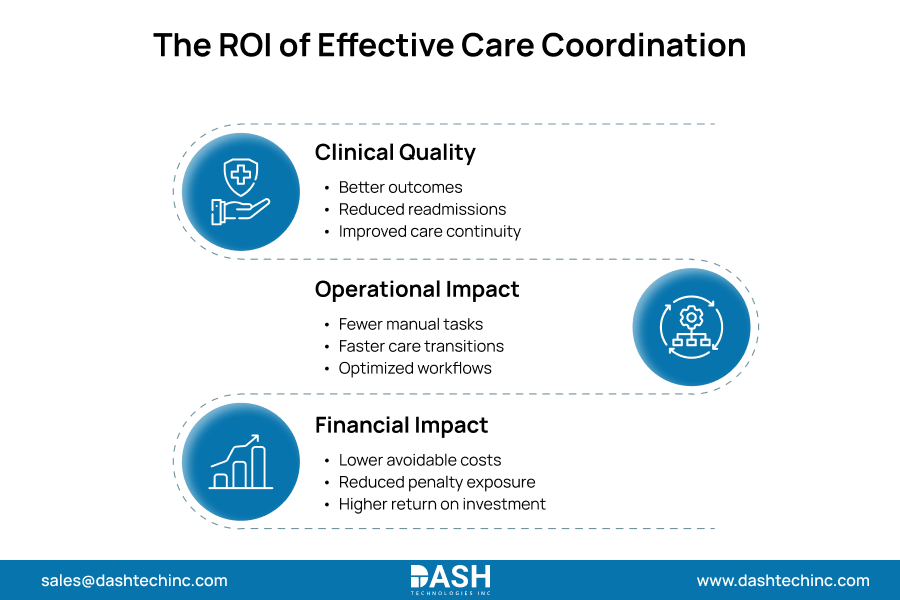
Care coordination programs document three consistent returns. Patient outcomes improvement comes first: lower readmission rates, better medication adherence, and stronger chronic disease control. Healthcare workflow optimization follows administrative burden drops as duplicate procedures and manual routing shrinks. The financial case closes through avoided readmission of penalties, reduced duplicate imaging, and fewer preventable ED visits.
Shared data cuts duplicate effort, and timely follow-up cuts readmissions. Both move in the same direction. The platform investment case is easy to defend when the numbers run on both sides of the ledger.
The administrative savings stack alongside the clinical outcomes. A care team spending fewer hours chasing records and routing follow-up tasks manually redirects that time to patient contact. The platform pays for itself before the quality metrics are even tallied.
Programs with active follow-up protocols and shared care team dashboards show measurable reductions in 30-day readmissions. The Hospital Readmissions Reduction Program gives acute care organizations a hard penalty structure to optimize against. Care coordination is not a quality initiative. It is a financial protection strategy.
Future of Connected Care Delivery
Telehealth, remote monitoring, and digital patient engagement now define what virtual care ecosystems mean at scale. AI-enabled care coordination takes the next step: identifying risk before the patient’s health deteriorates, not after the ED visit generates a claim.
Organizations building this infrastructure now are positioned ahead of where value-based payer contracts are heading. The case has already been made. Execution is what separates organizations capturing that value from those still in planning.
Risk stratification done manually takes hours per patient. Run algorithmically against the full census; it runs continuously. The organization that identifies deteriorating patients before the ED visit operates on a different model. That gap compounds over time and across every contract that penalizes avoidable utilization.
Conclusion
Platform infrastructure moves data. Clinical workflows act on it. Neither works without the other. Data with no action protocol is a dashboard. An action protocol with no data to trigger it is a phone tree. The two have to run together from day one.
Care coordination runs on connected infrastructure. Platforms that share data, automate transitions, and close follow-up gaps deliver what siloed tools cannot. Patient engagement systems that feed back into clinical workflows close to the loop. Our provider platform team builds care coordination infrastructure, patient engagement systems, and interoperability layers for health systems and digital health organizations.
Ready to build connected care delivery infrastructure? Dashtech’s engineering team starts with the platform architecture.
Frequently Asked Questions
About Dash

Dash Technologies Inc.
We’re technology experts with a passion for bringing concepts to life. By leveraging a unique, consultative process and an agile development approach, we translate business challenges into technology solutions Get in touch.