AI in Digital Health: From Personalization to Predictive Care
AI in digital health is not a future state. The health systems pulling ahead flipped the switch years ago. Clinical infrastructure learns from outcomes in real time, and the organizations still treating adoption as optional are watching the gap compound every quarter.
The Evolution of AI in Digital Health
- Rule-Based Systems
Rule-based systems applied coded clinical logic: if this lab value, trigger this alert. Useful in narrow bounds. They codified what clinicians already knew. - Machine Learning
Machine learning made risk stratification and diagnostic accuracy deployable at an enterprise scale. It sets a baseline for what the field could do. Not the ceiling. - Generative AI
Generative AI reads the complete clinical record and surfaces structured summaries when a clinician needs context; no separate retrieval step required. What previously required navigating multiple documentation systems now resolves in a single pass. - Predictive AI
Static care plans work until the patient’s condition changes. New labs arrive. A device reading shift. Predictive AI incorporates the update and revises the care plan without waiting for the next scheduled visit.
Key Clinical AI Applications
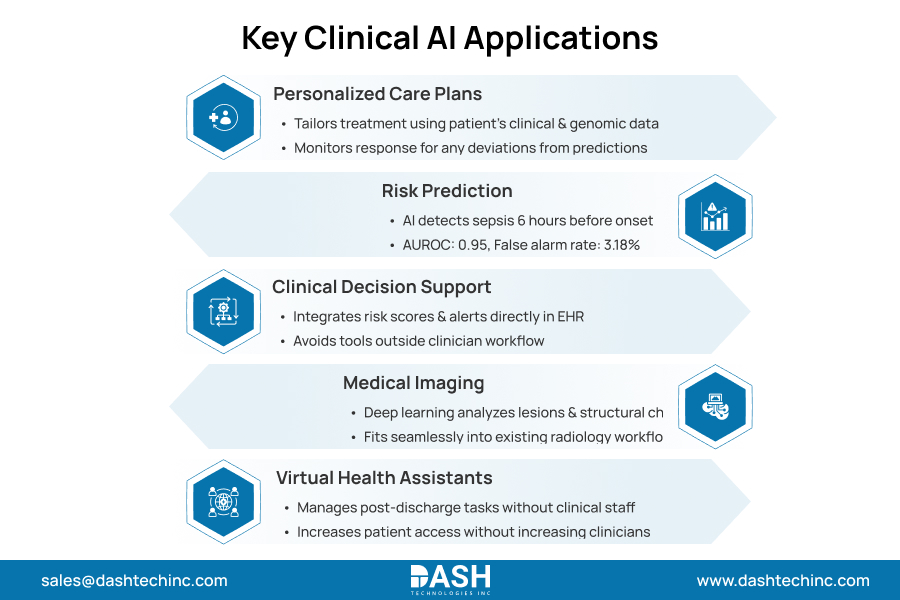
- Personalized Care Plans
Every population protocol finds the optimal treatment for the average patient. The specific patient in front of you is not always average. Personalized healthcare AI builds the plan from that patient’s own clinical and genomic profile, then watches treatment response patterns that diverge from what the model predicted. - Risk Prediction
The evidence is direct. A 2024 SepsisAI study in PLOS Digital Health found a deployed AI sepsis model hit an AUROC of 0.95, with warnings issued a median of six hours before onset and a false-alarm rate of 3.18%. Six hours before onset changes what is clinically possible. - Clinical Decision Support
The tools clinicians use are the ones inside their workflow. Clinical AI surfaces risk scores and flags interactions from within the EHR. Any tool requiring a separate tab gets ignored. - Medical Imaging
Deep learning reads lesions and structural changes with accuracy that holds across hundreds of scans per shift. Our radiology workflow solutions build those AI imaging capabilities into the infrastructure radiologists already work in. - Virtual Health Assistants
The tasks that eat most of a clinical team’s post-discharge schedule don’t require clinical expertise. Virtual health assistants handle those touchpoints entirely. What grows is patient access, not the number of clinicians required.
How AI Improves Patient Outcomes?
- Earlier Intervention
Standard clinical workflows check patient status at the scheduled visit. What happens between visits is where slow deterioration takes hold. Predictive monitoring running against device and lab feeds catches it as it develops, not when the next appointment finally arrives. - Better Treatment Matching
Population-average protocols over-treat some patients and under-treat others simultaneously; neither is an outlier, just a product of the averaging. AI-driven care plans built around individual profiles correct that. Personalized healthcare built at this specificity removes the systematic mismatch that population averaging produces. - Continuous Monitoring
A scheduled visit is a snapshot. Slow deterioration happens between appointments, which is exactly where periodic assessment breaks down. Continuous AI monitoring device feeds catches it before the next visit is scheduled. - Population Health Insights
Predictive healthcare analytics identify which cohorts carry the highest preventable risk. Targeted interventions reduce the total cost of care and convert directly into financial performance under value-based contracts.
Building an AI-Powered Digital Health Product?
From AI model integration and clinical workflow design to interoperability, compliance, and deployment, our experts help digital health innovators bring intelligent healthcare solutions to market faster.
Connect With Our AI ExpertsThe Data Infrastructure Clinical AI Demands
The promise of artificial intelligence in healthcare depends entirely on the data infrastructure beneath it. Most organizations underestimate how much the infrastructure work costs before viable model deployment.
- EHR Data
EHR data is the core training input for clinical AI, but it is not a uniform source. Structured labs and vitals require different pipelines than unstructured clinical notes, and a model trained on one institution’s records rarely generalizes to another without retraining. - Imaging Data
Computer vision models for radiology and pathology run on large annotated imaging datasets with specialized annotation requirements. Any diagnostic AI tool targeting clinical use falls under the FDA’s AI/ML-based SaMD pathway, which means provenance tracking is a data management requirement from the start. - Device Data
Connected monitors generate continuous physiological streams, powering real-time alerting, and deterioration prediction. One ICU patient produces millions of data points daily. Volume and latency are hard infrastructure problems. - Claims Data
Claims data captures what EHR records miss: prior utilization, medication adherence, and social determinants expressed in spending patterns. Population health models that exclude it from an incomplete picture. AI healthcare solutions built without this source rarely generalizes to the full patient population.
AI Implementation Challenges
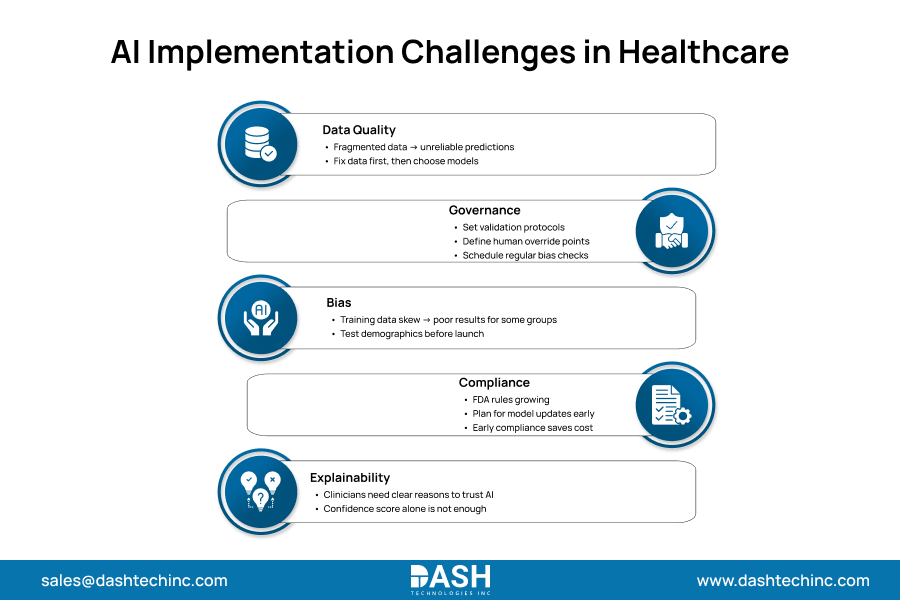
Deploying artificial intelligence in healthcare at scale surfaces the same failure modes repeatedly, because organizations skip the same prerequisites.
- Data Quality
AI tools deployed on fragmented data produce unreliable predictions, and organizations that purchase models before fixing their infrastructure consistently blame the vendor when results disappoint. The failure was in sequencing: data quality before model selection. - Governance
Clinical AI impacting treatment decisions requires documented governance before go-live: validation protocols, defined checkpoints where human judgment supersedes the model, and a scheduled bias-testing cadence. Skip the structure and performance drifts while liability quietly accumulates. - Bias
If the training dataset skews toward certain patient populations, the model learns that skew. Performance on underrepresented groups quietly drops while aggregate accuracy looks fine. Catching this requires demographic subgroup testing before the system goes live, not after a clinical failure makes it visible. - Compliance
The FDA’s regulatory scope over clinical AI tools is expanding. Predetermined change control plans now apply to models that update post-market. Compliance architecture built upfront costs less than remediation afterward. - Explainability
Ask a clinician to change a care decision based on a confidence score with no rationale behind it, and see what happens. Whether a model gets used depends on whether clinicians trust what it tells them. An accurate model that cannot show its work fails at adoption regardless of what its validation metrics say.
How to Build Clinical AI That Lasts?
- AI Governance Framework
Governance comes before deployment. Scheduled validation rounds and demographic bias testing are what sustain AI performance across a multi-year lifecycle. Health systems that build this structure correctly see performance improve over time. - Human-in-the-Loop
AI generates recommendations. Clinicians make decisions. Systems that make this distinction visible build faster adoption and carry less liability risk than those that obscure it. - Data Integration Strategy
Before model training starts, every source needs to feed one validated pipeline. Fragmented inputs produce fragmented predictions, and no architectural sophistication at the training layer fixes what breaks the data layer. - Responsible AI
Year one of clinical AI deployment looks nothing like year three. Getting from one to the other without performance degradation requires governance built before launch, not after problems surface. Dashtech’s provider-focused AI and digital health services build this structure in day one.
Future Trends of Clinical AI Deployment
- Agentic AI
Agentic AI acts rather than recommend. Order entry and triage routing are where it is already deployed clinically. Governance requirements grow with each level of autonomy added. - Multimodal AI
A radiology model only knows the images. A text model only knows the notes. Multimodal models process both at once. That is why their diagnostic ceiling sits above anything a single-source tool can reach. - Predictive Healthcare Ecosystems
Predictive healthcare analytics compounds in value when AI models across care settings share a common data layer rather than working independently. The difference between isolated point solutions and a connected clinical intelligence system lies in the architecture decision being made at deployment. - AI-Powered Care Coordination
A discharged patient who doesn’t get the right follow-up is where expensive complications start. AI-powered care coordination monitors those transition points and routes of alerts before deterioration of compounds. AI in digital health is what makes continuous, population-scale coordination viable to operate.
Accelerate Healthcare Innovation with AI Solutions
Health systems running AI-enabled operations already hold a compounding performance advantage over those that don’t. AI in digital health is no longer an initiative; it is the infrastructure gap that determines competitive position.
DASH engineers AI healthcare solutions across predictive analytics, care coordination, and decision support infrastructure for healthcare providers. Contact us to build the AI capability your organization requires.
Frequently Asked Questions
About Dash

Dash Technologies Inc.
We’re technology experts with a passion for bringing concepts to life. By leveraging a unique, consultative process and an agile development approach, we translate business challenges into technology solutions Get in touch.