IoMT in Healthcare: How Connected Devices Are Rewriting Clinical Infrastructure
IoMT in healthcare is not a trend that health systems get to evaluate at their leisure. Every quarter spent running on scheduled vitals checks and reactive protocols, health systems deploying continuous device monitoring widen a clinical and operational gap that compounds. The Internet of Medical Things is infrastructure, the kind that determines whether a care team catches deterioration at hour two or hour twelve. That distinction has outcomes attached to it and costs.
What Is IoMT?
Pick any connected healthcare device in a clinical setting. A wearable, implantable, a bedside sensor, an infusion pump. Each one sits inside the Internet of Medical Things. They all do the same basic thing, which is to capture patient data and transmit it somewhere. The category is easy to describe. Building the infrastructure to actually use it is not.
At clinical volume, cloud infrastructure is a different problem than general enterprise IT. The data density alone is something most off-the-shelf configurations weren’t built for.
Remove any layer, and the whole chain breaks. Without the cloud, the data goes nowhere. Miss EHR integration, and it gets ignored even when it arrives. Analytics and EHR integration are where most deployments fail, not at the hardware. The data just never makes it to the clinician.
How IoMT Is Reshaping Healthcare?
Most health systems still run on this model: scheduled vitals, assessments triggered by visible symptoms, deterioration caught after it is already a crisis. Not a staffing problem. An architecture problem.
Continuous monitoring changes the timeline. Wearable ECG monitors and bedside sensors catch physiological shifts hours before a patient looks sick. A prospective cohort study published on NCBI found that home telemonitoring cut average hospitalization rates from 0.45 to 0.19 in the three months after high-risk patient discharge, a 58% drop. That is not a marginal improvement. Readmissions stop being expected and start being preventable.
Predictive models run on the same stream. Machine learning trained on continuous physiological data learns the signatures of what comes before sepsis, cardiac events, and respiratory failure. Well before any of it registers clinically, care teams get hours of lead time to intervene. That is preventing infrastructure, not monitoring infrastructure.
The operational gains run in parallel. Connected healthcare devices feed EHRs directly, cutting out the manual documentation step that eats nursing time. Vitals, readings, equipment status: clinical workflow automation keeps all of it current. And when location data runs live, the shift-long hunt for a misplaced infusion pump stops happening.
Ready to Scale Your IoMT Strategy?
From device connectivity and interoperability to data management and compliance, we help healthcare organizations build IoMT platforms that deliver measurable impact.
Schedule a ConsultationCore IoMT Components
Five layers have to work together in any Healthcare IoT deployment. Pull one out, and the others stall.
- The device layer is the starting point. It handles vital signs, cardiac rhythms, glucose levels, and infusion status. Raw data, nothing more, until the next layer picks it up.
- Without solid connectivity (cellular, Wi-Fi, Bluetooth, LPWAN), nothing moves. A dropped signal here doesn’t just lose one reading. It breaks the whole downstream chain.
- Cloud infrastructure is where early IoMT builds often miscalculate. What handles general enterprise traffic won’t hold up under the data density a clinical environment generates.
- The analytics layer is the difference between warehousing data and using it. Without it, even a well-instrumented patient generates readings that pile up and go nowhere. With it, those same readings become deterioration alerts, early-warning signals, sepsis flags.
- EHR integration, built on FHIR standards, is the last mile. Device intelligence must be integrated into clinical workflows. It shouldn’t be in a separate dashboard that clinicians overlook. Most failed deployments broke here, not at the hardware.
Dashtech’s EHR integration services and device engineering connect device networks to clinical infrastructure directly, closing the gap that keeps device data locked in silos.
Top IoMT Use Cases
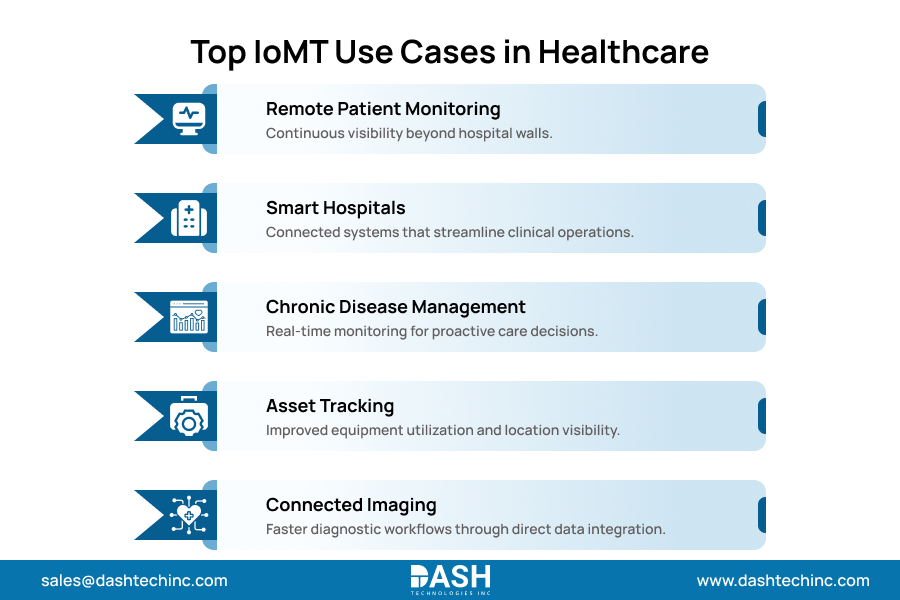
Where does IoMT actually move the needle? The gains cluster in five areas:
-
Remote Patient Monitoring
Post-discharge is where readmission risk is highest and clinical visibility drops to zero. Wearables and home sensors keep that patient in view. When something starts trending the wrong way, the care team knows before the patient ends back in the ED, and the response is still low in acuity. Drop the coverage, and you will find out about decompensation when the ambulance arrives.
-
Smart Hospitals
Clinical nursing shifts lose significant operational bandwidth to non-clinical administration: physically locating mobile hardware and manually executing supply chain documentation. Integrating connected infusion pumps, automated dispensing units, ambient OR sensors, and real-time telemetry platforms directly eliminates this specific logistical overhead. Abstracting these physical workflows into automated infrastructure immediately restores that capacity to direct patient delivery.
-
Chronic Disease Management
Managing diabetes, hypertension, or heart failure on four check-ins a year means working with four data points. That’s the math of quarterly appointments. Connected glucometers, blood pressure cuffs, and cardiac monitors change the denominator entirely. By the time a patient walks into the clinic, the care team has been watching the trend for weeks and can meet it, not chase it.
-
Asset Tracking
The pre-procedure equipment search is treated as normal in most hospitals. It isn’t. It’s a recoverable loss of clinical time that compounds across every shift. RTLS-enabled devices eliminate it. When location data is live, infusion pumps and monitoring equipment are where the system says they are. Utilization goes up, losses go down, and procedures start on schedule.
-
Connected Imaging
In high-throughput departments, the time between a bedside imaging result and an EHR entry routinely stretches to hours. That lag is a decision delay. Point-of-care diagnostics, portable ultrasound, bedside reads: direct integration sends results straight to the chart. No transcription step, no wait, no error introduced by manual entry.
Benefits of IoMT
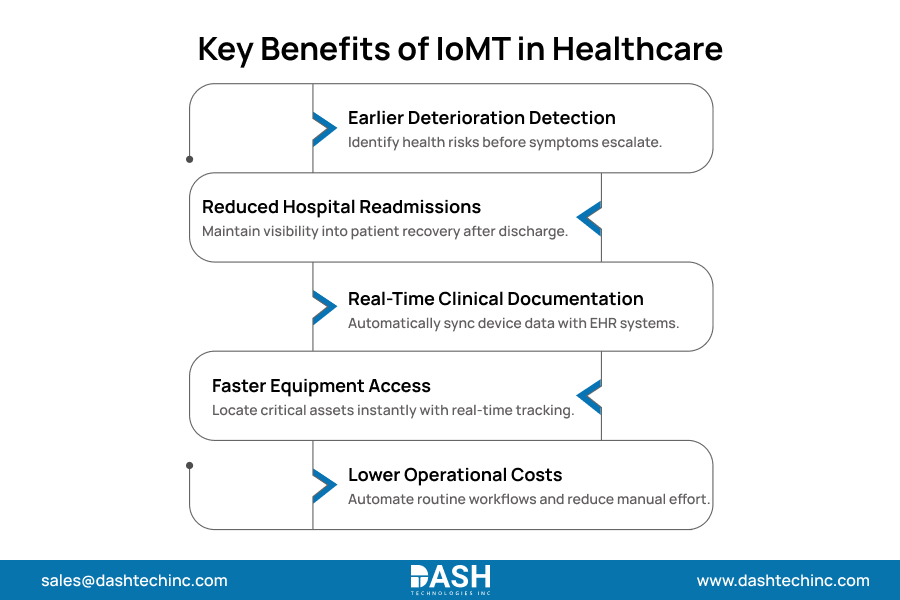
- Earlier deterioration detection: Continuous monitoring catches physiological shifts hours before clinical presentation. Care teams get lead time to act, not react.
- Reduced readmissions: Remote Patient Monitoring keeps post-discharge patients in view. When something goes wrong, the care team knows before the patient lands back in the ED.
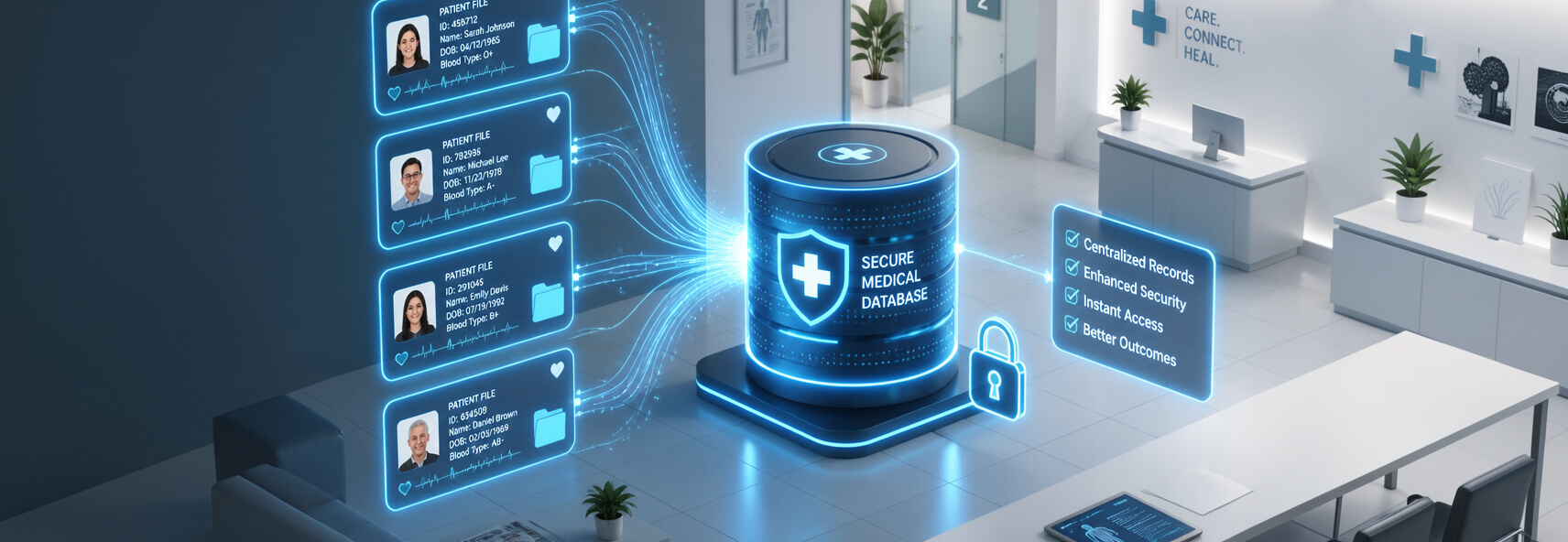
- Eliminated documentation lag: Connected Healthcare Devices feed EHRs directly. No manual entry, no transcription step, no hours-long gap between a reading and a record.
- Faster equipment access: Real-time asset tracking ends the pre-procedure search for misplaced infusion pumps and monitors. Procedures start on schedule.
- Lower operational cost: Clinical Workflow Automation handles vitals, readings, and equipment status without staff intervention. Those hours go back into direct care.
What Makes Deployment Hard?
Three issues trip up most deployments:
- In 2023, 732 organizations reported large breaches to HHS, and 113 million patient records were exposed. That’s the security reality for connected device networks. Every new endpoint is an entry point. Device authentication, encrypted transmission, network segmentation, and ongoing vulnerability monitoring: none of it is optional. HIPAA applies to the device layer just as it does at the EHR.
- Interoperability looks manageable in a vendor demo and falls apart in production. Dozens of manufacturers, mismatched protocols, incompatible data formats: a real Healthcare IoT deployment has all of them running at once. FHIR and HL7 exist to resolve this, but they require architectural discipline. Rushed integrations just produce silos with extra steps.
- Nobody budgets enough time for data governance. Streams from 200 live cardiac monitors are a categorically different problem than a quarterly EHR export: different provenance requirements, different retention rules, different access controls. These decisions can’t be made after go-live.
The Future of IoMT
Specific capabilities are actively shifting from research environments to live production deployments. Edge analytics directly reduces latency by executing data processing natively on the hardware, entirely bypassing centralized cloud routing. Digital twins supply clinical teams with a simulation layer mapped directly over continuous patient telemetry data. Ambient intelligence, which learns normal patterns in a care environment and adjusts alert thresholds, accordingly, is already reducing alarm fatigue without sacrificing detection accuracy.
Health systems building IoMT infrastructure now get these capabilities as they mature. The ones waiting will inherit years of catch-up work.
Connect Your Healthcare Ecosystem
IoMT in healthcare converts clinical environments from reactive to proactive. Clinical workflow automation, continuous device monitoring, and predictive analytics together drive the outcomes and cost performance that matter to health system leaders.
We engineer IoMT solutions that link connected healthcare devices to clinical workflows, EHR platforms, and analytics infrastructure at enterprise scale. Contact us to build the connected care infrastructure your health system requires.
Frequently Asked Questions
About Dash

Dash Technologies Inc.
We’re technology experts with a passion for bringing concepts to life. By leveraging a unique, consultative process and an agile development approach, we translate business challenges into technology solutions Get in touch.