FHIR Implementation in Healthcare: Challenges, Costs, and Best Practices
ONC’s 21st Century Cures Act Final Rule turned FHIR implementation in healthcare into a compliance requirement, and organizations still running clinical data through point-to-point interfaces and aging HL7 v2 feeds aren’t behind the curve; they’re completely out of compliance.
Compliance gets you in the door. Doing it well determines whether FHIR becomes an infrastructure or another IT liability.
What Is FHIR and Why Does It Matter?
Before FHIR, every integration required custom parsing logic. Every single one. HL7 v2 worked but was fragile. Using it meant creating a tangled web of custom connectors that broke up with any change upstream.
FHIR replaced that with an API-first framework built on REST principles, where clinical concepts are discrete, addressable resources with JSON or XML payloads that modern web services understand natively. For health system leaders, this means changing how they view healthcare interoperability. It shifts from seeing it as a vendor issue to seeing it as an engineering challenge. Those are different problems. The engineering one is solvable.
ONC didn’t frame FHIR as optional. Patient access APIs, payer data exchange, provider directories: the compliance posture requires this architecture. Health systems that don’t build for it now will be retrofitting under pressure.
Common FHIR Implementation Use Cases in Health Systems
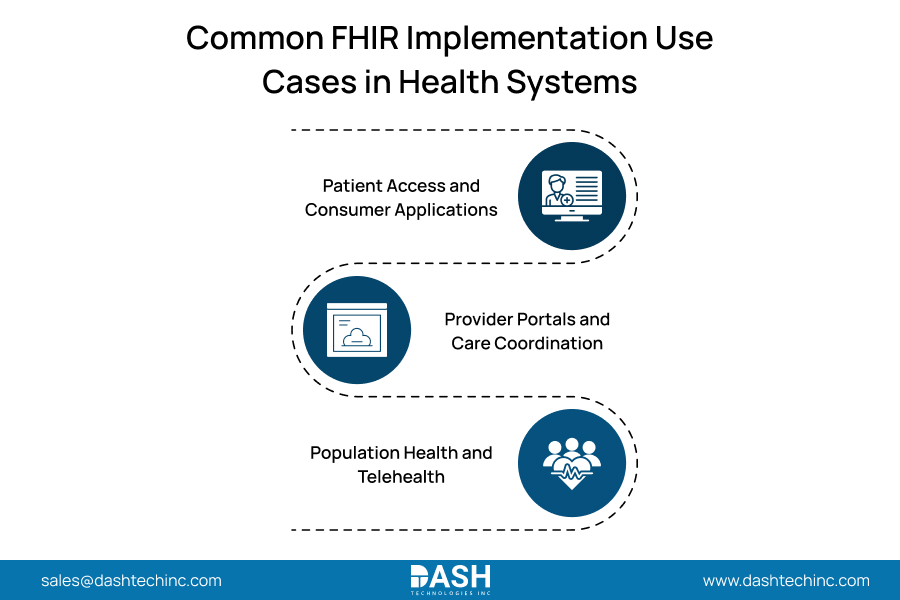
FHIR’s range is wider than most clinical and operational leaders assume.
- Patient Access and Consumer Applications
Under CMS interoperability rules, FHIR APIs power patient portals and apps. They let individuals access their records easily. Third-party developers use SMART on FHIR authorization. They create tools like condition management tools, medication trackers, and care transition apps. No custom EHR integration for each one. - Provider Portals and Care Coordination
Referral workflows, care gap notifications, and cross-facility chart pulls: these should be engineering problems, not vendor-negotiation problems. Health systems still running these on legacy batch interfaces are living with 24-to-48-hour data lags that FHIR integration eliminates. Real-time provider-facing solutions require it. - Population Health and Telehealth
Population health is one of the highest-value FHIR consumers. Platforms pull resources to build chronic disease cohorts, surface care gaps, and trigger targeted outreach. Telehealth runs into the same data access problem from a different angle: clinicians entering virtual visits without a clinical context are working from scratch. FHIR is what fixes that.
FHIR Architecture: The Core Components
At the architectural level, FHIR organizes clinical concepts as resources: Patient, Observation, Condition, Medication, Procedure, and a few hundred others. Standard HTTP handles querying and updating. Your server publishes a capability statement, a formal contract with every application consuming your data.
SMART on FHIR adds OAuth 2.0-based authorization: which apps get which data, at what scope, for which patients. Any health system accepting third-party app connections needs this in place. The FHIR endpoint without it is an open access point.
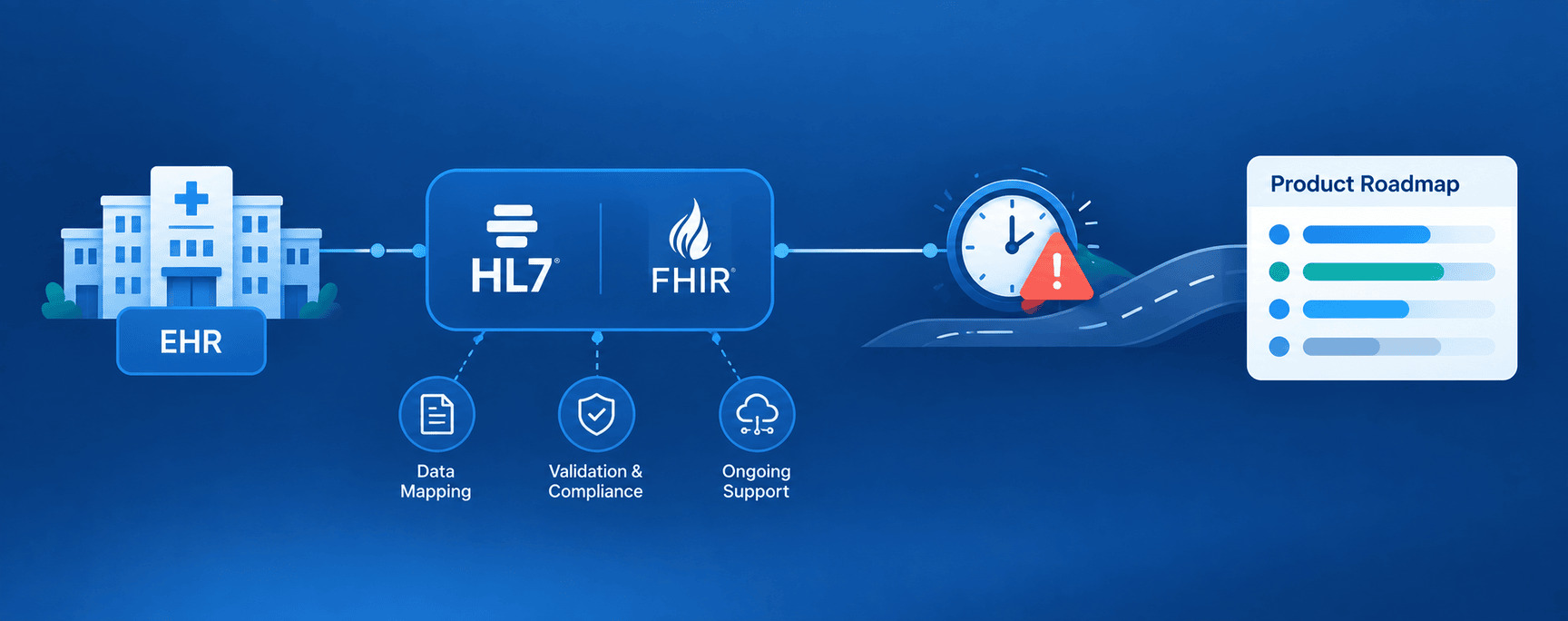
FHIR Implementation Roadmap
Most FHIR deployments fail due to the scope of integration of debt. A strict architectural roadmap prevents both.
- Inventory and Assessment: Start with an honest inventory of what you have. EHR systems, lab platforms, imaging archives, and billing. Map each one against the FHIR resource types it needs to expose or consume. Regulatory requirements set the priority order. Full migrations attempted in a single pass almost always end in scope of failures.
- Resource Mapping: Proprietary source schemas rarely map natively to FHIR resource structures. The transformation layer demands clinical informatics teams capable of defining exact data semantics, pairing directly with backend developers. Bypassing this collaboration strictly generates technically valid FHIR carrying clinically meaningless payloads.
- Testing and Validation: Run the HL7 FHIR validator and do conformance testing against US Core, Da Vinci, or CARIN as the use case requires. Build automated regression tests. When upstream systems change, those tests prevent silent breakage from reaching production.
- Deployment and Monitoring: Production brings surprises that test environments don’t. Rate limiting policies, performance baselines, real-time monitoring of API error rates, and payload validation failures: these belong to the deployment plan, not the post-incident review.
Common Challenges in FHIR Integration
- Vendor Variations: Every major EHR vendor implements FHIR differently. Epic’s resource profiles diverge from Cerner’s, and both diverge from the base HL7 specification in ways that break generic clients. Vendor-specific adapters aren’t a workaround. They’re the architecture.
- Legacy Data Quality: FHIR mandates structure. Decades of inconsistent data entry, deprecated code sets, and missing required fields in legacy systems don’t have it. Data quality remediation belongs to the project plan from day one, not as a follow-on initiative after go-live.
- Security and Governance: HIPAA, state privacy laws, and the ONC information blocking rule create overlapping compliance obligations that a FHIR deployment must satisfy. Every API endpoint is a potential breach of surface. A governance framework defining data access policies, audit logging requirements, and app onboarding standards closes to that exposure.
Cost Factors in FHIR Implementation
One-time costs concentrate on assessment, data mapping, API development, and conformance testing. For a mid-size health system with five or more source systems, this phase typically runs six to twelve months and requires FHIR consulting expertise that most internal IT teams don’t have. Organizations that lack in-house FHIR consulting capabilities consistently underestimate both the scope and the timeline.
| Implementation Type | Typical Cost Range |
| Basic Integration | $15K–$50K |
| Multi-System Project | $50K–$200K |
| Enterprise Initiative | $200K–$500K+ |
Ongoing costs include server hosting and licensing, monitoring tooling, developer support for third-party app onboarding, and continuous compliance validation as implementation guides update. Organizations that treat FHIR as a one-time project discover these costs when the first implementation guide update breaks their production environment. That’s when they realize it’s a platform, not a project.
Best Practices for FHIR API Development
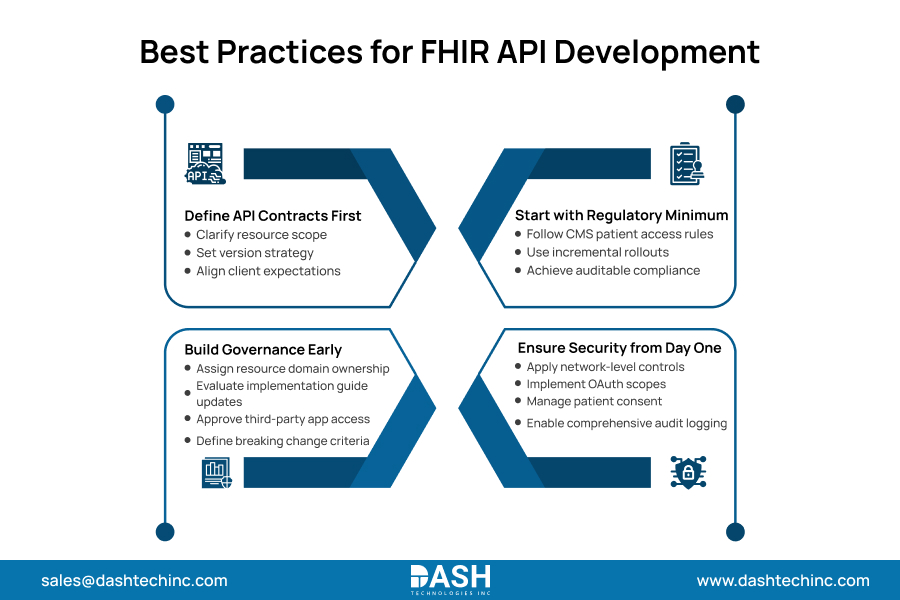
Define API contracts before writing transformation logic. API-first design forces clarity on resource scope, version strategy, and client expectations early. It prevents the accumulation of undocumented endpoint behaviors that become unmaintainable.
Start with the regulatory minimum, specifically the patient access API requirements under CMS rules, and build from there. Incremental rollouts let teams learn FHIR in production before committing to enterprise scope. They also produce auditable compliance milestones.
Build the governance framework in parallel with the first implementation phase, not after the second production incident. Define which teams own which resource domains, how implementation guide updates get evaluated, who approves third-party app access, and what constitutes a breaking change.
Network-level controls, OAuth scopes, patient-level consent management, and comprehensive audit logging belong in scope from the start. Security retrofitted onto a running FHIR platform costs more and leaves gaps.
The Future of FHIR in Healthcare
AI and machine learning pipelines depend on FHIR-structured data as their primary clinical input. The standardization it provides is what makes clinical AI models portable across institutions. Real-time interoperability through FHIR subscription resources is replacing the batch-processing patterns that still dominate clinical data exchange. Networks like the Trusted Exchange Framework and Common Agreement mandate FHIR for nationwide healthcare interoperability.
Organizations building FHIR infrastructure now own the data exchange architecture that every one of these use cases requires. Health systems that treat FHIR implementation as a strategic investment rather than a compliance checkbox build the data foundation that every future capability runs on. We cover the operational realities of executing these initiatives in complex health system environments.
Your interoperability architecture shouldn’t depend on vendor timelines or inherited technical debt. Launch your FHIR interoperability initiative faster with Dashtech.
Frequently Asked Questions
About Dash

Dash Technologies Inc.
We’re technology experts with a passion for bringing concepts to life. By leveraging a unique, consultative process and an agile development approach, we translate business challenges into technology solutions Get in touch.