AI in Drug Development: From Discovery to Clinical Trials
AI in drug development cuts into the timeline at every step where analysis is the bottleneck. Most of those 10 to 15 years are spent on analytical work. Machine learning is built for exactly that.
Target identification is a data problem. Candidate screening is a data problem. Trial design, safety monitoring, and post-market surveillance are data problems. Pharma organizations that have accepted that framing are redesigning operations. The ones that have not are running 2010 processes on 2025 data volumes.
Why AI Is Reshaping Drug Development?
AI in pharma changes the cost structure of research. Not just speed. A Phase III failure costs hundreds of millions per program. Healthcare AI innovation that catches a failing compound before late-stage investment recovers that cost before it is spent. That arithmetic is why the investment is accelerating.
The data gap is not about volume. Biology generates more information than any manual process can handle. The bottleneck is connecting and acting on it. FDA guidance on AI and machine learning in drug development shows where regulators have landed: AI-derived submission frameworks are no longer provisional guidance. They are part of the standard review. Dashtech’s life sciences analytics work starts with the data infrastructure that makes those submissions defensible.
Transform Drug Development with AI
Unlock faster insights, smarter clinical trials, and more efficient research workflows with tailored AI solutions for life sciences.
Talk to Our ExpertsHow AI Accelerates Drug Discovery?
AI drug discovery works at a scale that manual review cannot reach. Protein structures, genomic sequences, binding affinity records, and research literature are all inputs that machine learning models train on. Those models predict compound activity and toxicity without running every candidate through physical screening. The candidate pool that enters development is smaller and better selected.
Pharmaceutical research automation removes the experimental design and literature synthesis work that absorbs the most time per candidate. NIH research on AI in drug discovery has consistently shown that screening timelines, which previously ran for years, compress to weeks when machine learning handles the initial candidate evaluation. The experimental work that follows is more targeted.
The model handles volume. Researchers handle judgments. AI pharmaceutical research programs built on that separation change what enters development and what gets cut before it gets expensive.
Role of AI in Clinical Trial Optimization
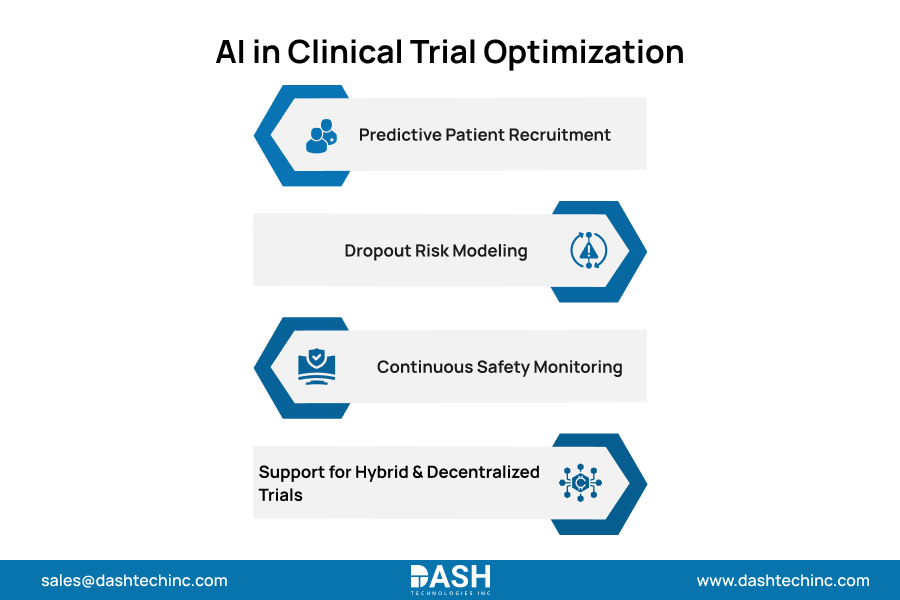
Three cost drivers define AI clinical trials economics. AI addresses all three:
- Enrollment: Predictive patient recruitment runs models against EHR records before the study opens. Finding qualified candidates computationally cuts what previously took 18 months or longer.
- Retention: Dropout risk models flag high-withdrawal patients while there is still time to act, before they exit the study.
- Safety Monitoring: Continuous AI monitoring catches adverse event signals between scheduled reviews, not just at them. Protocol adjustments happen before problems accumulate.
The enrollment impact is immediate. A PLOS Digital Health analysis of ClinicalTrials data shows decentralized and hybrid designs now account for a growing share of registered studies. Those designs run on digital recruitment and remote monitoring. They only work when the patient identification layer already exists before the study opens. Dashtech’s provider and life sciences engineering team builds identification and integration infrastructure for organizations running RWD-based trial programs.
Key Data Challenges in AI-Driven Drug Development
Pharma data integration challenges set the hard ceiling on what AI programs deliver. The specific barriers:
- Source fragmentation: Genomic, EHR, clinical trial, and outcomes data run on different systems with incompatible standards. Getting them into a single analytical environment takes serious engineering work.
- Healthcare AI datasets combining these sources need cleaning, normalization, and validation before any analysis is defensible.
- Data quality and provenance documentation are regulatory prerequisites. Organizations that treat them as follow-on cleanup find out what those costs during submission review.
Black-box models do not survive FDA review. FDA requires organizations to document, validate, and change-control AI algorithms before submission. Interpretability is an architecture decision that needs pre-planning. Organizations that treat governance as something to sort out later find out what it costs when a regulator asks for the model audit trail, and it does not exist.
The data harmonization layer is the part nobody funds until it blocks a submission. Proprietary EHR formats, inconsistent coding conventions across sites, gaps in real-world data coverage for minority populations: these problems do not solve themselves. They require dedicated engineering investment before the AI layer can run.
AI Use Cases Across the Drug Development Lifecycle
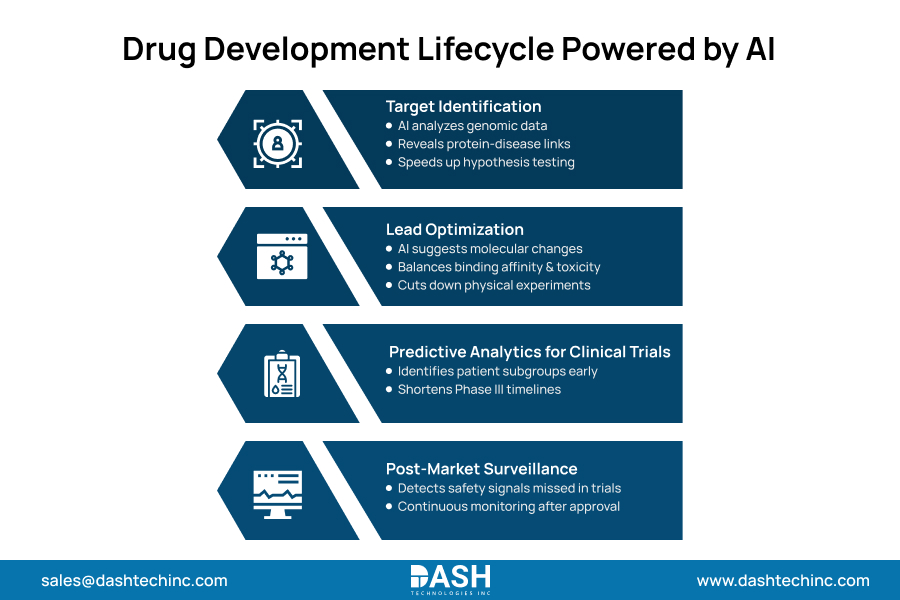
Machine learning in healthcare touches every stage of the drug development lifecycle. Machine learning healthcare models are used for target identification, lead optimization, biomarker discovery, and post-market surveillance. At target identification, models surface protein-disease pathway relationships from genomic data. Work that used to require years of manual hypothesis testing now runs computationally. During lead optimization, AI identifies molecular modifications that simultaneously meet binding affinity and toxicity targets, reducing iteration cycles that previously required thousands of physical experiments.
Predictive pharma analytics narrow the patient’s subgroups where a compound works before Phase III targeting begins. That collapses timelines that otherwise absorb years. Post-market surveillance is where AI catches safety signals that trial populations were too small to surface. Not a secondary function. The one that starts where the trial ends.
Pharma data analytics deployed across the full lifecycle change decision quality at every stage. Better candidates enter development. Fewer fails late. The cost-per-candidate drops across the program.
Regulatory and Ethical Considerations for AI in Pharma
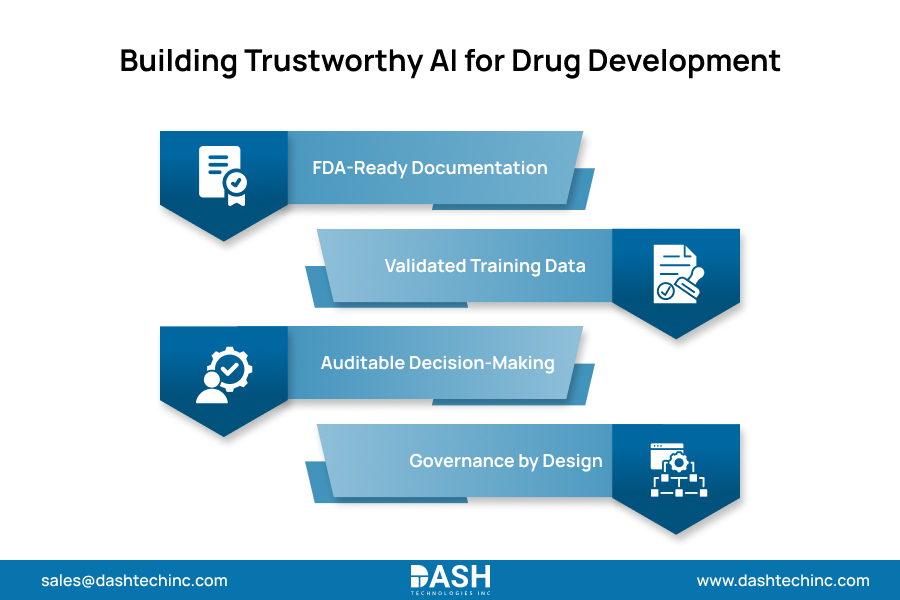
AI healthcare compliance requirements in drug development are not stabilizing but tightening. Algorithm transparency, validation documentation, and change control: FDA covers all three when AI-derived findings go into a submission. Not as guidance but as hard as requirements with audit expectations behind them. Programs that build interpretable, well-documented models early are not over-engineered; they are ready.
Ethical AI healthcare pipelines demand rigorously validated training data. Algorithms trained on exclusionary datasets generate clinical recommendations that succeed for represented demographics while actively harming omitted populations.
Every automated diagnostic decision strictly requires explainable and technically auditable execution. Models failing to satisfy these dual requirements of representative data and completely traceable outputs must face immediate rejection from regulatory submissions. They inherently lack the architectural integrity required for active clinical protocols.
Organizations building AI for regulated research need governance frameworks in place before the first submission, not after. Retrofitting documentation and validation onto a deployed model is costly. It also has less value. It’s much better to build it correctly from the start to avoid these issues.
Future of AI-Powered Pharmaceutical Innovation
Personalized medicine AI defines the next phase of drug development. The programs get their match treatments to patient subgroups at compound selection. Not at post-approval label expansion. The future of AI in pharma and AI in drug development is not about running the same trials faster. It is about selecting better candidates before the trial starts.
Continuous patient monitoring, real-time safety signal detection, and adaptive trial designs are the near-term direction. Organizations building that infrastructure now will not be catching up when those capabilities become standard. They will already run on them.
Conclusion
Timelines shorten rapidly when organizations fully integrate AI in drug development across computational pipelines backed by pristine data. Without strict data quality controls, algorithmic engines simply generate expensive noise rather than actionable, regulatory-grade findings.
Enterprises constructing durable data infrastructure today actively reduce their immediate cost-per-candidate while structurally lowering their late-stage clinical failure rates. Facilities deploying operational algorithms across discovery pipelines and post-market workflows execute higher program volumes with severely reduced financial overhead. Deferring to this architectural mandate exponentially increases the capital and engineering cycles required to remain competitive.
We build that governance framework before the first submission, so organizations are ready when regulators ask, not scrambling after. Contact us today!
Frequently Asked Questions
About Dash

Dash Technologies Inc.
We’re technology experts with a passion for bringing concepts to life. By leveraging a unique, consultative process and an agile development approach, we translate business challenges into technology solutions Get in touch.