How payers are using AI for risk adjustment and cost optimization?
AI for risk adjustment has moved from pilot to production inside payer organizations across the country. Math is not complicated. Inaccurate risk scores mean CMS underpays by thousands per member. On scale, that is not a rounding error. That is a budget shortfall. Payers running AI-driven payer analytics do not wait for audit cycles to surface the problem. They catch it before submission. The ones that do not absorb the cost.
Risk adjustment analytics programs across Medicare Advantage plans share the same structural problem: incomplete clinical documentation produces incomplete scores. Members with the highest actual care costs are frequently the ones least accurately coded. That gap is where AI-driven programs generate their clearest returns, and where manual processes have always fallen shortest.
Why Risk Adjustment Is a Strategic Priority for Payers?
Risk adjustment of healthcare programs determines per-member revenue. CMS calculates payment using Hierarchical Condition Categories assigned from clinical documentation. Accurate chronic condition of documentation drives the score up. Gaps in that documentation drive revenue down. That difference comes directly out of operating margin.
Payer cost management fails when the revenue baseline is wrong. A plan with a 2% coding error rate across a 500,000-member population is not dealing with a rounding error. It is a systematic revenue leak that compounds annually. Risk adjustment is a financial planning input, not a compliance checkbox. Organizations that treat it as the latter absorb the shortfall every year.
Challenges with Traditional Risk Adjustment Models
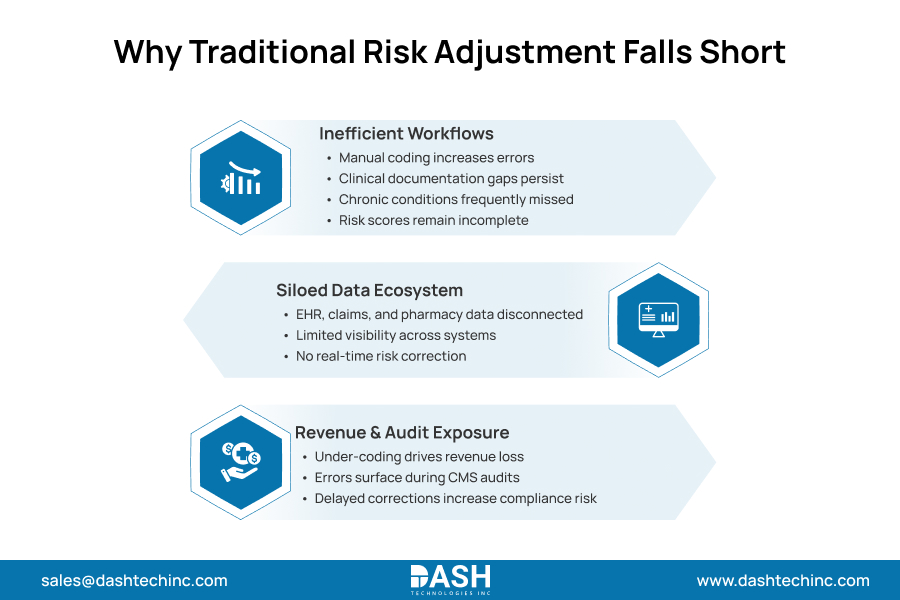
Healthcare risk analytics challenges in traditional models start at the workflow level. Manual coding of healthcare processes follows a predictable failure pattern: coders review clinical notes, assign ICD codes, and submit. Diagnoses documented in narrative form do not match the coded record. Supporting documentation for chronic conditions does not surface during chart review. The member is scored below their actual condition burden. The revenue gap is open.
The retrospective model finds errors after they cost money. Legacy systems do not connect EHR data to claims data to pharmacy data in time for prospective correction. CMS Risk Adjustment Data Validation audits identify under coded members after the submission window has closed and the revenue is gone. That is the structural failure of manual review operating without an integrated data infrastructure behind it.
Smarter Risk Adjustment Starts with AI
Reduce coding gaps, improve RAF score accuracy, and drive cost optimization with scalable AI solutions built for healthcare payers.
Explore AI SolutionsHow AI Improves Risk Adjustment Accuracy?
AI risk adjustment tools process clinical documentation at a scale and speed that manual review cannot approach. Natural language processing reads unstructured notes and flags diagnoses that coders miss. The models rank members by risk score gap:
- Which members carry under-coded chronic conditions
- Which submitted codes lack supporting documentation
- Which diagnoses are missing from the record entirely
Predictive analytics healthcare applications change the correction timeline. They run continuously against the full member population. Members are flagged before coding closes. Corrections happen prospectively, not retrospectively. Payers using these tools do not discover the revenue gap at year-end. They close it before submission, and reimbursement reflects actual member risk.
AI Use Cases in Payer Operations
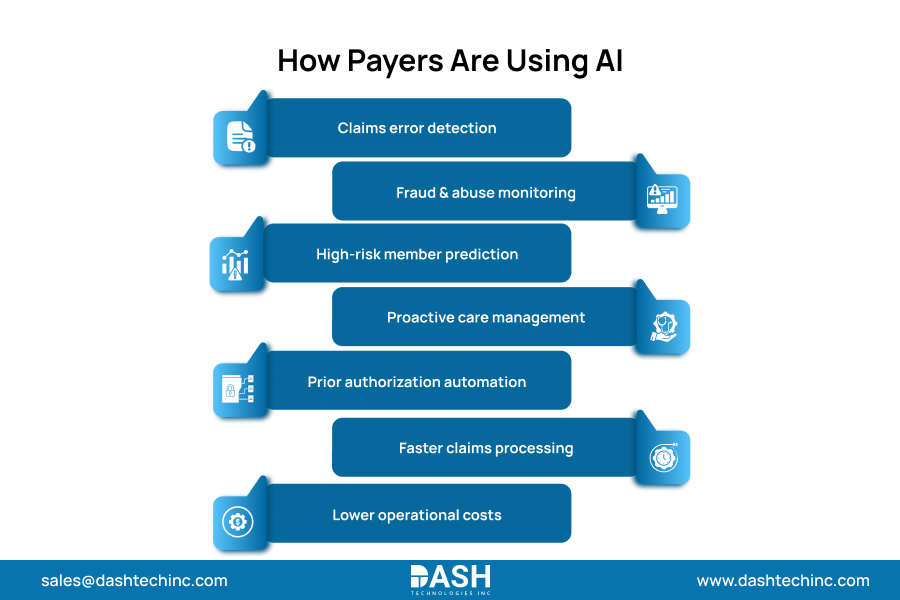
Payer automation extends across the full operations stack. The key workflows AI covers:
- AI in claims analysis: The system flags anomalous billing patterns that manual auditors consistently miss. This includes unbundling, duplicate charges, and up-coded procedures fundamentally detached from the documented care episode.
- Fraud, waste, and abuse detection: NLP models ingest historical claims to detect inconsistent provider billing patterns that random sampling ignores. This permanently increases detection rates and reduces manual review volume.
- Healthcare predictive modeling: These engines identify high-cost members 6 to 12 months before acute episodes generate claims. Care managers use this specific window to intervene prior to hospitalization.
- Prior authorization: NLP models auto-approve standard cases and strictly route exceptions for human review. This structural shift lowers per-care costs and permanently shrinks the operational backlog.
Deploying predictive analytics against high-risk populations redirects care manager capacity to specific members immediately before massive costs accumulate.
Role of Data Integration in Payer Analytics
The models only perform as well as the data behind them. Payer interoperability determines output quality. Claims data captures what was billed & clinical data captures what the member actually experienced. Lab results, ADT feeds, pharmacy records, and social determinants data each add a signal the model needs to produce accurate risk scores and cost projections.
Healthcare data exchange infrastructure that connects EHRs, health information exchanges, and pharmacy benefit managers gives the model a complete member picture. AI in health insurance that runs on claims data alone operates with half the available signal. The model scores what it can see. Payer analytics programs that integrate clinical and claims data produce materially better outputs. That difference shows up in revenue, not just reporting in AI for risk adjustment.
Benefits of AI-Driven Cost Optimization
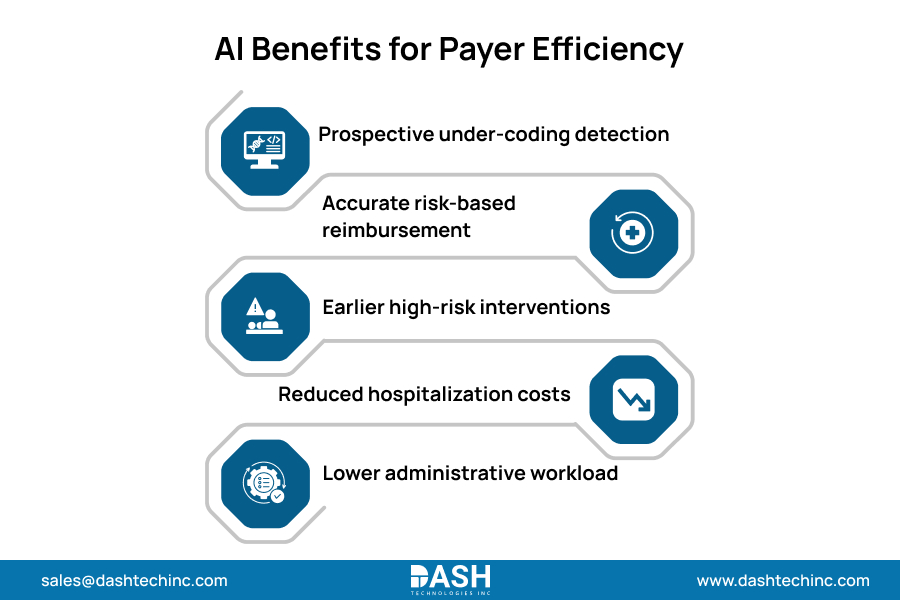
Healthcare cost reduction from accurate risk adjustment is direct. The payoff hits both the revenue side and the operational side:
- Risk adjustment analytics catch under-coded members prospectively. Revenue matches actual member cost before submission closes.
- Accurate risk identification supports earlier care management. Earlier intervention due to AI for Risk Adjustment reduces acute utilization.
- Reduced utilization reduces claims cost. Payer operational efficiency improves as manual review volumes drop.
- Coders handle complex cases; audit teams work with model-flagged outliers, and care managers reach high-risk members before hospitalization rather than after.
Healthcare cost optimization from these programs is measurable on the claims side and the administrative side. A coding team spending fewer hours on retrospective chart review redirects that capacity to proactive member engagement. These are not marginal improvements, but structural changes in how payer operations run.
Conclusion
AI enables scalable, accurate risk adjustments that manual processes cannot deliver at volume. Payers using integrated analytics programs generate better risk scores, lower administrative costs, and more defensible financial forecasting. The gap between organizations running AI-native payer analytics and those still running retrospective chart reviews grows every year. We connect clinical, claims, and pharmacy data into a single analytics layer built for risk adjustment accuracy, healthcare cost optimization, and population health programs.
Integrated data improves every payer decision downstream. If your organization is ready to close the gap, we build the infrastructure that makes it possible.
Frequently Asked Questions
About Dash

Dash Technologies Inc.
We’re technology experts with a passion for bringing concepts to life. By leveraging a unique, consultative process and an agile development approach, we translate business challenges into technology solutions Get in touch.