Healthcare Organizations
Who Benefits from Pediatric EHR Integration?
Healthcare organizations have different orthopedic workflows, operational challenges, and interoperability requirements. Orthopedic integration helps create connected workflows across hospitals, specialty practices, and enterprise healthcare environments.
Children's Hospitals & Health Systems
Connect pediatric departments with enterprise EHR platforms, diagnostic systems, medical devices, specialty applications, and care teams.
Pediatric Practices
Connect EHR, laboratory, diagnostic, immunization, scheduling, referral, and clinical workflows.
Neonatal & Newborn Care Centers
Integrate newborn clinical information, monitoring systems, diagnostic data, and care documentation across neonatal workflows.
Academic Medical Centers
Support pediatric research, specialty care, advanced diagnostics, clinical documentation, and interdisciplinary collaboration.
Multi-Specialty Pediatric Clinics
Connect pediatricians, specialists, diagnostic systems, and care management platforms to improve coordination across complex care journeys.
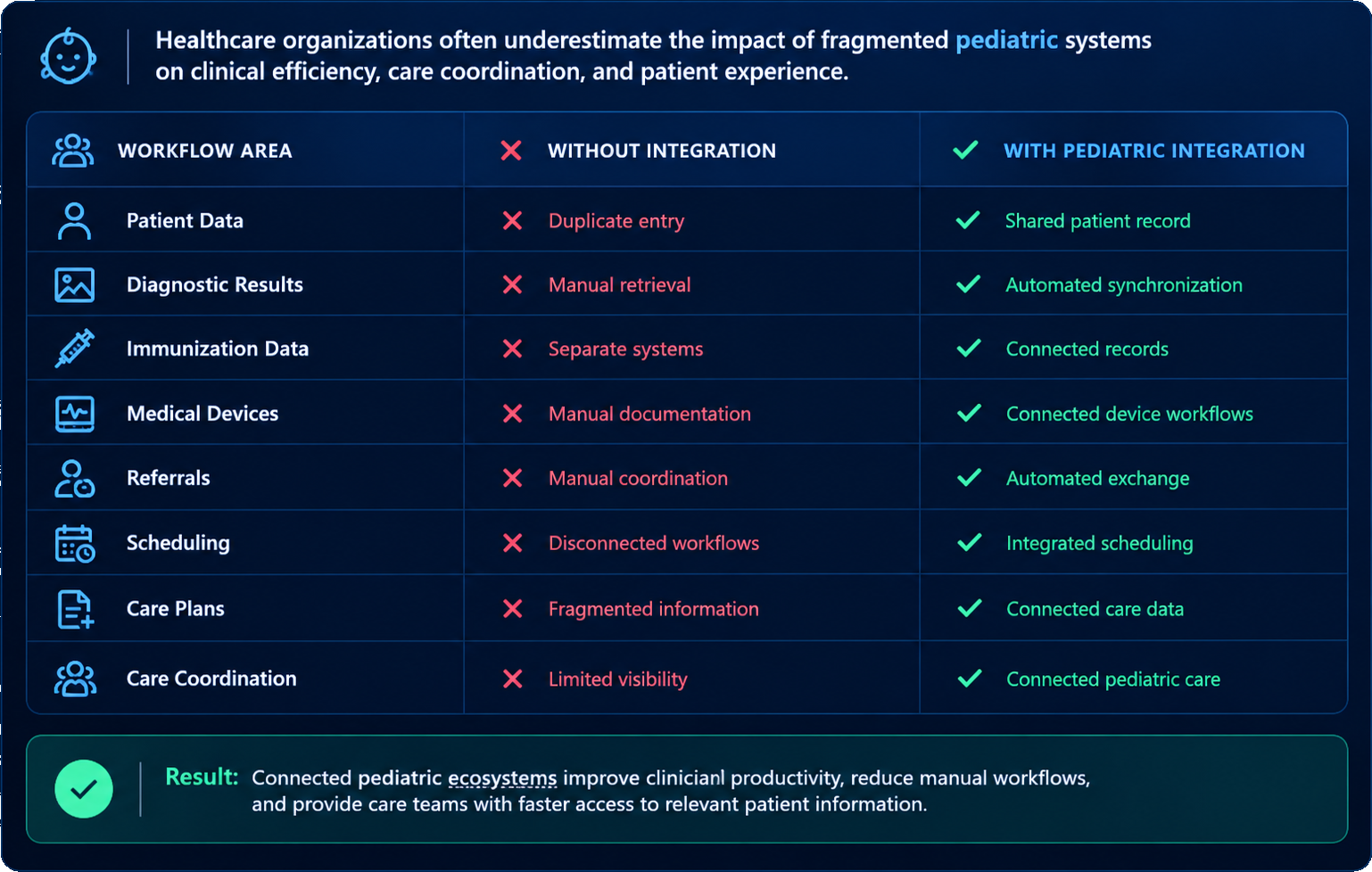
Before vs After
Manual Pediatric Workflows vs Connected Pediatric Care
Pediatric EHR ↔ Laboratory Integration
Pediatric EHR ↔ Laboratory Integration Use Cases
Bring Pediatric Diagnostic Results Directly into Clinical Workflows
Laboratory testing plays an important role in pediatric diagnosis, treatment, and ongoing care. Integrating laboratory systems with pediatric EHR platforms enables healthcare teams to exchange orders, results, and patient information without relying on disconnected workflows.
Pediatric Lab Order Integration
Transfer applicable laboratory orders from pediatric EHR workflows to connected laboratory systems.
Benefits :
Automated Pediatric Lab Result Exchange
Send finalized laboratory results directly into the appropriate pediatric patient record.
Benefits :
Multi-Facility Laboratory Connectivity
Enable authorized pediatric care teams to access relevant laboratory information across connected hospitals, clinics, and care locations.
Benefits :
Pediatric Diagnostic Integration
Connect Pediatric Diagnostic Systems with Clinical Workflows
Immunization Integration
Immunization Integration Use Cases
Connect Immunization Data with Pediatric Clinical Workflows
Immunization information is an important component of pediatric patient records. Connecting immunization systems with EHR and clinical applications helps providers access relevant vaccination information during routine visits and ongoing pediatric care.
Immunization Record Synchronization
Exchange applicable immunization information between pediatric EHR systems and connected immunization platforms.
Vaccination History Integration
Make relevant vaccination history available within pediatric clinical workflows.
Immunization Data Exchange
Connect pediatric practices and healthcare organizations with applicable immunization information systems
Automated Documentation
Reduce manual entry when recording applicable vaccination information within patient records.
Outcomes :
Improved
immunization data accessibility
Reduced
duplicate documentation
Better
clinical visibility
More connected
pediatric workflows
Integration Architecture
Pediatric Diagnostic Integration Use Cases
Connect Diagnostic Systems with Pediatric Clinical Workflows
Pediatric care can involve laboratory, imaging, pathology, cardiology, neurology, and other diagnostic services. Integrating these systems with pediatric EHR platforms helps clinicians access relevant diagnostic information within connected workflows.
Pediatric Imaging Integration
Connect applicable X-ray, ultrasound, MRI, CT, and other diagnostic imaging systems with pediatric EHR workflows.
Diagnostic Result Synchronization
Automatically exchange applicable diagnostic results and reports with patient records.
Pediatric Cardiology Integration
Connect ECG, echocardiography, and other compatible cardiovascular diagnostic systems with pediatric clinical workflows.
Pediatric Neurology Integration
Connect EEG, EMG, neurodiagnostic, and other compatible systems with pediatric care workflows.
Outcomes :
Faster
access to diagnostic information
Reduced
manual workflows
Improved
clinical documentation
Better
care coordination
Pediatric EHR Integration
Newborn & NICU Integration Use Cases
Connect Newborn Monitoring and Clinical Data with EHR Workflows
Newborn and neonatal intensive care workflows involve continuous monitoring, laboratory testing, medication management, clinical documentation, and specialized medical devices. Connecting these systems can help care teams access relevant information within integrated clinical workflows.
Neonatal Monitoring Integration
Connect compatible patient monitoring systems with clinical and EHR workflows.
NICU Device Data Integration
Exchange relevant data from compatible neonatal medical devices with connected clinical applications.
Newborn Diagnostic Integration
Connect laboratory, imaging, and other diagnostic systems with newborn patient records.
Neonatal Clinical Documentation
Synchronize applicable monitoring, diagnostic, and clinical information with the patient's EHR.
Outcomes :
Improved
clinical visibility
Reduced
manual documentation
Faster
access to patient information
Better
neonatal care coordination
Pediatric Medical Device Integration
Connect Pediatric Medical Devices with Enterprise Clinical Systems
Pediatric Medical Device Integration
Pediatric Medical Device Integration Use Cases
Connect Pediatric Medical Devices with Enterprise Clinical Systems
Pediatric healthcare environments use a wide range of monitoring and diagnostic devices that generate patient-specific data. Connecting compatible devices with EHR and clinical applications can reduce manual documentation and support connected care workflows.
Automated Device Data Exchange
Transfer relevant information from compatible pediatric medical devices into connected clinical systems.
Patient & Encounter Matching
Associate device-generated information with the appropriate pediatric patient and clinical encounter.
Pediatric Monitoring Integration
Connect compatible vital sign and physiological monitoring devices with pediatric clinical workflows.
Multi-Vendor Device Connectivity
Support interoperability across compatible pediatric devices from different manufacturers.
Outcomes :
Reduced
manual entry
Improved
data consistency
Faster
clinical workflows
Better
device interoperability
Pediatric Referral & Care Coordination Integration
Pediatric Referral & Care Coordination Integration Use Cases
Connect Pediatric Providers Across the Continuum of Care
Children with complex or specialty care needs often move between pediatricians, specialists, hospitals, diagnostic centers, and other care providers. Connected referral and clinical workflows can improve information exchange across these care settings.
Pediatric Referral Integration
Exchange referral information between pediatric primary care providers and specialists.
Appointment & Scheduling Integration
Synchronize applicable appointment and scheduling information across connected systems.
Clinical Information Exchange
Provide relevant patient information to authorized providers involved in the child's care.
Specialty Care Coordination
Connect pediatric primary care, specialty, diagnostic, and hospital workflows.
Outcomes :
Improved
care coordination
Reduced
referral delays
Better
clinical information access
More connected
pediatric care
Pediatric Revenue Cycle Integration
Pediatric Revenue Cycle Integration Use Cases
Connect Pediatric Operations to Financial Performance
Pediatric healthcare includes examinations, diagnostic testing, procedures, vaccinations, specialty services, and other billable activities. Disconnected systems can create inconsistencies between clinical activity, coding, charge capture, and reimbursement workflows.
Automated Charge Capture
Capture applicable charges from completed pediatric examinations, procedures, diagnostic services, and other billable activities.
Pediatric Coding Workflow Integration
Synchronize pediatric clinical documentation and service information with coding and billing systems.
Authorization Workflow Integration
Connect applicable authorization information with pediatric scheduling and treatment workflows.
Revenue Analytics
Combine clinical, operational, and financial information to improve visibility into pediatric healthcare operations.
Outcomes :
Increased
revenue capture
Reduced
billing errors
Improved
coding accuracy
Faster
reimbursement cycles
Enterprise Platforms
Enterprise Pediatric Integration Across Leading Healthcare Platforms
Epic Pediatric Integration Use Cases
Oracle Health Integration Use Cases
MEDITECH Integration Use Cases
eClinicalWorks Integration Use Cases
Other Pediatric Healthcare Platforms
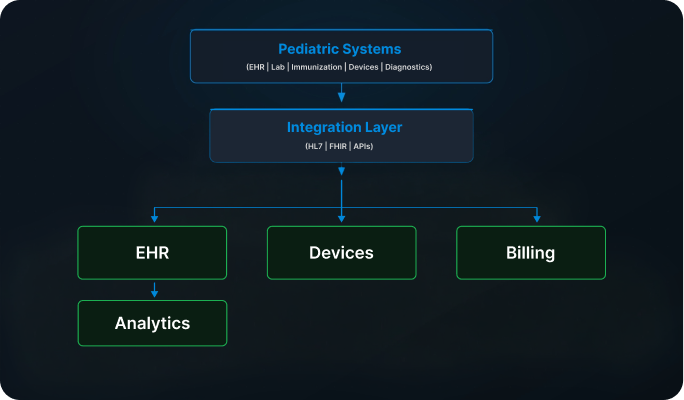
Pediatric Integration Architecture
Typical Pediatric Integration Architecture
How Connected Pediatric Healthcare Ecosystems Operate
Why DASH
Why Healthcare Organizations Choose Dash Technologies
Pediatric interoperability projects require expertise across pediatric workflows, clinical systems, medical devices, healthcare standards, enterprise architecture, and compliance requirements.
Our Expertise Enables:
Engagement Models
Integration Assessment
Not Sure Where Your Pediatric Workflow Bottlenecks Exist?
Many healthcare organizations know interoperability challenges are limiting pediatric care efficiency but struggle to identify where integration will deliver the greatest impact.
Our pediatric integration specialists evaluate your current environment and provide actionable recommendations for improving connectivity across EHR, diagnostic, immunization, medical device, referral, and clinical systems.
Included in the Assessment
Workflow Review
Integration Gap Analysis
Vendor Ecosystem Evaluation
Interoperability Assessment
Modernization Recommendations
Frequently Asked Questions
Healthcare organizations should use reliable patient identifiers, validate patient and encounter details, and apply matching rules before transferring data between systems. This is especially important when integrating newborn records, multiple facilities, and medical devices. Validation checks and exception handling can help identify mismatches before they affect clinical workflows.
Start by identifying the clinical workflows that need improvement, the systems involved, and the data that must be exchanged. Then review available interfaces, vendor requirements, data standards, security controls, and testing needs. A workflow and integration assessment can help prioritize the most important connections and reduce implementation risks.
Pediatric EHR integration can connect different vendors’ systems through supported HL7 interfaces, FHIR APIs, or other available integration methods. Integration engines or middleware can help transform data into compatible formats. For older systems without modern APIs, existing interfaces or custom connectors may be needed, depending on the vendor’s capabilities.
Organizations should apply role-based access controls, encryption, audit logging, and secure data transmission. They should also verify patient and user permissions, minimize unnecessary data sharing, and follow applicable privacy and security requirements, including HIPAA where relevant. Testing these controls before deployment helps protect sensitive pediatric information.
Test patient matching, data accuracy, order and result exchange, duplicate records, error handling, and recovery from connection failures. Include newborn and other relevant pediatric workflows in test scenarios. Clinical teams should validate that information reaches the correct patient record and appears as expected before the integration is released into production.
