Healthcare Organizations
Who Benefits from Orthopedic EHR Integration?
Healthcare organizations have different orthopedic workflows, operational challenges, and interoperability requirements. Orthopedic integration helps create connected workflows across hospitals, specialty practices, and enterprise healthcare environments.
Hospitals & Health Systems
Connect orthopedic departments with enterprise EHR platforms, imaging systems, surgical applications, rehabilitation platforms, and specialty care teams.
Orthopedic Practices
Connect EHR, imaging, scheduling, referral, clinical documentation, and orthopedic practice management workflows.
Orthopedic & Sports Medicine Centers
Integrate diagnostic imaging, clinical assessments, treatment plans, rehabilitation, and procedural workflows.
Ambulatory Surgery Centers
Connect orthopedic surgical workflows with EHR, scheduling, documentation, billing, and clinical systems.
Academic Medical Centers
Support orthopedic research, advanced diagnostics, surgical care, clinical documentation, and interdisciplinary collaboration.
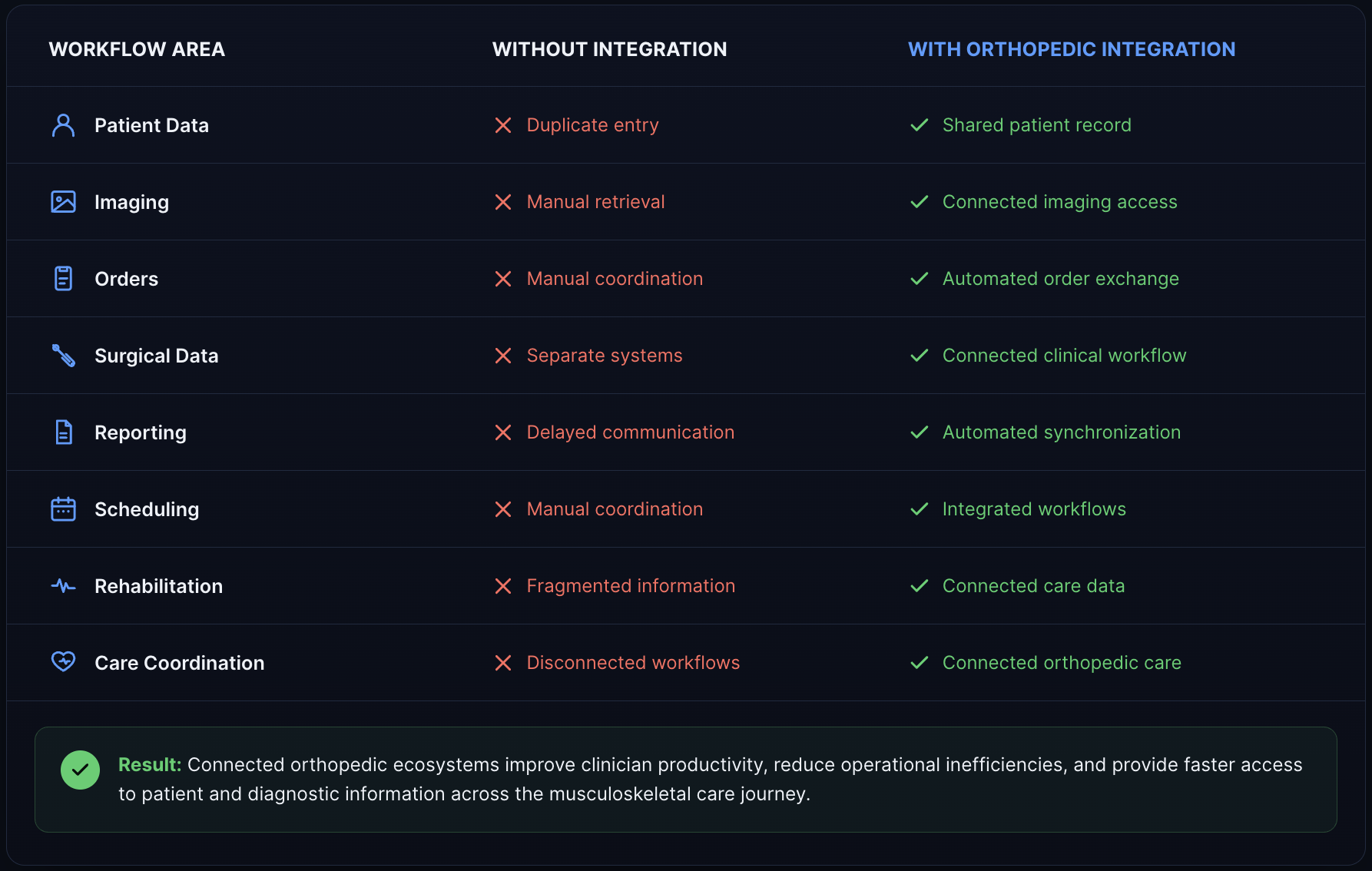
Before vs After
Manual Orthopedic Workflows vs Connected Musculoskeletal Workflows
Healthcare organizations often underestimate the impact of fragmented orthopedic systems on clinical efficiency, surgical coordination, and patient care.
Orthopedic EHR Integration
Orthopedic EHR ↔ Imaging Integration Use Cases
Bring Musculoskeletal Imaging Directly into Clinical Workflows
Orthopedic care relies heavily on diagnostic imaging, including X-ray, CT, MRI, and other imaging modalities. Integrating imaging systems with EHR and orthopedic applications allows providers to access relevant diagnostic information without navigating disconnected systems.
Orthopedic Imaging Access
Allow orthopedic specialists and authorized care teams to access relevant diagnostic images within connected clinical workflows
Benefits :
Automated Imaging Result Synchronization
Synchronize imaging reports and relevant diagnostic information with the appropriate patient record.
Benefits :
Multi-Location Imaging Access
Enable authorized providers to access orthopedic imaging across hospitals, orthopedic practices, and affiliated care locations.
Benefits :
Orthopedic EHR Integration
Bring Musculoskeletal Imaging Directly into Clinical Workflows
Orthopedic EHR Integration
Orthopedic PACS & DICOM Integration Use Cases
Connect Orthopedic Imaging with Enterprise Healthcare Systems
Orthopedic imaging workflows often involve PACS, modality systems, EHR platforms, and specialty applications. DICOM interoperability helps connect imaging data across these environments.
Multi-Modality Orthopedic Imaging Connectivity
Connect X-ray, CT, MRI, and other compatible imaging modalities with orthopedic clinical systems.
Orthopedic PACS Integration
Provide centralized access to musculoskeletal imaging studies across connected clinical workflows.
DICOM Image Exchange
Enable standardized exchange of compatible orthopedic imaging data between healthcare systems.
Imaging Order-to-Result Integration
Connect imaging orders, patient information, studies, and reports across orthopedic workflows.
Outcomes :
Improved
Operational Efficiency
Reduced
Scheduling Errors
Faster
access to orthopedic studies
Better
clinical coordination
Integration Architecture
Orthopedic Surgical Workflow Integration Use Cases
Connect Preoperative, Intraoperative & Postoperative Workflows
Orthopedic surgery involves multiple clinical, scheduling, documentation, procedural, and postoperative systems. Connecting these workflows helps organizations coordinate patient information throughout the surgical journey.
Surgical Scheduling Integration
Connect orthopedic procedure scheduling with EHR, operating room, and administrative systems.
Preoperative Data Exchange
Make relevant patient, diagnostic, medication, and clinical information available to surgical teams.
Procedure Documentation Integration
Synchronize orthopedic procedure information and documentation with patient records.
Postoperative Data Exchange
Connect postoperative information, clinical documentation, and follow-up workflows with the enterprise EHR.
Outcomes :
Better
surgical coordination
Reduced
manual documentation
Improved
clinical visibility
Connected
orthopedic workflows
Revenue Cycle Integration
Orthopedic Rehabilitation Integration Use Cases
Connect Orthopedic Care with Rehabilitation Workflows
Orthopedic patients frequently transition from diagnosis and treatment to physical therapy, rehabilitation, and follow-up care. Integrating these systems helps maintain continuity of relevant patient information.
Referral Integration
Transfer applicable orthopedic referrals and patient information to rehabilitation workflows.
Rehabilitation Data Exchange
Exchange relevant clinical information between orthopedic care teams and rehabilitation systems.
Treatment Plan Synchronization
Connect applicable orthopedic treatment plans and follow-up information across care settings.
Multi-Location Rehabilitation Access
Support authorized access to relevant orthopedic and rehabilitation information across connected locations.
Outcomes :
Better
care coordination
Improved
information accessibility
Reduced
manual data entry
More connected
patient journeys
Orthopedic Medical Device Integration
Orthopedic Medical Device Integration Use Cases
Connect Orthopedic Devices with Clinical Systems
Connect Orthopedic Devices with Clinical Systems
Automated Device Data Exchange
Automated Device Data Exchange Transfer relevant device-generated information into connected clinical systems.
Patient & Encounter Matching
Associate device-generated information with the appropriate patient and clinical encounter.
Procedure Workflow Integration
Connect device-related information with orthopedic procedural and clinical documentation workflows.
Multi-Vendor Device Connectivity
Support interoperability across compatible orthopedic devices from different manufacturers.
Outcomes :
Reduced
manual entry
Improved
data consistency
Faster
clinical workflows
Better
device interoperability
Orthopedic Medical Device Integration
Orthopedic Revenue Cycle Integration Use Cases
Connect Orthopedic Operations to Financial Performance
Orthopedic care includes examinations, imaging, procedures, surgeries, rehabilitation, and other billable services. Disconnected systems can create inconsistencies between clinical activity, coding, charge capture, and reimbursement workflows.
Automated Charge Capture
Automatically capture applicable charges from completed orthopedic examinations, procedures, surgeries, and diagnostic services.
Orthopedic Coding Workflow Integration
Synchronize orthopedic documentation, procedure information, and clinical data with coding and billing systems.
Authorization Workflow Integration
Connect applicable prior authorization information with orthopedic scheduling and procedure workflows.
Revenue Analytics
Combine clinical, procedural, and financial information to improve visibility into orthopedic operations.
Outcomes :
Increased
revenue capture
Reduced
billing errors
Improved
coding accuracy
Faster
reimbursement cycles
Enterprise Platforms
Enterprise Orthopedic Integration Across Leading Healthcare Platforms
Epic Orthopedic Integration Use Cases
Oracle Health Integration Use Cases
MEDITECH Integration Use Cases
eClinicalWorks Integration Use Cases
GE HealthCare Orthopedic Integration Use Cases
Siemens Healthineers Orthopedic Integration Use Cases
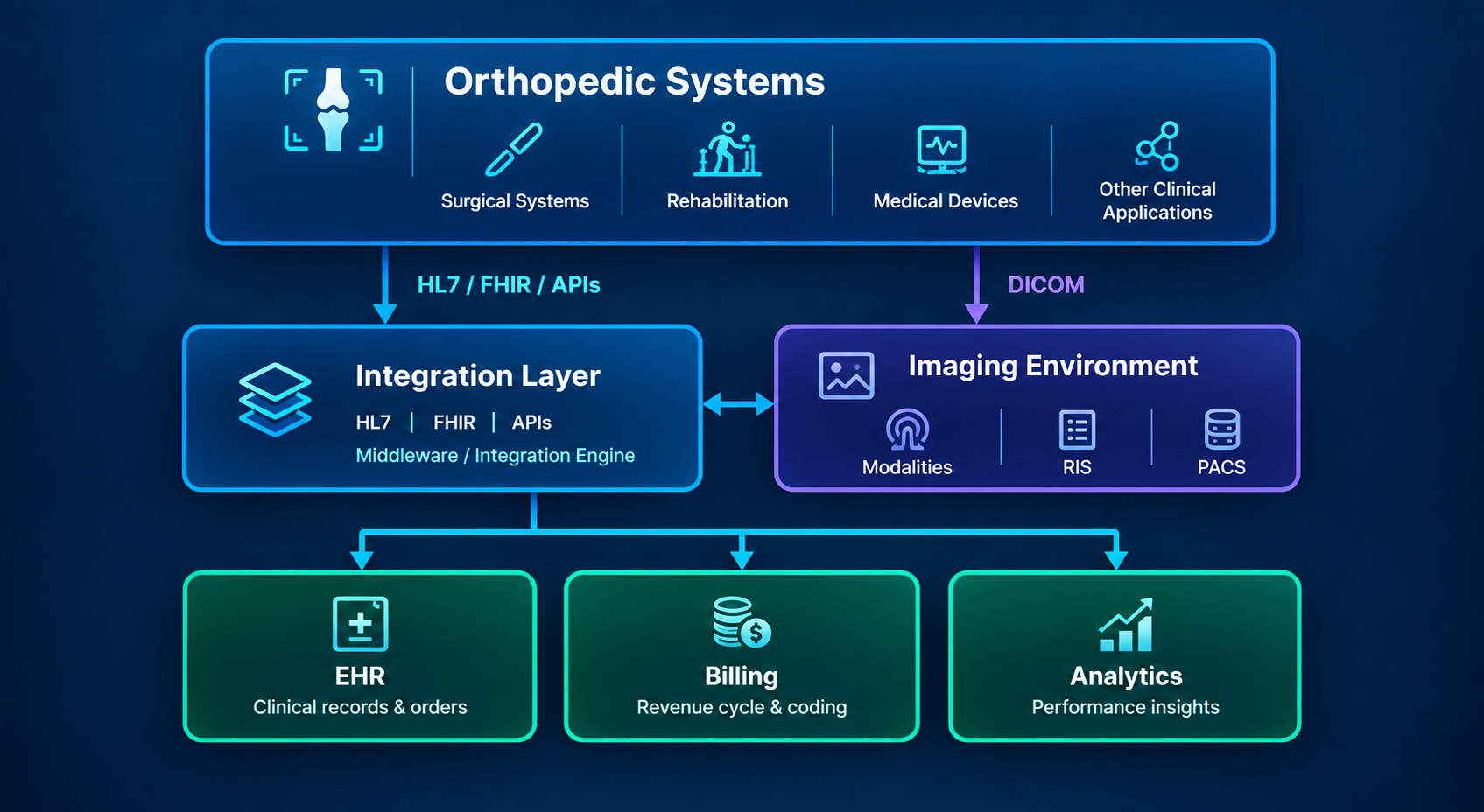
Integration Architecture
Typical Orthopedic Integration Architecture
How Connected Musculoskeletal Ecosystems Operate
Why DASH
Why Healthcare Organizations Choose Dash Technologies
Orthopedic interoperability projects require expertise across musculoskeletal workflows, diagnostic imaging, surgical systems, healthcare standards, enterprise architecture, and compliance requirements.
Our Expertise Enables:
Engagement Models
Integration Assessment
Not Sure Where Your Orthopedic Workflow Bottlenecks Exist?
Many healthcare organizations know interoperability challenges are limiting orthopedic efficiency but struggle to identify where integration will deliver the greatest impact.
Our orthopedic integration specialists evaluate your current environment and provide actionable recommendations for improving connectivity across EHR, imaging, surgical, rehabilitation, medical device, and clinical systems.
Included in the Assessment
Workflow Review
Integration Gap Analysis
Vendor Ecosystem Evaluation
Interoperability Assessment
Modernization Recommendations
Frequently Asked Questions
Orthopedic EHR integration can connect imaging, surgical workflows, rehabilitation, medical devices, scheduling, clinical documentation, referrals, and revenue cycle systems to create more connected musculoskeletal workflows.
Orthopedic integration commonly uses HL7, FHIR, DICOM, healthcare APIs, integration engines, and middleware, depending on the systems being connected and the data exchange requirements.
This complements the dedicated “Supported Standards” section rather than explaining each standard again.
Yes. Orthopedic environments can connect EHRs, imaging platforms, surgical applications, rehabilitation systems, medical devices, and other clinical technologies from different vendors using appropriate interfaces, APIs, interoperability standards, or integration middleware.
Many legacy systems can potentially be integrated using available interfaces, middleware, APIs, or other interoperability technologies, depending on the system’s technical capabilities, documentation, and available integration options.
Organizations can evaluate workflow bottlenecks, manual data exchange, disconnected systems, clinical priorities, vendor capabilities, and interoperability requirements to identify integration opportunities with the greatest operational impact.
