Discovery & Assessment
Analyze workflows, systems, interfaces, and business goals.
Overview
Oracle Cerner integration enables secure, real-time data exchange between Cerner EHR and the applications used across hospitals, health systems, imaging centers, physician groups, and specialty clinics.
Organizations rely on Cerner integration to eliminate data silos, improve care coordination, reduce manual data entry, and create a unified patient record — leveraging HL7 messaging, FHIR APIs, DICOM imaging standards, and interface engines to connect clinical and operational systems.
Integration Challenges
Clinical and operational systems store overlapping data with no unified record.
Teams re-key patient, order, and scheduling data across disconnected platforms.
Fragmented workflows slow the availability of patient data at the point of care.
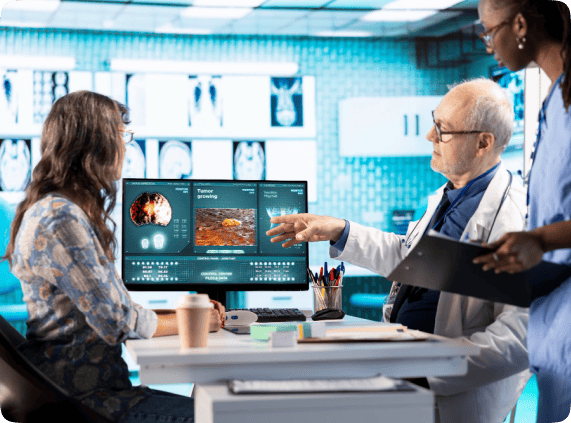
Imaging systems operate outside the EHR, forcing clinicians to switch context.
Older interfaces lack modern interoperability and API-driven connectivity support.
Multi-location scalability and analytics are constrained by inconsistent data flow.
Capabilities
From standards-based messaging to imaging, device, and revenue-cycle connectivity — mapped to the systems your organization actually runs.
Enable secure exchange of ADT messages, orders, results, and clinical documentation between Cerner and connected systems.
Leverage modern APIs for patient engagement, interoperability, and application connectivity across Cerner and third-party platforms.
API-driven exchange for real-time interoperability and patient-facing engagement scenarios.
Synchronize radiology scheduling, reporting, and operational workflows between RIS platforms and Cerner.
Automate order management and result delivery between Cerner and laboratory information systems.
Capture clinical data directly from diagnostic and monitoring equipment into Cerner workflows.
Improve billing accuracy and reimbursement workflows by connecting Cerner with revenue cycle platforms.
By Specialty
Integration strategies tailored to domain-specific clinical workflows.
Connect Cerner with PACS, RIS, imaging modalities, and DICOM-enabled systems to accelerate imaging and reporting.
Integrate ECG systems, cardiac imaging platforms, and monitoring devices with the clinical record.
Enable seamless communication between Cerner and laboratory information systems.
Support physician groups and outpatient clinics with connected, low-friction workflows.
Improve coordination across clinical, scheduling, and patient engagement systems.
Ecosystem
We adapt to Cerner’s data models and interfaces — and connect the platforms surrounding it.
Our Approach
Analyze workflows, systems, interfaces, and business goals.
Define integration standards, APIs, interface engines, and governance.
Design message structures and data transformations.
Build secure, scalable interfaces across systems.
Validate workflows, performance, and compliance requirements.
Monitor, optimize, and support integrations after launch.
Use Cases
Connect Cerner with PACS and RIS platforms for unified imaging workflows.
Automate provider referrals and care coordination.
Integrate Cerner with portals, telehealth, and communication tools.
Improve billing workflows and claims processing.
Capture real-time clinical data from connected devices.
Connect Cerner with analytics and reporting platforms.
Outcomes
Why DASH
End-to-end consulting, development, and support — from interface design to multi-site scale, built on a HIPAA-compliant implementation approach.
Standards-based execution across messaging, APIs, and imaging.
Radiology, laboratory, cardiology, and specialty workflows.
Consulting, development, and ongoing support under one team.
Reusable architecture built to grow across sites and systems.
Get an integration assessment mapped to your systems, workflows, and compliance requirements.
Oracle Cerner integration connects Cerner EHR with third-party healthcare applications, systems, and devices.
Yes. Cerner supports both HL7 and FHIR interoperability standards.
Yes. Cerner can integrate with PACS, RIS, and DICOM-enabled imaging platforms.
Laboratory systems, billing platforms, patient portals, telehealth solutions, CRM systems, medical devices, and more.
Timelines vary based on complexity, number of interfaces, workflows, and compliance requirements.








Copyright © 2026 Dash Technologies Inc. All rights reserved.
