Discovery and Assessment
Analyze existing healthcare systems, clinical workflows, integration requirements, and business objectives.
Overview
eClinicalWorks integration enables secure and real-time data exchange between the eClinicalWorks EHR platform and the clinical, operational, and financial applications used across physician practices, ambulatory care centers, community health organizations, specialty clinics, and healthcare networks.
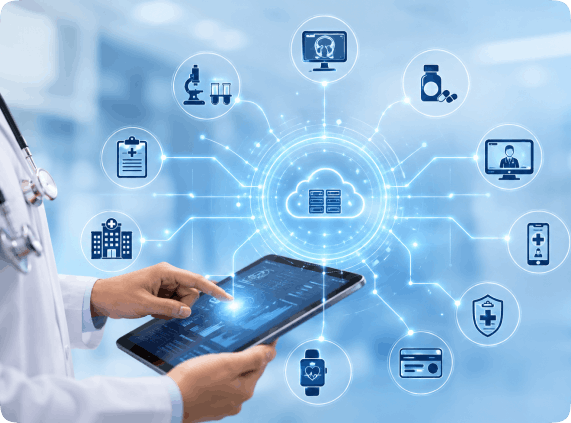
Healthcare organizations implement eClinicalWorks integration services to eliminate disconnected systems, automate workflows, reduce duplicate data entry, and create a unified patient record across multiple healthcare applications. Modern integration strategies leverage HL7 messaging, FHIR APIs, REST APIs, and interface engines to enable seamless interoperability while supporting regulatory compliance and scalable healthcare operations.
Integration Challenges
Without a modern eClinicalWorks integration strategy, organizations often experience slower workflows, fragmented patient information, higher administrative costs, and reduced operational efficiency.
Disconnected clinical and operational systems can lead to inefficiencies and delays in patient care.
Manual data entry and duplicate patient information can lead to errors and delays in patient care.
Limited interoperability between healthcare applications can slow the availability of patient data at the point of care.
Disconnected laboratory, pharmacy, and imaging workflows can lead to inefficiencies and delays in patient care.
Difficulty integrating cloud and legacy systems can lead to inefficiencies and delays in patient care.
Multi-location practice management challenges can lead to inefficiencies and delays in patient care.
Limited reporting and analytics capabilities can lead to inefficiencies and delays in patient care.
Capabilities
Enable secure exchange of ADT, ORM, ORU, SIU, and other HL7 messages between eClinicalWorks and connected healthcare systems.
Leverage FHIR APIs to support patient engagement, interoperability initiatives, mobile healthcare applications, and modern digital health solutions.
Connect eClinicalWorks with third-party healthcare software, business applications, and digital health platforms using secure REST APIs.
Automate laboratory orders, specimen tracking, and clinical result delivery through seamless LIS connectivity.
Capture patient vitals and diagnostic data directly from connected medical devices into eClinicalWorks.
Integrate billing software, payment processing, insurance verification, and financial applications to streamline revenue cycle management.
Connect patient portals, appointment scheduling, secure messaging, telehealth solutions, and remote patient engagement applications.
By Specialty
Integrate eClinicalWorks with PACS, RIS, imaging modalities, and DICOM-enabled systems to streamline diagnostic imaging, improve report accessibility, and enhance collaboration between care teams.
Connect eClinicalWorks with ECG systems, cardiovascular imaging platforms, and cardiac monitoring solutions to improve clinical workflows and support coordinated cardiac care.
Integrate eClinicalWorks with Laboratory Information Systems (LIS) to automate laboratory orders, specimen tracking, diagnostic results, and clinical data exchange across healthcare organizations.
Connect eClinicalWorks with orthopedic imaging, rehabilitation platforms, surgical documentation systems, and specialty clinical applications to improve workflow efficiency and patient care.
Integrate eClinicalWorks with EEG systems, neurodiagnostic platforms, brain imaging applications, and neurology workflows to provide clinicians with timely access to comprehensive patient information.
Connect eClinicalWorks with ophthalmology imaging devices, OCT systems, vision diagnostic equipment, and specialty eye care applications to streamline documentation and improve clinical efficiency.
Ecosystem
We adapt to eClinicalWorks’ data models and interfaces — and connect the platforms surrounding it.
Our Approach
Analyze existing healthcare systems, clinical workflows, integration requirements, and business objectives.
Design a scalable interoperability architecture using HL7, FHIR, APIs, and interface engine best practices.
Configure message mappings, workflow automation, API integrations, and data transformation to ensure consistent healthcare data exchange.
Develop secure, scalable integrations between eClinicalWorks and connected healthcare applications.
Validate interface performance, workflow accuracy, security, compliance, and interoperability requirements.
Deploy integrations, monitor performance, optimize workflows, and provide continuous technical support.
Use Cases
Automate laboratory order management, specimen tracking, and result reporting for improved clinical workflows.
Connect eClinicalWorks with patient portals, appointment scheduling, secure messaging, and telehealth platforms to improve patient communication.
Enable seamless provider referrals and care coordination across healthcare organizations.
Integrate financial systems to streamline insurance verification, billing, claims processing, and reimbursement workflows.
Capture real-time patient data from monitoring and diagnostic devices directly within eClinicalWorks.
Integrate eClinicalWorks with business intelligence and reporting platforms to support operational and clinical decision-making.
Outcomes
Why DASH
Dash Technologies is a leading healthcare technology company that specializes in eClinicalWorks integration. We have a team of experts who have extensive experience in delivering healthcare interoperability solutions. We are committed to providing our clients with the best possible service and support.
Schedule a consultation to discuss your interoperability goals and roadmap for healthcare system modernization.
eClinicalWorks integration connects the eClinicalWorks EHR platform with third-party healthcare applications, medical devices, laboratories, billing systems, pharmacies, and digital health solutions for secure healthcare data exchange.
Yes. eClinicalWorks supports HL7 messaging, FHIR APIs, and REST-based integrations to enable interoperability across healthcare systems
Yes. eClinicalWorks can integrate with laboratory information systems, PACS, RIS, diagnostic platforms, and other healthcare applications.
eClinicalWorks can integrate with patient portals, telehealth platforms, pharmacy systems, CRM software, billing applications, healthcare analytics platforms, Health Information Exchanges (HIEs), and medical devices.
Project timelines depend on the number of interfaces, integration complexity, workflow customization, data mapping requirements, and compliance considerations.








Copyright © 2026 Dash Technologies Inc. All rights reserved.
