Healthcare Organizations
Who Benefits from Cardiology EHR Integration?
Healthcare organizations have different cardiovascular workflows, operational challenges, and interoperability requirements. Cardiology integration helps create connected workflows across hospitals, specialty practices, and enterprise healthcare environments.
Hospitals & Health Systems
Connect cardiology departments with enterprise EHR platforms, CVIS, diagnostic systems, cardiac imaging, and specialty care teams.
Heart & Vascular Centers
Automate scheduling, diagnostic, reporting, procedural, and cardiovascular data workflows to improve clinical efficiency.
Cardiology Practices
Connect EHR, ECG, echocardiography, imaging, scheduling, and clinical applications across outpatient cardiology workflows.
Academic Medical Centers
Support cardiovascular research, advanced diagnostics, clinical care, and interdisciplinary collaboration.
Multi-Specialty Clinics
Provide seamless access to cardiovascular information across primary care, endocrinology, neurology, oncology, and other specialty workflows.
Before vs After
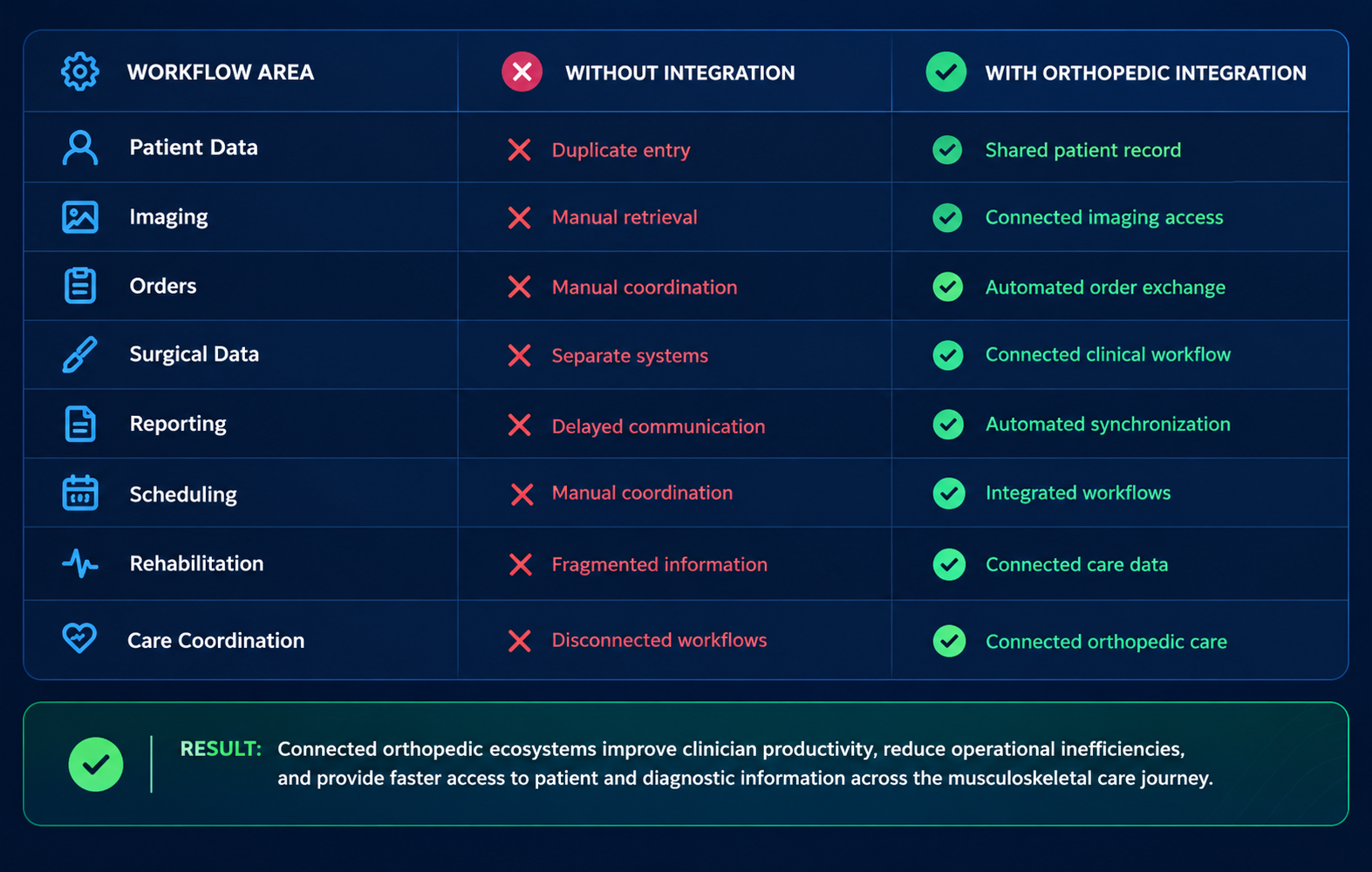
Manual Cardiology Workflows vs Connected Cardiovascular Workflows
Healthcare organizations often underestimate the impact of fragmented cardiovascular systems on clinical efficiency, care coordination, and patient outcomes.
CVIS Integration
CVIS ↔ EHR Integration Use Cases
Bring Cardiovascular Information Directly into Clinical Workflows
Cardiovascular Information Systems help organize diagnostic, procedural, and clinical information across cardiology workflows. Integrating CVIS platforms with EHRs enables clinicians to access relevant cardiovascular information without navigating disconnected applications.
Cardiovascular Data Access
Allow physicians to access cardiology information directly within EHR workflows.
Benefits :
Automated Cardiology Report Synchronization
Ensure finalized cardiology reports are automatically available within patient records.
Benefits :
Multi-Facility Cardiology Data Sharing
Provide secure access to cardiovascular records, diagnostic results, and reports across hospitals, specialty clinics, and affiliated care organizations.
Benefits :
Connect Cardiology Systems, Simplify Workflows
Integrate CVIS, ECG, echocardiography, imaging, scheduling, and clinical applications to improve interoperability and cardiovascular access.
ECG Integration
ECG Integration Use Cases
Automate ECG Data Exchange from Acquisition to Clinical Review
ECG systems generate critical cardiovascular diagnostic information, but disconnected workflows can require clinicians to manually retrieve, review, and document ECG results.
Integrating ECG systems with EHR and cardiology platforms creates connected workflows from test ordering through clinical review and reporting.
ECG Order Integration
Automatically transfer ECG orders from EHR systems to connected ECG workflows.
Automated ECG Result Exchange
Send finalized ECG results and reports directly into patient records
ECG Workflow Management
Track ECG orders, testing status, results, and reporting across connected systems.
ECG Device Integration
Connect ECG acquisition systems with EHR and cardiovascular applications to reduce manual data entry.
Outcomes :
Improved
diagnostic efficiency
Reduced
manual workflows
Faster
ECG result availability
Better
clinical documentation
Echocardiography Integration
Echocardiography Integration Use Cases
Connect Echo Diagnostics with Enterprise Clinical Workflows
Echocardiography generates detailed cardiovascular measurements, images, and reports that must be accessible to cardiologists and care teams. Integration connects echo systems with EHR, CVIS, imaging, and reporting workflows.
Echo Order-to-Study Integration
Transfer echocardiography orders from EHR systems into diagnostic workflows.
Automated Echo Report Distribution
Make finalized echocardiography reports available within connected patient records.
Echo Image & Measurement Exchange
Connect relevant imaging and measurement data with cardiology clinical workflows.
Multi-Site Echo Access
Enable authorized clinicians to access echocardiography information across hospitals and cardiology locations.
Outcomes :
Faster
diagnostic workflows
Improved
data accessibility
Reduced
duplicate documentation
Better
cardiovascular care coordination
Cardiac Imaging & DICOM Integration
Cardiac Imaging & DICOM Integration Use Cases
Enable Cardiovascular Imaging Interoperability Across Healthcare Systems
Cardiac imaging workflows can involve multiple imaging modalities, PACS platforms, EHR systems, and specialty applications. DICOM and healthcare integration technologies help connect these systems across enterprise environments.
Multi-Modality Cardiac Imaging Connectivity
Connect compatible CT, MRI, ultrasound, and other cardiac imaging systems across diverse vendor environments.
Cardiac PACS Integration
Provide centralized access to cardiovascular imaging studies across connected clinical workflows.
Cross-Enterprise Cardiac Image Sharing
Enable secure image exchange between hospitals, cardiology practices, and healthcare partners.
Cardiac Imaging Workflow Automation
Connect imaging orders, studies, reports, and patient information across cardiovascular workflows.
Outcomes :
Improved
imaging interoperability
Faster
access to cardiac studies
Reduced
infrastructure complexity
Better
care coordination
Revenue Cycle Integration
Cardiology Revenue Cycle Integration Use Cases
Connect Cardiovascular Operations to Financial Performance
Cardiology services involve complex procedures, diagnostic testing, coding, and reimbursement workflows. Disconnected systems can lead to missed charges, coding inconsistencies, and reimbursement delays.
Automated Charge Capture
Automatically generate charges from completed cardiology procedures and diagnostic services.
Cardiology Coding Workflow Integration
Synchronize cardiology reports and procedure information with coding and billing systems
Prior Authorization Tracking
Automate authorization management throughout applicable cardiology workflows.
Revenue Analytics
Combine clinical, procedural, and financial data to improve visibility and reporting.
Outcomes :
Increased
revenue capture
Reduced
billing errors
Improved
coding accuracy
Faster
reimbursement cycles
Modernize Your Cardiology Workflows
Connect EHR, CVIS, ECG, echocardiography, cardiac imaging, scheduling, and clinical applications for seamless interoperability.
Enterprise Platforms
Enterprise Cardiology Integration Across Leading Healthcare Platforms
Epic Cupid Integration Use Cases
Oracle Health Integration Use Cases
Philips Cardiovascular Integration Use Cases
GE HealthCare Cardiology Integration Use Cases
Siemens Healthineers Cardiology Integration Use Cases
Integration Architecture
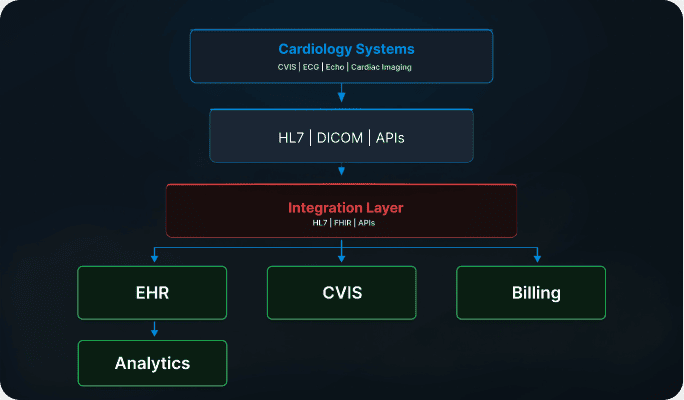
Typical Cardiology Integration Architecture
How Connected Cardiovascular Ecosystems Operate
Why DASH
Why Healthcare Organizations Choose Dash Technologies
Cardiology interoperability projects require expertise across cardiovascular workflows, healthcare standards, enterprise architecture, clinical systems, and compliance requirements.
Our Expertise Enables:
Engagement Models
Integration Assessment
Not Sure Where Your Cardiology Workflow Bottlenecks Exist?
Many healthcare organizations know interoperability challenges are limiting cardiovascular efficiency but struggle to identify where integration will deliver the greatest impact.
Our cardiology integration specialists evaluate your current environment and provide actionable recommendations for improving connectivity across EHR, CVIS, ECG, echocardiography, cardiac imaging, and clinical systems.
Included in the Assessment
Workflow Review
Integration Gap Analysis
Vendor Ecosystem Evaluation
Interoperability Assessment
Modernization Recommendations
Frequently Asked Questions
Yes. Cardiology workflows can connect systems from different vendors using standards such as HL7, DICOM, FHIR, and vendor-supported APIs. The exact approach depends on what each system supports and what data needs to move between them.
For example, an ECG system from one vendor can exchange orders and results with an EHR from another vendor, while cardiac imaging can connect through DICOM and related imaging workflows. Before implementation, teams should review each system’s interface capabilities and define which workflows need to be connected.
Why this is valuable:This addresses a very practical concern for hospitals with mixed vendors and adds information that the page currently only implies. Multi-vendor interoperability is a recurring focus in IHE cardiology workflows.
Not necessarily. The systems that need to be connected should be determined by the specific clinical workflow.
For example, an ECG workflow may require connectivity between the EHR, ECG management system, and ECG devices. A cardiac imaging workflow may also require PACS and imaging modalities. Connecting systems that do not contribute to the target workflow can add unnecessary complexity and maintenance.
A practical approach is to map the workflow first, identify where data is created and consumed, and then determine which systems need to exchange that data.
Why this is valuable:This is a much better AEO question than “How do cardiology systems integrate with EHRs?” It gives the reader an actual implementation decision. Healthcare integration guidance similarly recommends choosing the exchange approach based on the specific use case and existing infrastructure.
Yes, but the integration approach depends on what clinicians need to access. A workflow may exchange a finalized ECG result or report with the EHR while also providing access to the underlying waveform or study through the appropriate cardiology or imaging system.
For cardiac imaging, for example, the EHR may provide access to study information while the actual images remain available through PACS or an imaging viewer. This allows clinicians to see relevant information in the EHR without unnecessarily duplicating large imaging datasets.
Why this is valuable:This adds an important distinction that the current page does not explain. It also reflects established cardiac imaging workflows where the EHR can retrieve study information and provide access to the underlying images.
Legacy cardiology systems can often be connected through an integration layer, middleware, HL7 interfaces, APIs, or other supported interfaces. The first step is to identify what the existing system can send and receive and which workflows need to be preserved.
Instead of replacing every legacy system, organizations can prioritize the most important data flows, connect them through an appropriate integration architecture, and modernize individual systems over time where needed.
Why this is valuable:The existing FAQ only says legacy systems can be integrated. This version answers the more useful question of how to approach that problem, which is more valuable for an organization actually planning an integration project.
Start by mapping the complete workflow, not just the systems. Identify where patient, order, scheduling, diagnostic, imaging, report, procedure, and billing data is created, where it needs to go, and when each exchange should occur.
Then document the systems involved, supported standards and interfaces, patient and procedure identifiers, data ownership, error handling, and the clinical or operational outcome expected from the integration. This helps determine whether HL7, FHIR, DICOM, APIs, middleware, or a combination is appropriate.
Why this is valuable:This is probably the strongest FAQ for the page because it turns the page from a list of use cases into something actionable. It also aligns with FHIR guidance that the business and workflow decisions should be made before selecting the technical exchange mechanism.
