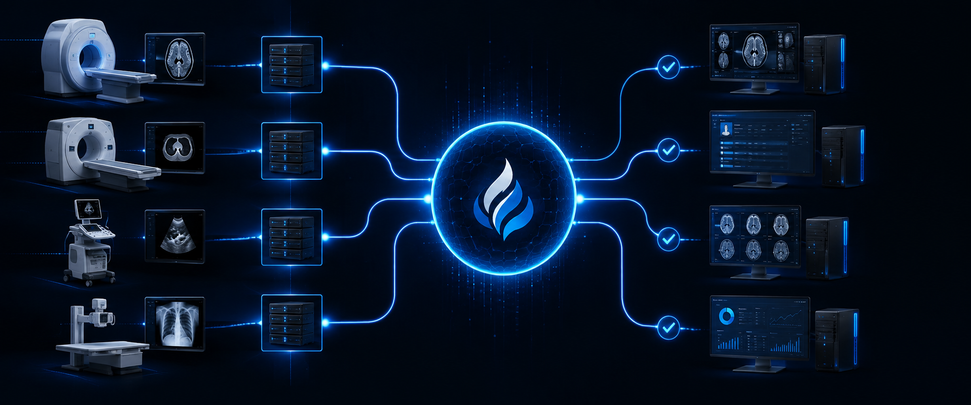
Top Clinical Workflow Automation Use Cases in Hospitals (Beyond EHR)
Advanced clinical workflow automation healthcare deployments represent the ultimate defense against operational breakdown. Facilities attempting to navigate severe clinician shortages and thinning margins through manual effort guarantee systemic failure. Sustained profitability demands automating workflows that were never designed for human execution.
The prevailing executive fixation on EHR deployments ignores the true root of healthcare workflow challenges. The EHR is a static repository; it cannot manage the dynamic friction between disparate systems. Massive administrative waste occurs during manual handoffs, uncoordinated queues, and forced data reconciliation. Forcing clinical staff to squander 35% of their time navigating these gaps actively destroys service line efficiency.
Automating these interstitial gaps delivers immediate, compounding ROI. Hospital and health system leaders, looking beyond their next EHR upgrade cycle, we need to adopt aggressive automation. This strategy will help reclaim wasted clinical hours. Doing this can improve patient outcomes. It also boosts operational efficiency. Plus, it helps keep staff for the long term.
Where Hospital Workflows Break Today?
Predictable system boundaries and manual handoffs drive severe hospital workflow inefficiencies. Relying on manual intervention at critical decision points guarantees clinical and operational failure. Service line executives must target four catastrophic bottlenecks:
- Manual Intake & Registration: Redundant data entry corrupts downstream quality. Manual demographic and clinical input guarantee structural errors, immediately devastating billing accuracy and clinical care coordination.
- Fragmented Scheduling: Manual coordination destroys facility capacity. Inefficient block management and failed patient backfill limit the use of premium ORs. They also hurt catheterization labs and radiology services.
- Delayed Care Transitions: Late discharge planning and uncoordinated post-acute referrals lead to readmission penalties. They also harm the margins of value-based contracts.
- Administrative Bloat: Manual billing processes consume massive operational bandwidth. Prior authorization alone squanders an average of 14 hours of staff time per physician per week. Executives must deploy rules-based automation to eliminate this staggering administrative loss permanently.
High-Impact Workflow Automation Use Cases
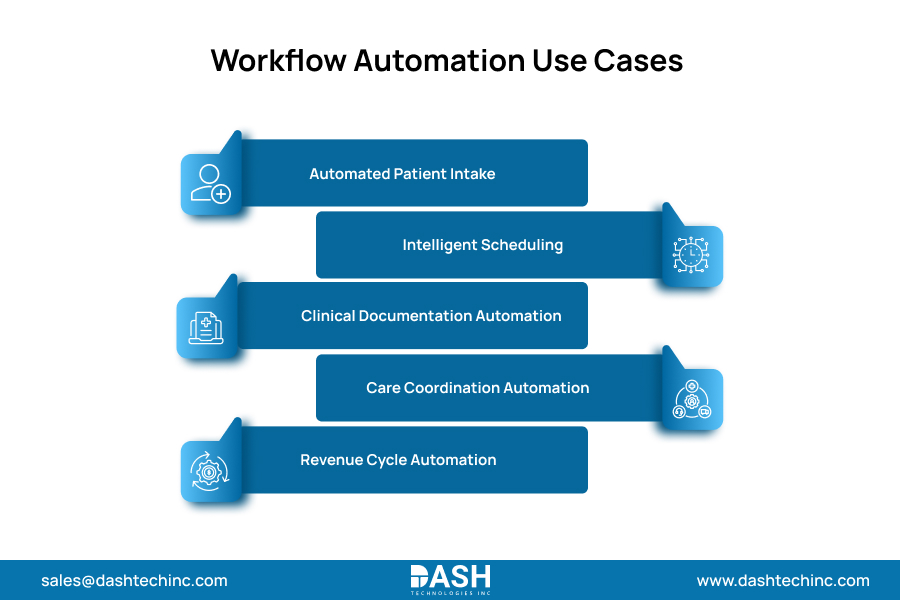
Deploying hospital workflow automation is not an experimental IT initiative; it is a strict margin protection strategy. Here’s the workflow automation use cases. They show where smart investment leads to quick, clear gains in clinical time saved, fewer errors, and faster patient processing.
-
Automated Patient Intake and Eligibility Verification
Manual pre-visit intake workflows, such as insurance verification, demographic collection, and consent capture, are massive administrative bottlenecks. Executing healthcare process automation via real-time payer APIs and digital intake platforms completely eliminates front desk friction. Patients complete intake externally; systems instantly populate downstream data architectures without human intervention. This strict automation immediately maximizes clean claim rates, scheduling accuracy, and operational efficiency.
-
Intelligent Scheduling and Capacity Management
Manual scheduling actively destroys facility margins and represents a massive source of operational failure. Hospital workflow automation engines, such as processing historical utilization, staff availability, equipment readiness, and exact patient acuity, optimize slot allocation far beyond human capability.
For high-margin procedural departments facing severe capacity constraints, this capability is non-negotiable. Automating surgical block utilization eliminates chronically empty operating rooms, prevents uncaptured revenue, and strictly enforces maximum facility throughput. -
Clinical Documentation Assistance
Ambient documentation tools and structured data capture workflows reduce the administrative burden on physicians. Instead of clinicians spending 30% to 40% of their time on EHR documentation after encounters, automation handles transcription and code suggestion in near real-time. Specialty departments with high documentation complexity, such as neurology or oncology, see the largest time recapture through clinical workflow automation in healthcare.
-
Care Coordination and Transitions of Care
Manual discharge planning and post-acute referral management consistently generate dangerous clinical blind spots. Automated care coordination platforms actively trigger follow-up protocols based on strict clinical events, permanently eliminating the vulnerabilities of manual tracking.
This proactive infrastructure replaces fragmented workflows with closed-loop execution, aggressively compressing readmission rates, and strictly protecting value-based contract performance. -
Revenue Cycle and Billing Execution
Prior authorizations, denial management, and claim scrubbing remain dangerously manual across most health systems despite being entirely rule-based. Robotic process automation (RPA) and AI-driven coding architecture now possess the operational maturity to instantly process routine billing workflows, forcing revenue cycle teams to focus exclusively on high-value complex appeals.
For facilities processing thousands of claims each week, aggressive denial prevention is crucial. It directly impacts massive and sustained revenue recovery.
Make Automation a Strategic Advantage
From intake to revenue cycle, DASH helps healthcare leaders deploy scalable automation that delivers real performance gains.
Explore Our CapabilitiesHow Automation Improves Clinical and Operational Outcomes?
Architecting successful workflow optimization of healthcare platforms requires anchoring every automated process to absolute, measurable facility performance data instead of theoretical efficiency concepts. Offloading routine administrative tasks to algorithmic systems permanently redirects premium clinical staff toward high judgment medical execution. This aggressive operational shift produces absolute documented performance improvements across every major facility specialty:
- Surgical OR Utilization: Operating rooms are the most expensive & profitable assets in any facility. Maximizing utilization requires real-time insights. This includes block schedules, room turnover, and equipment readiness. Automated orchestration provides absolute transparency. It empowers health systems to recapture massive surgical capacity strictly through intelligent scheduling rather than expensive physical capital expansion.
- Interventional Cardiology Throughput: Cardiac procedures demand precise coordination of catheterization lab availability, specialized inventory, and multidisciplinary personnel. Automated orchestration dictates the difference between suboptimal utilization and absolute facility throughput. The cath lab workflow challenges facing high-volume programs must deploy comprehensive process automation outside the core EHR to permanently eliminate structural workflow bottlenecks.
- Radiology Backlog Eradication: Radiology departments facing critical specialist shortages and surging imaging volumes require immediate algorithmic intervention. Workflow automation instantly eradicates diagnostic backlogs by intelligently triaging studies, routing high-acuity reads, and executing automated report distribution. This guarantees that no critical clinical finding ever remains trapped in a manual administrative queue.
Technologies Enabling Workflow Automation
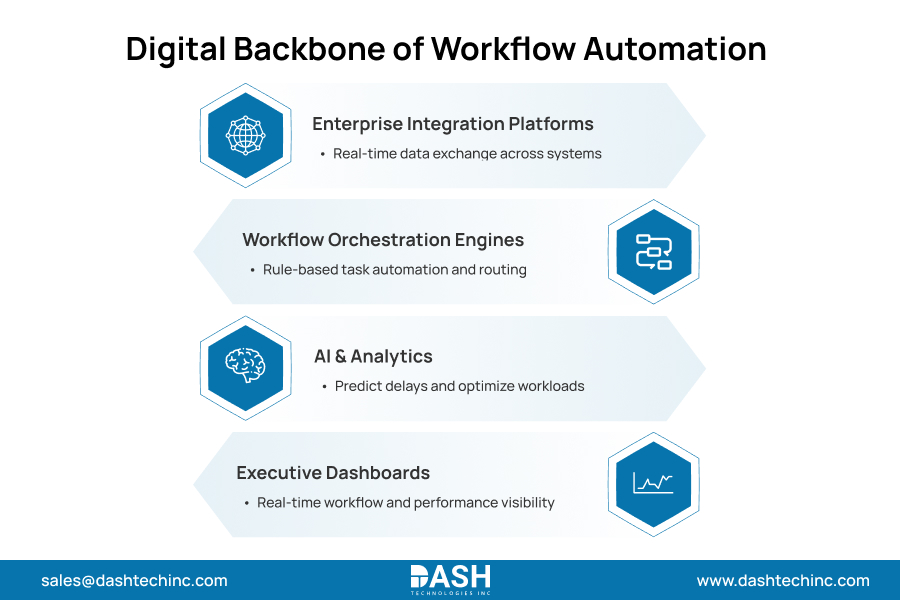
To execute these use cases, hospitals must deploy an ecosystem of healthcare automation tools that wrap around their existing EHR infrastructure.
- Enterprise Integration Platforms: Seamless data exchange serves as the absolute foundation for automation. Maintaining disconnected registration, scheduling, and billing systems guarantee brittle operational failures. True workflow fluidity demands aggressive data synchronization across all clinical platforms.
- Workflow Orchestration Engines: Advanced rules engines dictate exact operational logic. These systems strictly define sequential actions, trigger automated staff notifications, and route critical tasks instantly whenever patient conditions or facility capacities shift.
- Artificial Intelligence and Analytics: Predictive algorithms permanently eliminate static administrative processes. These intelligent engines aggressively prioritize clinical workloads, predict systemic delays, and identify complex operational exceptions completely invisible to manual coordination.
- Executive Monitoring Dashboards: Real-time analytics provide absolute visibility into facility performance. Leadership must track active workflow status, handoff efficiency, and task completion metrics to ensure automation remains a strictly governed operational capability rather than an unmanaged background process.
Conclusion
Executing clinical workflow automation healthcare strategies represents a strict operational mandate rather than an optional IT initiative. Facilities attempting to scale capacity beyond the structural limits of the EHR must eliminate the everyday administrative failures actively crippling their margins. The absolute highest return on investment exists entirely within routine operational breakdowns. Hospital leadership must aggressively target and eradicate intake of friction, scheduling failures, severe documentation delays, care coordination gaps, and massive billing bottlenecks.
The mindset shift matters. Automation is not a side project or a convenience upgrade. It is a core part of how hospitals improve capacity, reduce waste, and support more reliable care across systems. The organizations that treat workflow automation as essential will be better positioned to scale operations without scaling friction.
Frequently Asked Questions
About Dash

Dash Technologies Inc.
We’re technology experts with a passion for bringing concepts to life. By leveraging a unique, consultative process and an agile development approach, we translate business challenges into technology solutions Get in touch.