Enterprise Imaging Strategies for Digital Health Leaders
An enterprise imaging strategy establishes a unified infrastructure for storing and managing imaging data across clinical departments. As digital health transformation expands beyond radiology into fields like cardiology and pathology, treating imaging as an isolated departmental asset creates severe operational bottlenecks. Imaging data integration is a direct technical requirement for building interoperable clinical systems.
Health systems generate massive volumes of imaging data across distributed platforms. These clinical assets frequently remain locked in separate archives or vendor-specific viewers. This structural fragmentation blocks direct clinical decision-making and limits the scalability of enterprise analytics.
A standardized enterprise imaging healthcare architecture fixes this fragmentation. Connecting these isolated archives establishes strict data governance and builds the exact infrastructure required to scale AI deployments.
For a broader context on why imaging data matters so much to digital health, check: Why Radiology Data Is the Backbone of Digital Health Transformation.
What Is Enterprise Imaging in Healthcare?
Enterprise imaging is a clinical strategy. It brings together data from various medical specialties into one platform. This shared infrastructure helps clinical workflows and enterprise AI development. It removes the need for separate databases in different departments.
- Consolidated Imaging Repositories
Enterprise imaging systems use central databases. They store images and metadata from various modalities. These repositories eliminate data duplication and allow clinicians to retrieve historical studies instantly. - Cross-Department Imaging Access
Medical staff access diagnostic data through a common system. Specialists like cardiologists and oncologists review critical imaging studies directly within their active clinical workflow. - Standardized Imaging Workflows
Enterprise imaging platforms enforce uniform technical workflows for image acquisition and retrieval. This structural consistency improves baseline operational efficiency and reduces process variability.
Consolidating this core infrastructure establishes the necessary environment to drive enterprise-wide clinical decision-making.
When Imaging Breaks, Radiology Slows
70% of hospitals struggle to exchange patient data—forcing manual workarounds in radiology Connect systems and simplify imaging access across care settings.
Start the ConversationWhy Digital Health Strategies Depend on Enterprise Imaging?
When hospital executives design a digital health imaging strategy, they quickly realize that medical images are the foundational pieces of the patient’s narrative. You simply cannot build a resilient digital health infrastructure without prioritizing deep healthcare data integration. Enterprise imaging directly supports:
- Care Coordination: Multidisciplinary teams, like oncology tumor boards, need to access the same diagnostic images at the same time. This helps them agree on a complex treatment plan.
- Clinical Decision Support: An EHR with integrated imaging helps doctors make quick, accurate decisions right at the point of care. They don’t have to wait for external record transfers.
- Digital Health Platforms: Modern telehealth portals and patient-facing applications rely on enterprise imaging digital health frameworks to push vital visual data to remote specialists and to the patients themselves.
- Analytics and AI: Broad analytical tools require a comprehensive, 360-degree view of the patient, which is impossible if half of their diagnostic history is locked on a dermatology clinic’s private server.
Imaging Data Challenges Across Healthcare Organizations
Many healthcare organizations operate fragmented imaging systems. These imaging data silos directly block digital transformation.
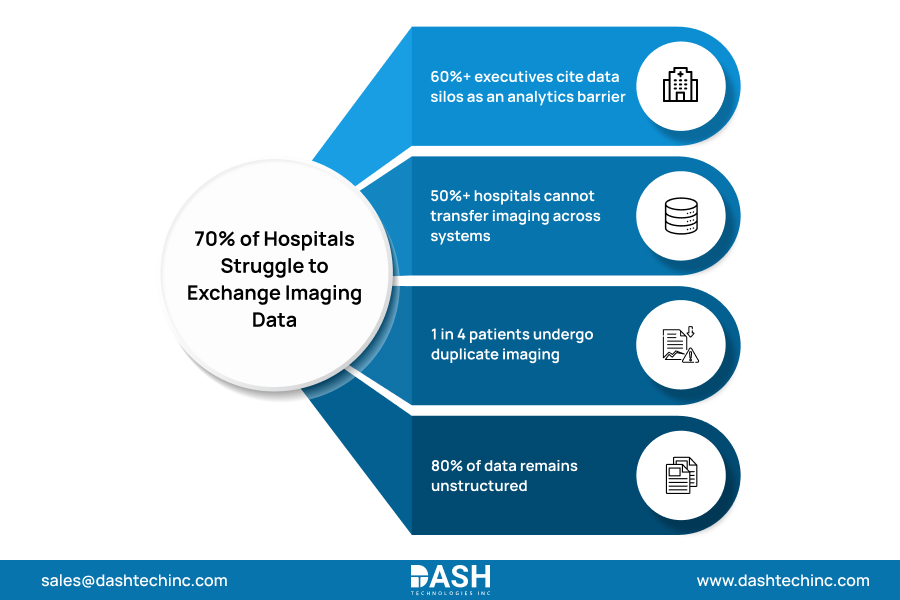
- Department-Specific Imaging Systems: Health systems historically deployed imaging archives based on isolated departmental requirements. Radiology utilizes one infrastructure while cardiology relies on another, establishing a network of disconnected platforms.
- Limited Interoperability Between Platforms: Underlying databases fail to exchange information natively due to conflicting interfaces and access models. This technical friction forces clinical teams to rely on manual workarounds and duplicate study uploads.
- Inconsistent Data Standards: Departmental fragmentation generates severe standardization failures. Imaging content labeled with inconsistent metadata links poorly to the core patient record. These structural variations prevent the deployment of reliable clinical analytics and enterprise data governance.
This is where interoperability becomes essential. If you want to go deeper on that topic, read: Interoperability in Radiology: Why Integration Is Critical for Digital Health.
Core Components of an Enterprise Imaging Strategy
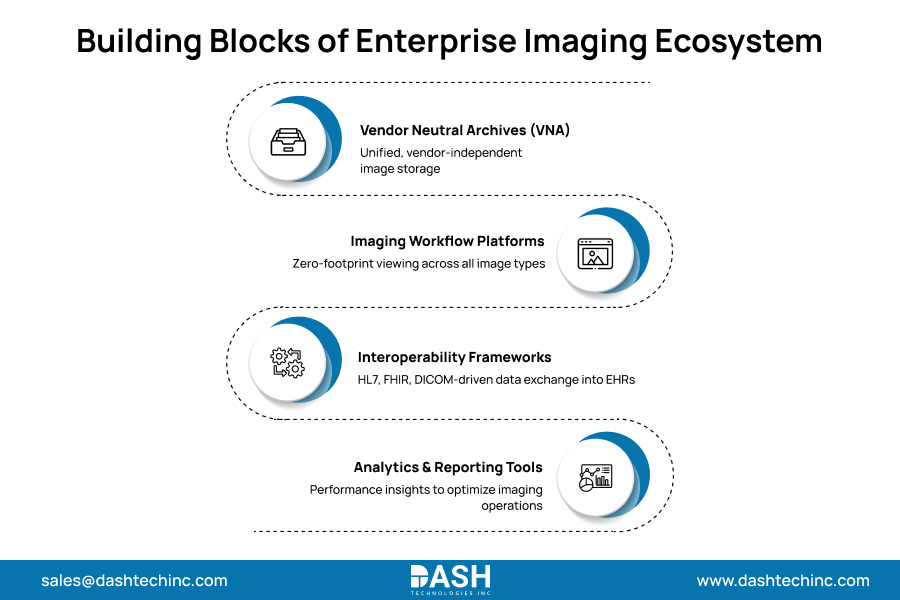
Deploying an enterprise imaging architecture requires integrating distinct clinical technologies to execute a functional imaging platform strategy.
- Vendor Neutral Archives (VNA): VNAs establish the technical foundation. They decouple image storage from the specific viewing application, allowing departments to store files in standard formats independent of the original scanner manufacturer.
- Imaging Workflow Platforms: This layer relies on zero-footprint universal viewers. Physicians analyze complex DICOM MRIs and non-DICOM JPEG wound photos on one platform. They keep a high standard for diagnostic clarity.
- Interoperability Frameworks: These systems use standard HL7, FHIR, and DICOM protocols. They route imaging data straight into the core EHR databases.
- Analytics and Reporting Tools: Diagnostic software monitors scanner usage while also tracking departmental performance. This helps improve operational capacity over time.
Operational Benefits of Enterprise Imaging
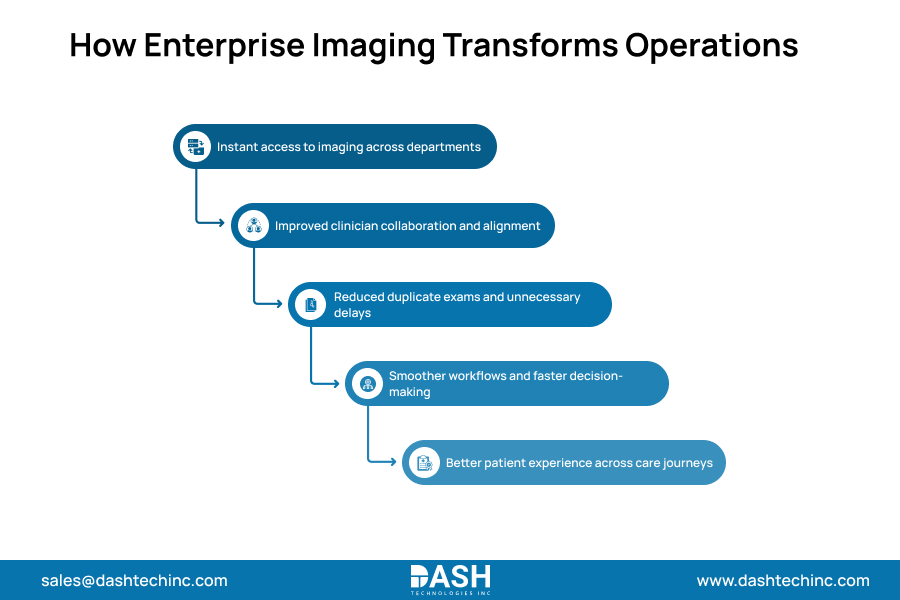
The operational value of enterprise imaging is often what gets executive attention first. Imaging workflow optimization and healthcare operational efficiency improve when clinicians and administrators can work from a more connected imaging environment.
One major benefit is faster access to imaging data. Instead of logging into different viewers or calling other departments for access, clinicians can retrieve what they need more quickly. That reduces friction and speeds decision-making.
Shared access to images and clinical context directly improves clinician collaboration. Multidisciplinary teams rely on this unified data to align on exact treatment plans. This baseline visibility dictates outcomes in complex care pathways like oncology and cardiovascular surgery.
Enterprise imaging can also help reduce duplicate imaging exams. When prior images are accessible and visible, clinicians are less likely to repeat studies unnecessarily because the original exam cannot be found or trusted.
Patient experience improves as well. Fewer unnecessary repeat studies, less waiting for transferred records, and smoother transitions across settings all contribute to a more connected care experience.
Enterprise Imaging as a Foundation for AI and Advanced Analytics
Imaging data for AI is only helpful if it is centralized, accessible, and standardized. This ensures that it can support model development and deployment. Healthcare AI infrastructure depends on more than algorithms. It depends on the quality and usability of the underlying data environment.
Enterprise imaging provides centralized data access and outcome tracking needed to scale AI across distributed sites. Fragmented, manual data extraction workflows often cause isolated machine learning pilots to stall before achieving full enterprise deployment.
The same principle applies to analytics. Analytics platforms need imaging data that is discoverable, normalized, and linkable to other enterprise systems. Enterprise imaging reduces the barriers between imaging data and the dashboards, quality programs, and operational tools that depend on it.
This is one reason enterprise imaging should be viewed as infrastructure, not just imaging IT modernization. It sets the stage for higher-level innovation.
Conclusion: Enterprise Imaging Is the Future of Digital Health Infrastructure
Imaging data is key to today’s healthcare. It creates value only when it can flow between systems, specialties, and workflows. A thoughtful healthcare imaging strategy helps organizations unify imaging content, reduce fragmentation, and create the infrastructure needed for more connected care.
That is why enterprise imaging is no longer just a radiology conversation. It is a digital health conversation. Organizations that invest in integrated imaging infrastructure position themselves to improve usability today while building toward AI, analytics, and more coordinated care tomorrow.
Eliminating isolated imaging data requires strict system interoperability and targeted workflow analytics. Partner with our team to architect and deploy the exact digital health infrastructure required to stabilize your clinical operations.
Frequently Asked Questions
About Dash

Dash Technologies Inc.
We’re technology experts with a passion for bringing concepts to life. By leveraging a unique, consultative process and an agile development approach, we translate business challenges into technology solutions Get in touch.