EHR Platforms
EHR/EMR Systems We Integrate With






Integration Challenges
Common EHR Integration Challenges in Healthcare
Healthcare organizations and MedTech companies often struggle with fragmented systems, interoperability standards, and complex clinical workflows during EHR integration projects.
HL7/FHIR expertise is scarce
Specialized interoperability engineers are expensive and difficult to hire.
Every hospital is a new build
Site-specific EHR configurations require custom integration work each time
Compliance adds hidden delays
Security reviews, BAAs, audits, and regulatory approvals to extend deployment timelines.
Engineering is pulled off roadmap
Internal teams spend months on integration instead of core product development.
Manual workflows create clinical risk
Data entry errors and delays can impact care quality and patient safety.
6months+
Average time from first hospital deal to live EMR integration at scale — for companies building without specialist support.
$150K+
Typical cost of custom EMR integration using HL7 consultants or in-house teams without prior healthcare data experience.
1 in 3
Hospital deals that stall or are lost entirely due to EMR integration delays — before the product even gets evaluated.
Core Capabilities
EHR Integration & Healthcare Interoperability Capabilities
From HL7 interfaces and FHIR APIs to DICOM imaging workflows and medical device connectivity, DASH delivers scalable healthcare integration and interoperability solutions.
EHR Platform Connectivity
Native bidirectional integration with the EHR systems your hospital customers actually use — ambulatory, acute, and post-acute settings. We embed your product directly into clinical workflows, so it becomes indispensable to care teams.
Bidirectional sync
Read and write data to and from any EHR in real time
Epic App Orchard
Full submission, certification, and SMART on FHIR build
Workflow embedding
Integrated into clinician views — no separate login required
Multi-site deployment
Scalable across health systems with varied EHR configurations
HL7 & FHIR Integration
Map your device outputs to HL7 v2 message workflows and FHIR R4 resource models. We build SMART on FHIR applications and CDS Hooks that surface contextual alerts directly inside the EHR — no clinician context switching required.
Message mapping
ORM, ORU, ADT message types for all major EHR ingestion paths
FHIR resource modeling
Observations, Diagnostics, Imaging, and custom profiles
CDS Hooks
Contextual decision support alerts triggered at point of care
Audit trail
Complete traceability for FDA 21 CFR Part 11 and HIPAA audits
Medical Imaging & Diagnostics
Connect imaging systems, diagnostic devices, PACS, RIS, and EHR platforms through standards-based DICOM and clinical workflow integration. DASH helps ensure images, reports, and diagnostic results flow into the right clinical record quickly and securely — reducing manual routing, delays, and workflow gaps.
DICOM routing
Standards-compliant imaging from device to EHR viewer
PACS/RIS integration
Imaging systems connected to clinical ordering workflows
Multimedia support
Images, video, PDF reports — all formats, all devices
Real-time delivery
Zero-latency result availability for time-critical decisions
Device Connectivity & IoMT
Connect your medical hardware — wearables, bedside devices, surgical instruments, remote monitors — to EHR systems and clinical data infrastructure. We handle firmware, SDK, and cloud bridge architecture.
Wireless connectivity
Wi-Fi, BLE, LTE for wearables and remote monitoring devices
Wired connectivity
Ethernet, USB, HDMI for bedside and surgical devices
Device SDKs
SDK and middleware agents bridging hardware to EHR APIs
Remote management
Device monitoring, diagnostics, and OTA updates at scale
Integration Middleware
Design, configure, and manage the middleware layer that normalizes, transforms, and routes device and clinical data across complex EHR environments. DASH works with leading integration engines and custom API gateways to improve reliability, scalability, monitoring, and data flow between systems.
Engine configuration
Full Mirth, Redox, Rhapsody setup and channel management
Data normalization
Transform any device output format to EHR-compatible models
Retry & resilience
Retry logic and downtime handling for mission-critical flows
Hospital network setup
VPN, IP whitelisting, firewall config for hospital IT environments
Data Normalization & Migration
Map device output formats to EHR-compatible data models. Handle EDI billing workflows. Migrate historical clinical and financial data with full auditability — including device replacement scenarios.
Format mapping
Device output → EHR-compatible data models across all major schemas
EDI billing support
X12 837, 835, 270/271 for billing-connected device workflows
Historical migration
Auditable migration for device replacement and platform upgrades
Data quality
Cleansing, validation, and deduplication pipelines
Eliminate Data Silos Across Healthcare Systems
Enable seamless interoperability across EHRs, imaging systems, devices, and clinical workflows.
By Specialty
Specialty-Based EHR Integration
Healthcare workflows vary significantly across specialties. Our integration strategies are tailored to domain-specific requirements.
Integration Architecture
A Structured, Layered Framework
Every DASH integration follows a modular, four-layer architecture — independently scalable at each stage. Adopt incrementally or deploy end-to-end.
EHR Layer
Integration Layer
Data Layer
Device Layer
Platform Ecosystem
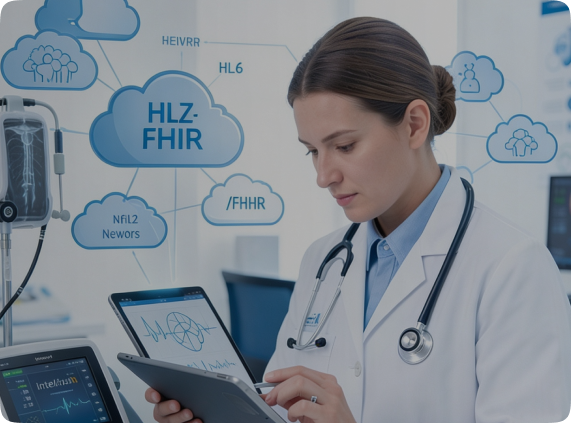
EHR/EMR Systems We Integrate With
We integrate across leading EHR platforms and specialty systems—adapting to each vendor’s data models, interfaces, and integration constraints.
Key platforms include:
Epic — enterprise-scale EHR with complex interoperability workflows
Oracle Health — widely adopted system with diverse interface requirements
GE Healthcare — imaging and clinical systems with deep workflow dependencies
Philips — device and imaging ecosystems requiring tight data synchronization
And other leading EHRs and healthcare platforms
Our Approach
Integration Engineering Approach
We implement EHR integrations with an architecture-first approach—focused on data integrity, reliability, and scalability.
Integration Discovery
Assess source/target systems, data models, and interface specs (HL7, FHIR, DICOM)
Architecture & Interface Design
Define interface topology, data flows (event-driven/API), transformations, and error handling
Build & Configuration
Build HL7 interfaces, FHIR APIs, DICOM connectors, SMART apps, device bridges, and middleware pipelines using engines like Mirth Connect, Cloverleaf, and Rhapsody
Validation & Workflow Testing
Execute field-level mapping, message validation, and workflow testing across edge cases
Go-Live & Scale
Deploy with logging, message tracking, alerting, and performance tuning
Use Cases
Use Cases We Solve
PACS ↔ EHR Integration
Align imaging orders, study status, and reports for real-time clinical access
Medical Device Data Ingestion
Capture and normalize high-frequency device data into structured EHR records
Clinical–RCM Data Alignment
Sync encounters, procedures, and codes to reduce billing gaps and denials
Cross-System Patient Data Exchange
Maintain a consistent patient record across EHRs and specialty systems
Order & Result Workflow Integration
Ensure seamless flow of orders (ORM) and results (ORU) across systems
Legacy ↔ Modern System Interoperability
Bridge HL7-based systems with FHIR/API-driven applications
Client Success
EHR Integration Case Studies
Real-world results from standards-based EMR integration across neonatal, cardiology, and digital health workflows.
Neonatal Care
Automated Medical Data Processing for Newborn Care
Challenge
Manual neonatal data entry across NICU devices and EHR systems created compliance risks, transcription errors, and siloed patient records that delayed critical clinical decisions.
Solution
Automated EMR integration with real-time data transmission. Configurable data transformation (JPG, PDF, TIFF). Intuitive HL7 configuration system. FHIR compliant interoperability with EHR validation.
Outcomes
Seconds vs. hours
for data transfer
100%
error-free automation
90%
faster data delivery
Cardiology
Cardiac Device Company — ECG Reporting in Epic
Challenge
ECG data siloed outside Epic. Cardiologists faced 30–45 minute delays per case. No AI-assisted anomaly detection for real-time triage in the clinical workflow.
Solution
FHIR-based data orchestration layer pushing ECG data into Epic. AI arrhythmia classification (AUC >92%). CDS Hooks triggering real-time alerts. Zero-latency data availability in 3 seconds.
Outcomes
40%
Faster diagnosis
95%
Data accuracy
35%
Workflow efficiency
Digital Health / Diabetes
AI-Powered Insulin Dosing Platform — Epic Integration
Challenge
Low adoption due to separate login outside Epic. No real-time glucose integration feeding the AI model. Need for explainable AI to meet compliance and build clinician trust.
Solution
AI dosing engine embedded in Epic via App Orchard using SMART on FHIR microservices. Real-time glucose telemetry with sub-2-second latency. Explainable AI framework with audit trails for regulatory traceability.
Outcomes
70%
More clinical adoption
88%
Fewer dosing errors
100%
Epic Showroom listed
BridgeFast: Integrate with EHRs 10x Faster
Book a free 30-minute integration strategy call. We’ll map your first EMR connection, assess your timeline, and give you an honest scope — no sales pressure.
Why DASH
WHY DASH.
Not just integration — end-to-end
partnership from day one
EHR integration is more than an interface challenge—it involves clinical workflows, data quality, compliance, infrastructure, and adoption. DASH combines software, device, interoperability, AI, QA, and regulatory expertise to move your product from pilot to production across real healthcare environments.
What sets us apart:
- Healthcare-first engineering: Experience across MedTech, digital health, providers, payers, and specialty workflows.
- Full-stack integration depth: Device, cloud, middleware, data, API, EHR, and workflow layers.
- Standards-based execution: HL7, FHIR, SMART on FHIR, DICOM, X12, C-CDA, and custom APIs.
- Regulated-product mindset: Security, auditability, validation, and compliance-aware delivery.
- Scale beyond the first site: Reusable architecture for multi-hospital deployment.
Frequently Asked Questions
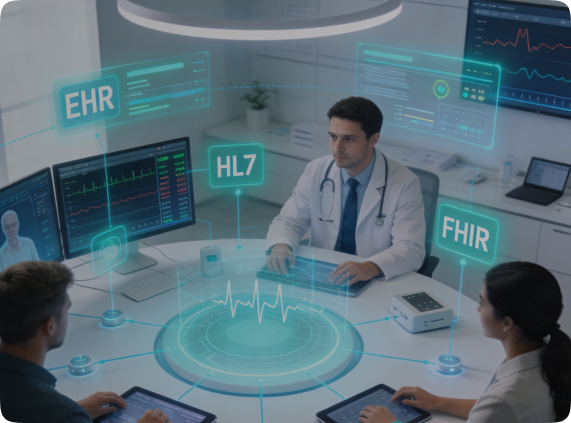
EHR integration connects healthcare systems to enable seamless data exchange, improving workflows, and patient care.
HL7 is a traditional messaging standard, while FHIR is a modern, API-based framework designed for real-time interoperability.
Timelines vary based on system complexity, but most integrations range from a few weeks to several months.
EHRs, PACS, RIS, medical devices, billing systems, and third-party healthcare applications can all be integrated.
