Why Enterprise Imaging Is a Strategic Priority for Healthcare CIOs?
Medical imaging is permanently beyond departmental control. It represents the largest, fastest growing, and most clinically vital data asset across modern health systems. An enterprise imaging strategy has become a board-level and CIO-level priority because imaging is no longer confined to radiology. However, the foundational infrastructure hospitals initially deployed to govern this massive influx of information was fundamentally incapable of handling its current scale and operational scope.
While radiology dictates major volume, enterprise stakeholders have radically expanded. Cardiology produces hemodynamic studies, echocardiograms, and catheterization images. Pathology generates enormous whole-slide digital images. Dermatology, ophthalmology, gastroenterology, and specialized wound care capture highly sensitive visual records carrying severe diagnostic and legal implications
What most hospitals have instead of a strategy for managing all of this is a collection of disconnected departmental systems, each one purchased to solve a specific problem, none of them designed to work together. For health system leadership and CIOs, that fragmentation is now a strategic liability, not just an IT inconvenience.
Challenges with Fragmented Imaging Systems
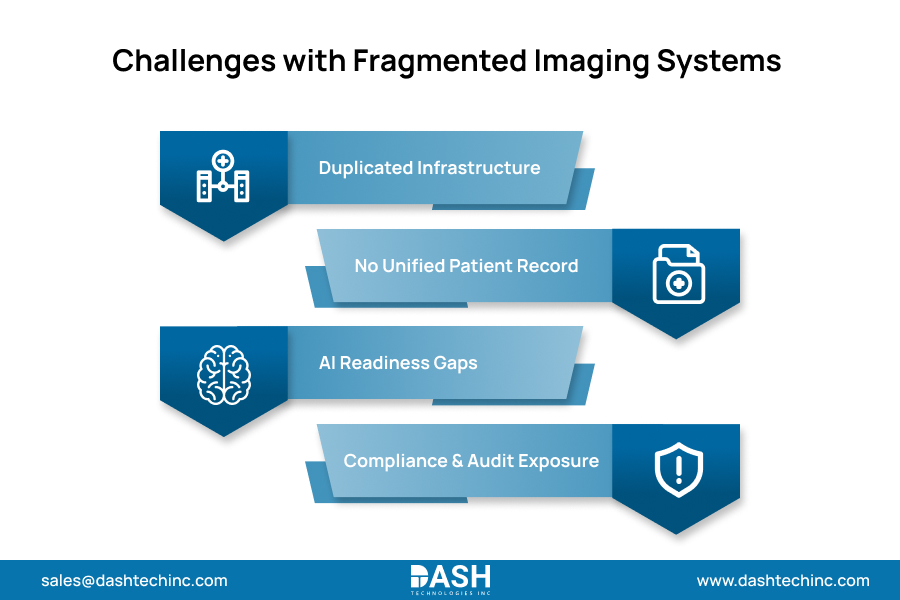
The imaging data silos that have accumulated across hospital departments create compounding operational, clinical, and financial problems. Each system solved a local problem and created a systemic one.
- Duplicated Infrastructure
Radiology runs a PACS. Cardiology runs a separate CVIS. Pathology has its own image management platform. Each requires dedicated storage, vendor contracts, maintenance cycles, and support staff; multiplying costs without multiplying value. - No Unified Patient Record
When imaging from different specialties lives in separate systems, clinicians assembling a patient’s longitudinal record must navigate multiple portals. Critical findings from prior studies are missed because they’re inaccessible in the moment of care. - AI Readiness Gaps
Clinical AI tools in imaging require consistent, accessible, high-quality data. Fragmented storage architectures and chaotic metadata guarantee that health systems cannot deploy their massive AI investments. Intelligence exists, but structural isolation renders it entirely useless. - Compliance and Audit Exposure
Imaging data often spread across different platforms. This makes it hard to enforce retention policies. Access logs and audit trails are also difficult to manage consistently. Regulatory exposure follows directly from that inconsistency.
What Enterprise Imaging Actually Means?
The term enterprise imaging requires a strict executive definition. Enterprise imaging platforms are never simply enlarged legacy PACS. They dictate a fundamental architectural shift governing how clinical data is stored and leveraged across the entire organization.
Executing this architecture requires four uncompromising pillars:
- Unified Storage: Deploying a vendor-neutral archive consolidates all departmental imaging into a single governed repository. This permanently destroys isolated silos while maintaining strict clinical workflows.
- Universal Viewer: Implementing a singular diagnostic interface guarantees immediate, role-based access to all visual data. Providers review the full diagnostic picture without toggling between legacy systems.
- Standardized Interoperability: Enforcing DICOM, HL7, and FHIR protocols ensures continuous bidirectional synchronization with EHR frameworks and clinical AI inference tools. This completely removes the need for individual connection builds.
- Centralized Governance: Organizations must apply uniform policies for access control, data retention, de-identification, and audit logging across all imaging data, regardless of the originating department.
This is never a basic software upgrade. An uncompromising enterprise imaging strategy demands treating visual data as foundational enterprise infrastructure, applying the exact rigorous governance required for core financial operations.
Build an Imaging Strategy That Delivers ROI
Standardize imaging systems and governance to drive measurable efficiency gains, reduce operational overhead, and scale with enterprise needs.
Talk to Our ExpertsWhy CIOs Are Investing in Enterprise Imaging?
The modern healthcare CIO has transitioned from being an operational manager of IT hardware to a strategic driver of clinical and financial success. In this context, PACS modernization and enterprise imaging are critical investments for several strategic reasons.
- Vendor Consolidation and Cost Control: Maintaining legacy systems is expensive. CIOs can save money by consolidating storage and standardizing viewing apps. They can retire from outdated departmental PACS. This change cuts licensing fees, lowers hardware maintenance costs, and reduces the server footprint.
- Driving Healthcare Digital Transformation: You can’t create a modern, smart hospital with broken data. Telehealth programs need quick access to medical images. So do remote patient monitoring and virtual tumor boards. Enterprise imaging gives the data flow needed to turn these digital care models into reality.
- AI Readiness: Artificial Intelligence is revolutionizing diagnostics, but AI algorithms require massive, centralized, and meticulously normalized datasets to function. CIOs know that if their hospital’s imaging data remains trapped in departmental silos, they will be entirely locked out of the AI revolution. An enterprise archive creates the clean data pipeline necessary to train and deploy machine learning models safely and effectively.
Top Benefits of Enterprise Imaging
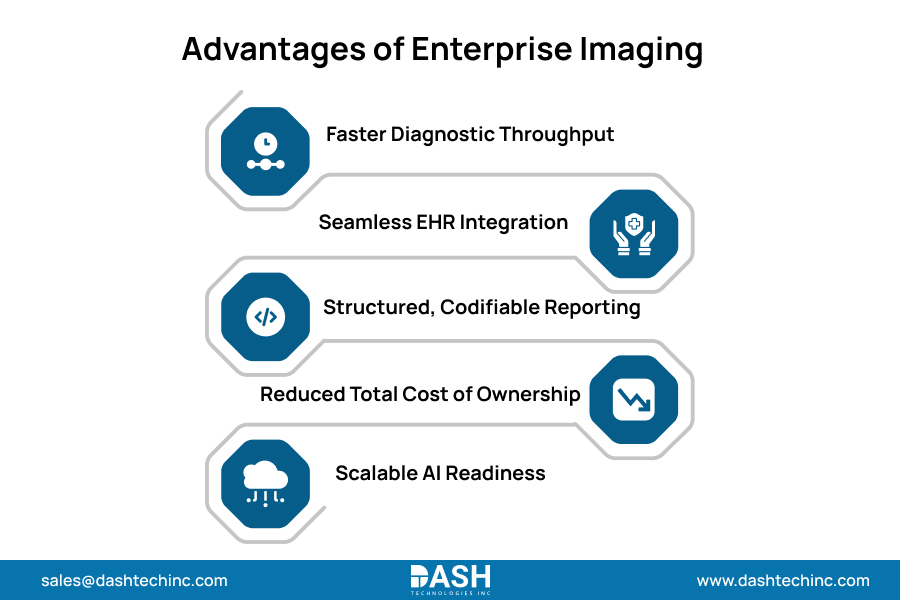
Executing a rigorous enterprise imaging strategy produces immediate, quantifiable returns. Health systems are architecting this transition to report aggressive improvements across clinical quality, total cost of ownership, and strict imaging workflow optimization.
- Accelerated Diagnostic Throughput: Consolidated worklists and algorithmic triage cut down the time between getting images and clinical execution. This boost helps increase the number of cases radiologists can handle.
- Fluid EHR Synchronization: Mandating FHIR-compliant archives guarantees imaging intelligence flows natively into the EHR. Care coordination loops close automatically. The manual reconciliation burden disappears. This is the foundation that hospital interoperability programs require imaging to be part of, not separate from.
- Structured Clinical Reporting: Advanced platforms mandate machine-readable, codifiable findings instead of useless free-text narratives. This structurally opens downstream analytics and enterprise quality measurements.
- Total Cost Eradication: Consolidating fractured departmental storage onto a singular Vendor Neutral Archive eliminates redundant vendor contracts and bloated IT support. Systems operating multiple legacy platforms routinely secure a 35 percent cost reduction within three years.
- Algorithmic AI Readiness: A unified, standards-compliant repository serves as the absolute prerequisite for clinical AI deployment. This architectural foundation guarantees that the facility can successfully operationalize future AI-driven diagnostic support.
Key Components of Enterprise Imaging Architecture
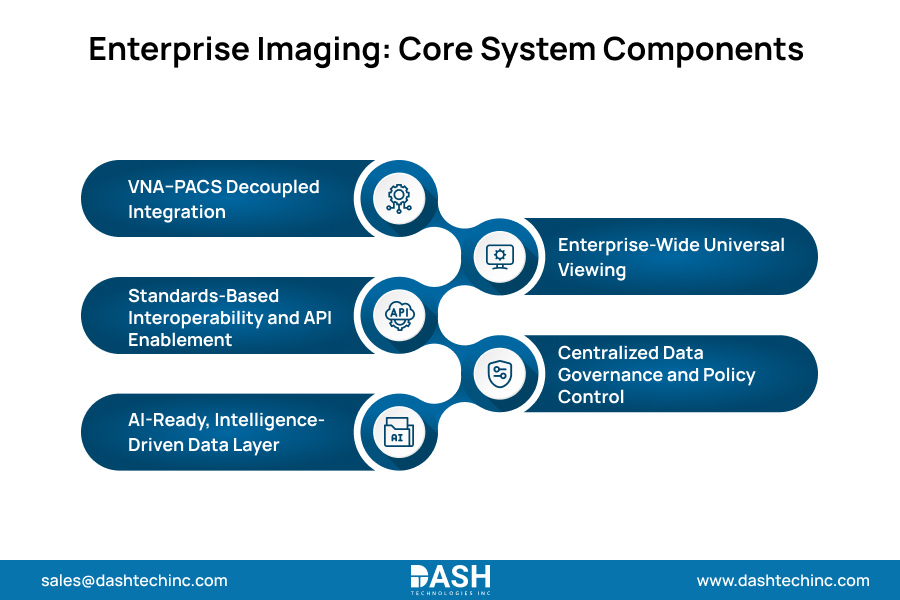
A dominant enterprise imaging strategy relies on strict foundational architecture, never just product selection. CIOs must construct layered capabilities dictating integration, governance, and enterprise scale.
- VNA PACS integration: A vendor-neutral archive aggressively decouples image storage from departmental applications. This breaks vendor lock-in and permanently alters the structural relationship between workflow tools and the foundational data repository.
- Universal Viewers: Deploying universal enterprise viewers grants consistent diagnostic access across all medical departments, bypassing isolated radiology environments to drive immediate facility adoption.
- Interoperability Services: Architecture must mandate standards-based exchange, metadata normalization, and direct EHR connectivity. Without aggressive API enablement, the platform simply devolves into a larger data silo.
- Rigorous Data Governance: Executive leadership must enforce absolute policies for access control, retention schedules, and identity management. Infrastructure lacking strict governance simply replicates historical fragmentation failures.
- Algorithmic Readiness: The environment must function as an active intelligence engine, structuring clinical visuals for immediate operational reporting, quality monitoring, and future clinical AI deployments.
Conclusion
Imaging is no longer a radiology-only infrastructure. It is enterprise data, and that changes how healthcare CIOs need to think about architecture, investment, and digital transformation. An enterprise imaging strategy is not just about modernizing one department’s technology. It is about creating a scalable, interoperable, and AI-ready foundation for how imaging supports the entire health system.
That is why enterprise imaging has become a strategic investment rather than a technical upgrade. For CIOs, the opportunity is bigger than storage consolidation or PACS modernization alone. It is about integration, scalability, governance, and the ability to make imaging data more usable across the enterprise.
About Dash

Dash Technologies Inc.
We’re technology experts with a passion for bringing concepts to life. By leveraging a unique, consultative process and an agile development approach, we translate business challenges into technology solutions Get in touch.