Reducing Radiology Backlogs with Workflow Analytics
Radiology workflow analytics helps hospitals spot stalled work. This way, they can reduce reporting delays and avoid patient care. A radiology backlog builds when the need for imaging exceeds reporting capacity. This leads to unread studies and pending follow-ups. Rising imaging volumes and tight radiologist availability require hospitals to gain better visibility into imaging workflow challenges and workload distribution. Relying on already stretched teams for increased output is unsustainable.
Imaging exam volume grew 31% over a recent seven-year period compared to a 24% growth in working radiologists. This baseline data directly quantifies the widening pressure on imaging services. For a broader context on why imaging data matters at the enterprise level, see Why Radiology Data Is the Backbone of Digital Health Transformation.
What Causes Radiology Backlogs?

Causes of radiology backlogs rarely come from one issue alone. In most departments, they build gradually as several operational weaknesses compound throughout the day.
- Rapid Growth in Imaging Volumes
Rising demand for advanced imaging and unscheduled scans increases reporting pressure. Departments fall behind when clinical case complexity exceeds standard workflow design. - Limited Radiologist Capacity
Capacity depends on headcount, subspecialty coverage, and non-interpretive duties. The UK’s Royal College of Radiologists reported 30% shortfall in 2023. They noted 97% of clinical directors cited workforce shortages as the primary driver of delays. - Inefficient Worklist Management
Static worklists fail to account for varying case urgency. This operational friction allows critical cases to sit while individual radiologists become overburdened. - Fragmented Imaging Systems
Loosely connected PACS, RIS, and EHR databases delay system handoffs. Missing prior exams and manual case routing directly lengthens the time from image acquisition to the final report.
The Impact of Radiology Backlogs on Patient Care and Operations
Radiology turnaround time degradation creates consequences that extend well beyond departmental performance metrics into direct patient safety and institutional financial risk.
- Delayed Diagnoses
Clinicians wait longer for critical diagnostic information when facing delayed imaging reports. These bottlenecks force postponed treatment decisions. - Increased Clinician Frustration
Referring physicians rely on fast radiology turnaround time to guide clinical action. Slow reporting forces clinicians to repeatedly query radiology teams for updates. - Reduced Departmental Efficiency
Radiology operational challenges multiply as teams struggle to manage growing worklists. Compounding backlogs directly disrupt scheduling and workflow planning. - Longer Patient Wait Times
Patients experience extended wait periods for imaging results and follow-up consultations. These delays directly degrade patient satisfaction and overall clinical outcomes.
For a related perspective, see How Digital Health Platforms Are Reducing Reporting Delays in Radiology.
Why Traditional Workflow Management Falls Short?
Traditional imaging workflow management approaches often rely on manual processes and limited operational visibility.
- Static Worklists: In many departments, imaging studies appear in simple chronological queues. These lists provide limited information about case complexity or urgency.
- Manual Case Assignment: Supervisors or radiologists may manually assign studies based on availability. These manual radiology workflows can lead to uneven workload distribution.
- Limited Workload Visibility: Radiology leaders lack direct visibility into active departmental workload patterns without integrated analytics tools. System bottlenecks only become visible after reporting delays register on the schedule.
Relying on legacy systems forces a reactive operational stance. Department heads only identify capacity failures after backlogs form, requiring analytics-driven infrastructure to establish proactive resource management.
Fix What’s Slowing Your Radiology Workflow
Identify hidden bottlenecks, balance workloads, and improve turnaround times with analytics built for real imaging environments.
Talk to Our ExpertsHow Workflow Analytics Improves Radiology Operations?
Radiology workflow analytics changes the conversation from “we are busy” to “this is where the workflow is breaking.” Imaging operations analytics gives teams measurable visibility into how work enters, moves through, and exits the reporting process.
Analytics helps identify bottlenecks in reporting workflows by showing where cases stall, whether at image acquisition, queue assignment, interpretation, sign-off, or notification. It shows an imbalance in radiologist workloads. This is done by comparing queue depth, case mix, and turnaround time across different readers or subspecialties. That matters because two radiologists may each have 20 studies pending, but the true workload may be very different if one has mostly routine X-rays, and the other has complex CT or MRI studies.
It also highlights modalities causing delays. If one site consistently shows longer MRI turnaround time or a higher age of unread CT exams, leaders can investigate whether the issue is staffing, protocoling, workflow design, or technology friction.
Radiology productivity analytics does not replace operational judgment. It strengthens it by making invisible workflow patterns visible.
Key Workflow Metrics Radiology Leaders Should Track

Tracking specific radiology performance metrics and radiology productivity metrics establishes the quantitative baseline for backlog management. Operational improvement requires monitoring these core data points:
- Report turnaround time (TAT): Measuring report turnaround time captures the exact duration from study completion to the finalized report. Segmenting this data by modality and priority tier enables precise root cause identification.
- Worklist backlog volume: Real-time count of studies awaiting interpretation, tracked continuously rather than sampled to enable same-day intervention when thresholds are approached.
- Case complexity distribution: Breakdown of study mix by complexity level to distinguish genuine capacity constraints from workflow inefficiencies masked by aggregate throughput numbers
- Radiologist productivity metrics: Calculating specific radiology productivity metrics reveals the studies interpreted per hour by individual physicians. Departments use this data to identify high performers and standardize successful workflow habits.
- SLA adherence rates: Evaluating SLA adherence rates determines the percentage of studies meeting defined turnaround standards across distinct urgency tiers(stat, urgent, routine). Continuous measurement ensures strict operational control over reporting timelines.
- Backlog age distribution: Mapping backlog age distribution calculates exactly how long studies remain pending. Segmenting this timeline highlights chronic reporting delays and acute system spikes that require immediate operational response.
Using Workflow Analytics to Prioritize High-Impact Cases
Radiology case prioritization is one of the strongest applications of intelligent imaging workflow design. Not every case in the backlog carries the same clinical urgency, operational consequence, or service expectation.
With workflow analytics, departments can support automated prioritization by combining exam type, patient location, target TAT, and queue age. Critical cases can be escalated faster when systems detect that a study is nearing or exceeding a high-priority threshold. Balanced workload distribution also becomes more practical when queue management reflects both study count and complexity.
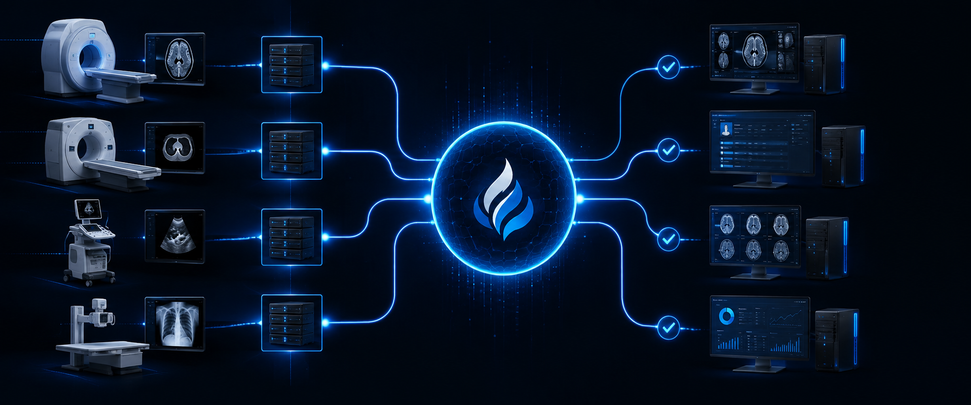
This is where analytics and interoperability meet. Prioritization works best when imaging systems, reporting tools, and clinical context are connected well enough to identify what matters in real time. That kind of coordination becomes much easier when imaging data flows cleanly across systems, which is why interoperability matters. For more on that, see Interoperability in Radiology: Why Integration Is Critical for Digital Health.
Building a Data-Driven Radiology Workflow Strategy
Implementing new technology requires a strict radiology workflow optimization strategy. Effective imaging operations management relies on direct observation and standardized data inputs.
Leadership must physically shadow the clinical team to identify exact manual friction points in the reading room before deploying new software.
Imaging technologists across all facilities must use identical naming conventions and priority codes when sending studies to the central PACS.
Facilities must then implement role-based analytics dashboards. These tools provide macro-level hospital trends to executives while giving shift supervisors real-time visibility into active reading queues.
Finally, departments must continuously monitor performance metrics. Aggregating data in weekly huddles helps improve daily scheduling. It also fixes operational drift before backlogs can start.
Conclusion: Workflow Analytics Enables Sustainable Radiology Operations
The future of radiology operations depends on implementing proactive radiology workflow modernization. Radiology workflow analytics provides hospitals with the exact operational context required to identify delay causes and accelerate turnaround times.
Rising imaging demand requires healthcare organizations to invest directly in workflow visibility and performance metrics. Building this data-driven infrastructure definitely reduces active backlogs to stabilize care delivery.
To explore how your organization can implement these strategies effectively, connect with our experts
Frequently Asked Questions
About Dash
Dash Technologies Inc.
We’re technology experts with a passion for bringing concepts to life. By leveraging a unique, consultative process and an agile development approach, we translate business challenges into technology solutions Get in touch.