Orthopedic Data Analytics: Turning Surgical Data into Better Outcomes and Smarter Decisions
Orthopedic teams have plenty of data available to them. What they really lack is clarity.
Most orthopedic departments and practices all over the U. S. are currently performing more procedures than ever before joint replacements, sports injuries, spine cases while at the same time, they have to deal with tighter margins, staffing…
Everyone agrees that data should be helpful. Actually, it often causes delays.
Spreadsheets arrive weeks late. Reports answered yesterday’s questions. Dashboards look impressive but don’t reflect how orthopedic care actually works.
That gap—between having data and using it confidently—is exactly where orthopedic data analytics proves its value.
The Real Problem Isn’t Data. It’s Fragmentation.
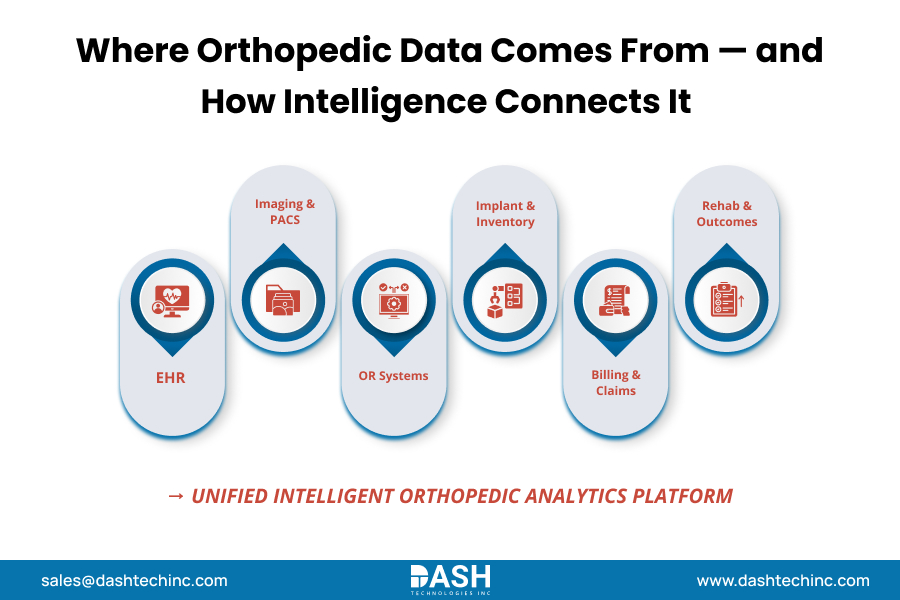
Orthopedics touches more systems than most service lines. Clinical notes live in the EHR. Images sitting in PACS. OR data comes from scheduling systems. Implant costs live somewhere else entirely. Billing and claims data arrive after the fact.
Each system works fine on its own. Together, they rarely tell a complete story.
For leadership teams, this creates real friction:
- Surgeons don’t trust reports that lack clinical nuance
- Administrators struggle to compare performance across sites or providers
- Finance teams see rising implant costs but can’t explain the variation
Without connected analytics, decisions rely on experience and intuition—valuable, but no longer sufficient in today’s environment.
What Orthopedic Data Analytics Actually Changes
When analytics are designed specifically for orthopedic workflows, they stop being “reports” and start becoming decision tools. The impact shows up in a few key areas.
Clearer Visibility into Surgical Outcomes
Instead of looking back at the results months later through a review, teams are now able to keep up with trends on different types of procedures, patient cohorts, or surgeons. It becomes quite easy to identify the patterns concerning the complications, the readmissions, and the recovery timelines at an early stage. There is still enough time to act if necessary.
More Predictable Length of Stay
Variation in LOS often has little to do with the procedure itself and everything to do with the process. Analytics helps identify where delays happen, whether it’s pre-op prep, post-op mobility, or discharge coordination.
Even small reductions add up quickly at scale.
Implant Cost Control Without Oversimplification
Implant spend is a sensitive topic. Surgeons want a choice. Finance wants consistency. Analytics bridges that gap by showing cost in context—paired with outcomes, not just price tags.
This supports informed discussions instead of blanket standardization.
Proactive Risk Identification
By means of predictive analytics, teams are enabled to identify higher, risk patients at an earlier stage. This leads to well, thought, out care, more focused patient education, and lesser post, surgery surprises.
It’s not about replacing clinical judgments. It’s about supporting it.
Smarter Use of OR Time and Staff
When OR utilization data is tied to real workflows, inefficiencies stand out. Block time, staffing, and turnover issues become easier to address—especially important for ASCs and high-volume programs.
Why Many Analytics Efforts Stall
Most orthopedic organizations already have analytics tools. What they lack is relevance.
Generic dashboards don’t reflect surgical pathways. Static reports don’t keep pace with operational reality. And when clinicians don’t trust the data, adoption stalls.
Effective orthopedic analytics works because it:
- Mirrors how orthopedic teams actually practice
- Connects clinical, operational, and financial views
- Delivers insight fast enough to matter
When that happens, conversations change. Decisions move faster. Alignment improves.
Turn Orthopedic Data into Clear Decisions
Connect outcomes, operations, and costs with analytics designed for orthopedic care
Explore Intelligent Orthopedic SolutionsHow U.S. Orthopedic Organizations Use Analytics in Practice
Hospital Orthopedic Departments
Health systems use analytics to reduce unwarranted variation, improve bundled payment performance, and support service line growth—without forcing one-size-fits-all clinical decisions.
Multi-Location Orthopedic Practices
Practice leaders have the opportunity to see across all their locations and figure out which procedures and which sites not only lead to strong outcomes but are also profitable in the long run.
Ambulatory Surgery Centers
Regarding ASCs, analytics typically look at metrics like how efficiently the OR is being used, how well the staff is being utilized, controlling the cost of implants, and the effectiveness of same, day discharge. There is less room for error, and therefore, the right insight is of greater value.
Across settings, the common thread is confidence—knowing decisions are backed by reliable, specialty-specific data.
Where Orthopedic Analytics Is Headed
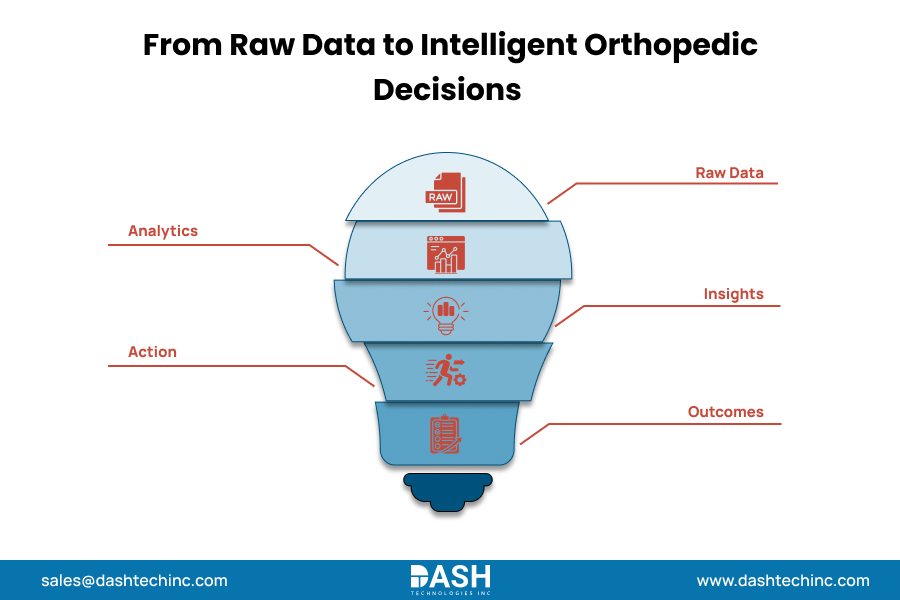
The future of orthopedic analytics is less about looking backward and more about anticipating what’s next.
Predictive models, AI-assisted insights, and population-level musculoskeletal analytics are already shaping how organizations plan care, manage risk, and negotiate value-based arrangements.
The goal isn’t automation for its own sake. It’s better decisions, made earlier, with less friction.
Why Intelligent Orthopedic Analytics Is No Longer Optional
Orthopedic care has become too complex to manage with disconnected reports and gut instinct alone.
Organizations that succeed moving forward will be the ones that:
- Understand their data in context
- Act on insight instead of hindsight
- Align clinical quality with operational and financial realities
Intelligent orthopedic analytics brings those pieces together. Not by adding complexity—but by removing uncertainty.
And in today’s orthopedic landscape, clarity is one of the most valuable tools you can have.
A Practical Next Step for Orthopedic Leaders
Orthopedic data analytics works best when it’s guided by people who understand both the clinical realities of orthopedic care and the operational pressures of U.S. healthcare systems.
That’s where consulting for specific topics can really be different. Our team of orthopedic specialists, instead of producing general dashboards, work side by side with the healthcare professionals to ensure the data strategy is in line with the actual workflows, performance goals, and value, based care requirements.
In case your healthcare facility is considering a way to make orthopedic data more understandable for decision, making and lead to tangible improvements, this article can be very helpful.
Talk to our orthopedic analytics consultants and tell them what you need.
Frequently Asked Questions
About Dash

Dash Technologies Inc.
We’re technology experts with a passion for bringing concepts to life. By leveraging a unique, consultative process and an agile development approach, we translate business challenges into technology solutions Get in touch.