Intelligent Orthopedic Care: How AI & Data Revolutionize Arthroplasty Outcomes
Orthopedic surgery is not what we knew it used to be. Hospitals and surgeons are now expected to deliver precise, predictable, and patient-specific joint replacement outcomes. This is in addition to their increasing caseloads, complex patient profiles, and operational challenges.
This is where intelligent orthopedic solutions based on AI in orthopedic surgery are revolutionizing the treatment of orthopedic patients. Right from pre-op planning to conducting the surgery and post-op recovery, data-driven orthopedic care is ensuring that orthopedic patients are treated not through intuition but through standardized treatment processes.
Imagine a hospital preparing for a knee replacement. AI-powered orthopedic systems examine the patient’s scans, indicate possible complications, and recommend the best possible positions for the implant. During surgery, intelligent guidance ensures accurate implantations during the surgery. After discharge, the wearable sensors allow for constant patient surveillance and early intervention.
Hospitals and MedTech teams adopting AI-enabled orthopedic platforms aren’t experimenting anymore; they’re standardizing outcomes, improving efficiency, and scaling quality. But how does this look like inside real orthopedic workflows?
Let’s walk through it.
Top Challenges in Arthroplasty
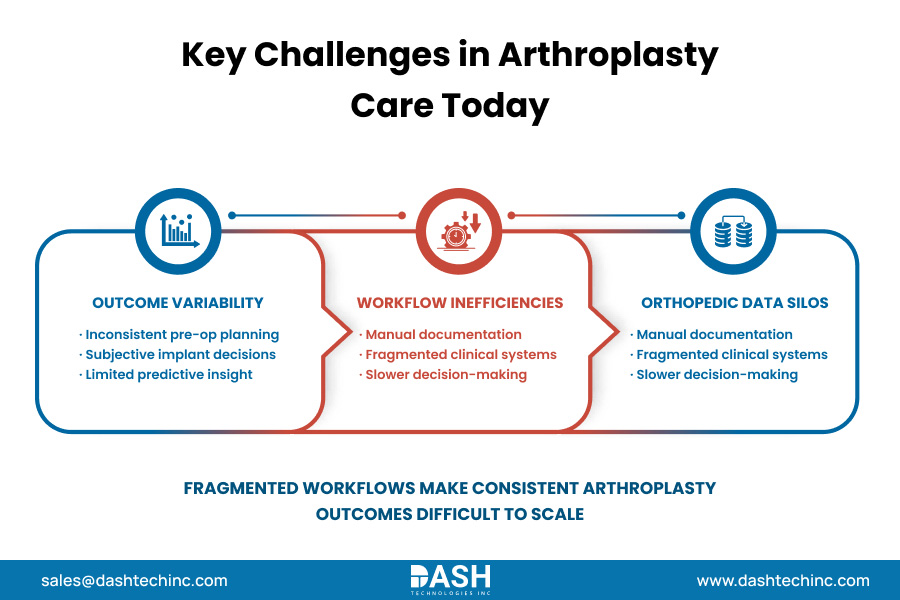
Even with modern techniques, hospitals experience challenges in orthopedic surgery workflows, especially in arthroplasty units.
- Outcome variability remains high
Despite surgeon expertise, orthopedic surgery outcome variability persists due to inconsistent pre-op planning, implant selection, and execution. Reliance on 2D imaging and experience alone introduces avoidable risk. - Arthroplasty care inefficiencies slow teams down
Manual documentation, fragmented imaging systems, and disconnected tools contribute to inefficiencies in joint replacement surgery. These orthopedic clinical workflow challenges increase cognitive load and delay decisions. - Orthopedic data silos limit insight
Clinical, imaging, and registry data often live in separate systems, creating orthopedic data silos. This fragmentation makes real-time, evidence-based decisions difficult particularly at a large scale.
These challenges make one thing clear: it is no longer a choice whether to use integrated AI workflows—it is a necessity for reliable outcomes in arthroplasty.
What Makes Orthopedics “Intelligent”?
So, what does intelligent orthopedic care actually mean in practice?
It’s the convergence of intelligent orthopedic technology, connected systems, and workflow-aware AI:
- AI and robotics in orthopedics enable precision and repeatability in the OR
- Smart orthopedic care systems support decision-making across the care continuum
- Digital transformation in orthopedics enables a single workflow that links planning, surgery, and recovery.
Behind this capability is a connected ecosystem that supports consistent execution, not isolated innovation.
Modernize radiology without disrupting workflows.
Streamline pre-op planning, surgery, and monitoring with AI built for real orthopedic workflows.
Explore Arthroplasty SolutionsBuilding the Intelligent Data Infrastructure
Every intelligent orthopedic system depends on a strong data foundation.
Effective hospitals invest in orthopedic data integration solutions that bring together imaging, EHRs, and outcomes data:
- EHR integration for orthopedics connects clinical and imaging data
- Orthopedic analytics platforms enable benchmarking and continuous improvement
- Healthcare data interoperability for orthopedics ensures systems work together securely
This AI-ready orthopedic data architecture supports predictive models and longitudinal outcome tracking.
Example: A hip replacement patient wears a mobility sensor for post-surgery. The system flags slower-than-expected recovery, enabling early intervention before complications escalate.
Unified data doesn’t just improve decisions—it improves the entire orthopedic operating model.
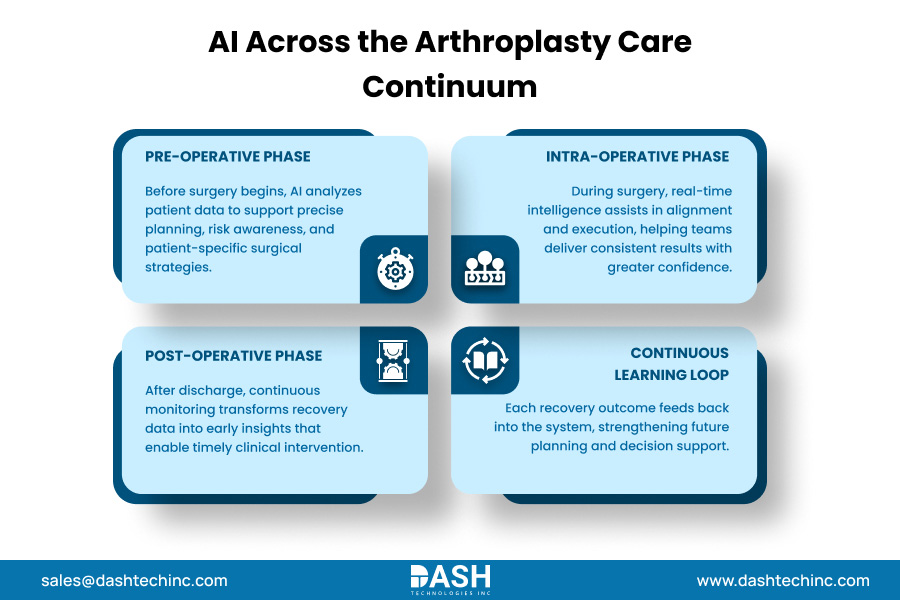
AI in Action: Pre-Op, Intra-Op, Post-Op
AI-Powered Pre-Operative Planning
AI preoperative planning for arthroplasty replaces guesswork with precision.
- AI surgical planning in orthopedics reconstructs 3D anatomy
- Predictive analytics in joint replacement identifies risk factors
- Patient-specific orthopedic planning personalizes implant selection
Intra-Operative Assistance & Decision Support
Inside the OR, AI intraoperative decision support in orthopedics ensures execution matches the plan.
- Smart surgical guidance systems provide real-time alignment feedback
- Orthopedic robotic assistance technology supports precise placement
- Real-time surgical analytics reduce variability across cases
This is not automation replacing surgeons—it’s intelligence supporting consistency.
Post-Operative Monitoring & Continuous Learning
AI postoperative monitoring in orthopedics ensures recovery is proactive.
- Remote orthopedic patient monitoring tracks mobility and vitals
- Orthopedic recovery analytics identify deviations early
- Wearable technology in orthopedics enables continuous insight
Each case strengthens continuous learning orthopedic systems, improving future care.
Patient & Provider Benefits
For Patients
- Personalized recovery pathways
- Fewer complications and easier rehabilitation
- Continuous engagement through patient-centric orthopedic technology
For Providers & Hospitals
- Streamlined workflows and reduced manual effort
- Clear benchmarking through outcome analysis
- Improved orthopedic surgical procedures with reduced variability.
Overcoming Adoption Challenges
Adopting orthopedic AI requires more than tools—it requires strategy.
Common orthopedic AI implementation challenges include integration, workflow change, and compliance.
Successful hospitals focus on:
- Secure orthopedic data platforms
- Interoperability solutions for orthopedics
- Compliance-ready orthopedic software
With the right partners, enterprise orthopedic technology platforms scale safely and sustainably.
Conclusion: The Future of Arthroplasty Is Intelligent
From planning to recovery, intelligent orthopedic solutions for hospitals are redefining arthroplasty care:
- Pre-op: Patient-specific, predictive planning
- Intra-op: Real-time guidance and robotic precision
- Post-op: Continuous monitoring and learning
Hospitals working with experienced orthopedic digital transformation partners are not just improving outcomes—they’re building resilient, scalable orthopedic programs.
Ready to explore how AI-powered orthopedic systems can standardize outcomes across your arthroplasty workflows? Connect with experts who design intelligent solutions around real clinical operations.
About Dash

Dash Technologies Inc.
We’re technology experts with a passion for bringing concepts to life. By leveraging a unique, consultative process and an agile development approach, we translate business challenges into technology solutions Get in touch.