
Why Orthopedic Departments Struggle to Turn Surgical Data into Actionable Insights
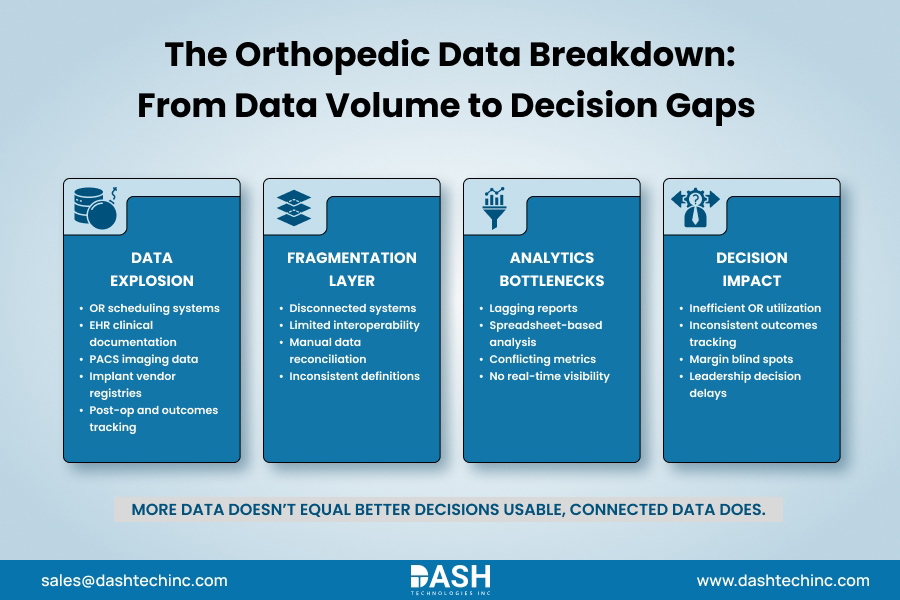
Orthopedic departments hold more surgical data than any other service line. But many find it hard to gain useful insights from this information. Orthopedic data analytics challenges often arise not from too little information. Instead, they come from healthcare data fragmentation within orthopedic departments. Operating room logs, implant registries, imaging archives, patient reported outcome databases, the list of orthopaedic surgery related data captured in hospitals is staggering.
Orthopedic services create massive amounts of data each day. Still, leaders face one inescapable truth. They lack access to usable, timely intelligence. This data is crucial for choices that impact patient care, improve operational efficiency, and financial performance.
The data paradox isn’t caused by the shortage of data; healthcare data fragmentation is the reason orthopedic departments can’t solve their biggest challenges. When data is trapped in silos, it’s difficult, if not impossible, to connect the dots across systems. Service line directors, surgeons, and administrators don’t have real-time answers. Instead, they depend on old reports, incomplete data, or gut feelings. This lack of real-time evidence limits their decision-making.
The Volume and Complexity of Orthopedic Surgical Data
Orthopedic surgical workflows are complex & Orthopedic data analytics challenges are unique. This makes them different from most other areas in healthcare. Each step in the patient’s journey creates touchpoints across the entire continuum of care. These touchpoints generate distinct information streams. Over time, all these streams must converge to provide a complete clinical picture.
Orthopedic clinical data & orthopedic operational data sources include:
- Pre-operative assessments, patient histories, and diagnostic imaging
- Intra-operative documentation including surgical technique, implant selection, and procedural times
- Post-operative recovery metrics, rehabilitation progress, and long-term outcomes
- Imaging data from PACS (Picture Archiving and Communication System)
- EHR documentation spanning multiple care episodes
- Vendor-specific implant tracking systems and registries
- OR management platforms tracking utilization and turnover times
In many other service lines, a procedure is a singular event. In orthopedics, a procedure includes several factors: a specific surgeon, a certain vendor’s device, a patient’s BMI, and a rehab plan for follow-up. Each element plays a crucial role in the outcome. This collection of data points along the care continuum generates a lot of orthopedic surgical data. But without the right analytics tools, it’s hard to understand that data consistently. It also makes comparisons across locations or time tricky.
Fragmented Systems Create Data Silos Across Orthopedic Programs
The biggest barrier to orthopedic analytics is orthopedic data silos. Hospitals have used top systems for imaging, documentation, OR management, and supply chain operations. While effective individually, these systems were never designed to function as a cohesive ecosystem.
Disconnected Clinical and Operational Systems
Clinical documentation and operational execution often live in separate digital worlds. A surgeon documents the medical necessity for a total joint replacement in the EHR, while the implant for that procedure is managed in a standalone ERP system. In many cases, there is no automated link between the two.
This creates the “swivel chair” problem: This fragmented healthcare data forces the staff to move between systems to piece together performance insights. Without orthopedic system integration, calculating true cost-per-case becomes a manual exercise built on spreadsheets and assumptions, undermining confidence in the results.
Limited Interoperability Between OR, EHR, and Imaging
The lack of orthopedic system integration between critical platforms creates visibility gaps that impact both clinical and operational performance. When OR scheduling systems don’t share data with EHRs, and imaging archives remain disconnected from surgical documentation, leaders lose the ability to correlate inputs with outcomes.
Surgeons can’t easily compare their implant choices with recovery trajectories, and administrators struggle to identify which procedures deliver the best value. For departments seeking integrated solutions, platforms that enable comprehensive orthopedic data integration become essential to breaking down these barriers.
Why Orthopedic Data Rarely Translates Into Decision-Ready Insights
Even when hospitals successfully aggregate their data into a warehouse, the orthopedic analytics challenges don’t disappear; orthopedic data analytics challenges just shift. The raw material exists, but transforming it into actionable orthopedic insights is a different problem entirely.
Healthcare data usability suffers due to three main factors:
Raw Data ≠ Insight: 5,000 lines of surgical logs do not equal insight; it just means a big list. Without cleaning & standardization, raw healthcare data causes more problems than it solves. For example, if one surgeon documents a case as “Total Knee,” another as “TKA.” Your reporting tool treats them as different procedures. Now your numbers are off before you even start analyzing.
Lagging Reports: In many departments, performance reports are generated monthly or quarterly. If a department chair gets a report showing how well the OR blocks were utilized for Q2, 45 days after the quarter is over, it’s useless. The behavior that led to low utilization is ancient history, and the chance to course correct has long passed.
Inconsistent Metrics: Trust is easily eroded in data analytics. If the finance team calculates “margin” = reimbursement- direct cost, but the surgical director calculates it differently, they are effectively speaking different languages. This inconsistency leads to countless meetings arguing about whose numbers are correct instead of discussing what the numbers represent.
Ready to Turn Your Orthopedic Data Into Actionable Insights?
See how integrated analytics can improve OR utilization, outcomes tracking, and service line performance.
Explore Orthopedic Analytics SolutionsThe Operational Impact on Orthopedic Service Lines
When your data lives in disconnected systems or buried Excel files, orthopedic service line performance pays the price. Orthopedic data silos aren’t small inconveniences; they’re operational blind spots that directly hurt orthopedic margins and burn out your team.
Inefficient OR Utilization
Good OR utilization orthopedics management depends on visibility. Without it, departments struggle to schedule blocks efficiently, reduce turnover delays, or maximize case volume. Who’s consistently running late? Which procedures take longer than scheduled? Where could you adjust to improve flow and revenue? Data silos keep those answers locked away.
Inconsistent Outcomes Tracking
When clinical systems don’t connect, orthopedic outcomes data tracking becomes inconsistent across the board. Documentation quality varies wildly between providers. The result? No reliable benchmarks. No clear path to quality improvement. And when value-based care contracts come up for negotiation, you’ve got nothing concrete to show payers.
Margin Pressure and Cost Blind Spots
Orthopedic margins are getting hammered by reimbursement rates, rising implant costs, and inefficient operating costs. But without integrated analytics, pinpointing where the leakage happens is nearly impossible. Are certain implants overpriced? Blind spots around implant pricing variations, supply waste, and procedure-level profitability prevent strategic cost management.
For departments focused on improving OR efficiency and margin performance, addressing these orthopedic data analytics challenges requires moving beyond fragmented data toward unified visibility.
Why Traditional Reporting Falls Short for Orthopedic Leaders
Orthopedic reporting challenges stem from slow, stale reports and backward-looking dashboards that won’t cut it for orthopedic leaders anymore. Orthopedic reporting fails most departments at their core because most hospitals struggle with the very basics of healthcare performance reporting & hospital orthopedic analytics.
Static Reports Provide Limited Context
Most orthopedic departments receive standardized reports that show what happened: OR utilization percentages, average length of stay, and implant costs, without explaining why. Leaders see that a problem exists, but cannot drill down to understand contributing factors.
Retrospective Insights Arrive Too Late
Monthly financial reports and quarterly quality dashboards look backwards. In a surgical environment where decisions happen in real-time, yesterday’s data cannot inform today’s choices. Orthopedic KPIs delivered weeks after the fact cannot support operational improvement.
The Gap Between Reporting and Analytics
There is a critical distinction between reporting and analytics. Reporting only tells you what happened, analytics will help you see patterns, forecast events and recommend actions. Most orthopedic programs are stuck in the reporting phase, leaving significant value untapped.
What Actionable Orthopedic Insights Actually Look Like
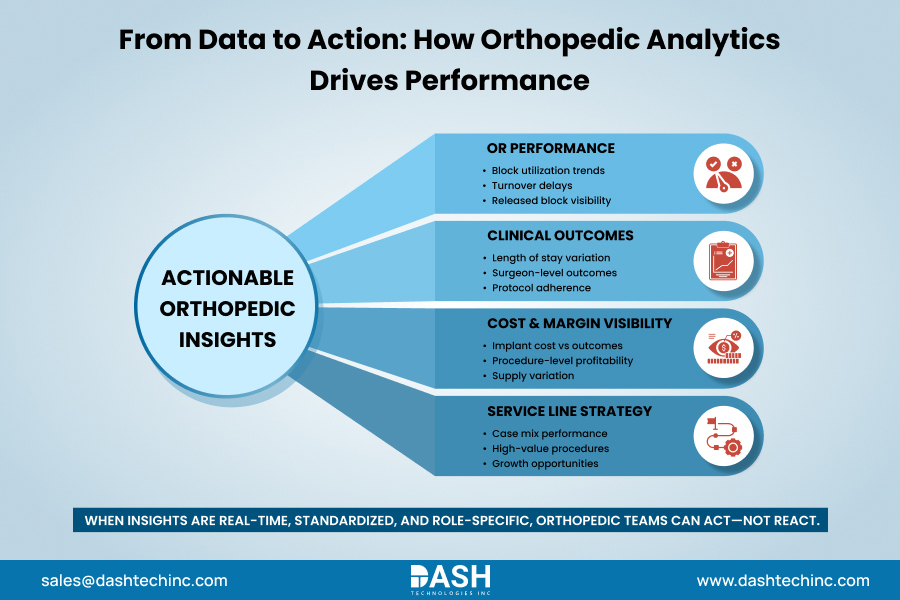
Orthopedic performance analytics is taking data and turning it into actionable information for decision-making. Actionable orthopedic insights are those that provide orthopedic leaders the ability to see opportunities in real time and act on them.
Key Examples of Actionable Insights
In practice, real-time orthopedic insights include:
- Case mix performance: Identify which procedures boost margins and outcomes. This helps focus on high-value services.
- Length of stay variation: Seeing which surgeons, anesthesiologists, or protocols are causing longer lengths of stay, that allows for targeted improvements.
- Implant cost versus outcomes: Correlating which devices you are choosing that may be contributing to a high revision rate or low patient satisfaction.
- OR block utilization trends: Real-time visibility into released blocks, turnover delays, and scheduling gaps that enable immediate operational adjustments
When displayed on an orthopedic dashboard, actionable intelligence is displayed visually so leaders can slice and dice by any dimension, compare metrics between surgeons or time periods, and click through to individual cases that fall outside of expected parameters.
How Modern Analytics Platforms Help Orthopedic Teams Act Faster
Modern orthopedic analytics platforms are designed to address the structural challenges that limit data usability. Rather than replacing existing systems, they focus on making data usable.
Key capabilities include:
- Aggregating data from multiple clinical and operational sources
- Normalizing definitions across facilities and service lines
- Visualizing performance through role-based dashboards
- Delivering insights aligned to leadership, clinical, and operational needs through healthcare analytics solutions
By improving orthopedic data visibility, analytics platforms help teams move from reactive reporting to proactive decision-making, without adding reporting burden.
Preparing Orthopedic Departments for Data-Driven Decision-Making
Data-driven orthopedics is less about collecting more data and more about making existing data usable for decision-making.
Orthopedic departments must first align analytics to service-line priorities such as OR utilization, implant cost control, length of stay, and outcomes variation. When data supports clearly defined goals, insights become easier to interpret and act on.
Standardizing orthopedic performance metrics across surgeons and facilities is equally critical. Consistent definitions for utilization, cost, and outcomes establish trust in the data and enable meaningful comparisons.
Finally, departments need timely, role-based visibility. Real-time dashboards allow leaders and clinicians to identify trends and outliers as they emerge, supporting proactive adjustments instead of delayed course correction.
When orthopedic data is aligned, standardized, and accessible, it becomes a reliable driver of clinical and operational improvement.
Conclusion: Turning Orthopedic Data Into Strategic Advantage
What sets elite orthopedic departments apart from those that struggle isn’t more data; it’s transforming data into actionable healthcare intelligence that can be linked to tangible improvements in quality, efficiency, and bottom-line performance. Orthopedic leaders aren’t satisfied with reports. They deserve clarity, confidence, and the competitive edge that comes from acting on real-time evidence instead of institutional “best guesses.”
If your department is ready to close the book on fragmented data and stagnant reporting, find out how integrated analytics platforms can help bring together all of your information streams and provide the visibility your department needs to thrive. Learn how intelligent orthopedic solutions can benefit your department and tackle all the orthopedic data analytics challenges. Contact us today!
Frequently Asked Questions
About Dash

Dash Technologies Inc.
We’re technology experts with a passion for bringing concepts to life. By leveraging a unique, consultative process and an agile development approach, we translate business challenges into technology solutions Get in touch.