Modern Diagnostic Healthcare: How Radiology Workflows Are Transforming Medical Imaging
Medical imaging plays a critical role in modern diagnosis. Today, clinicians have access to advanced tools such as CT, MRI, and sophisticated image processing technologies that deliver clearer and faster insights than ever before. As a result, diagnostic imaging has become central to clinical decision-making across healthcare settings.
However, the reality inside many hospitals and imaging centers often tells a different story. While imaging technology continues to advance, radiology teams are under growing pressure. Imaging volumes keep increasing, staffing levels remain tight, and expectations for faster reporting continue to rise. At the same time, radiologists are expected to do more administrative work, not less. In many cases, the systems designed to support them such as PACS, RIS, and EHR platforms do not communicate effectively, creating friction rather than efficiency.
Because of these challenges, the future of diagnostic healthcare depends on more than just better equipment or intelligent algorithms. Instead, it depends on how radiology workflows are designed, connected, and supported. When workflows are structured properly, imaging teams can work more efficiently, reports can be delivered faster, and diagnostic accuracy can improve. Ultimately, well-integrated workflows allow radiology departments to deliver better outcomes not only for clinicians, but for patients as well.
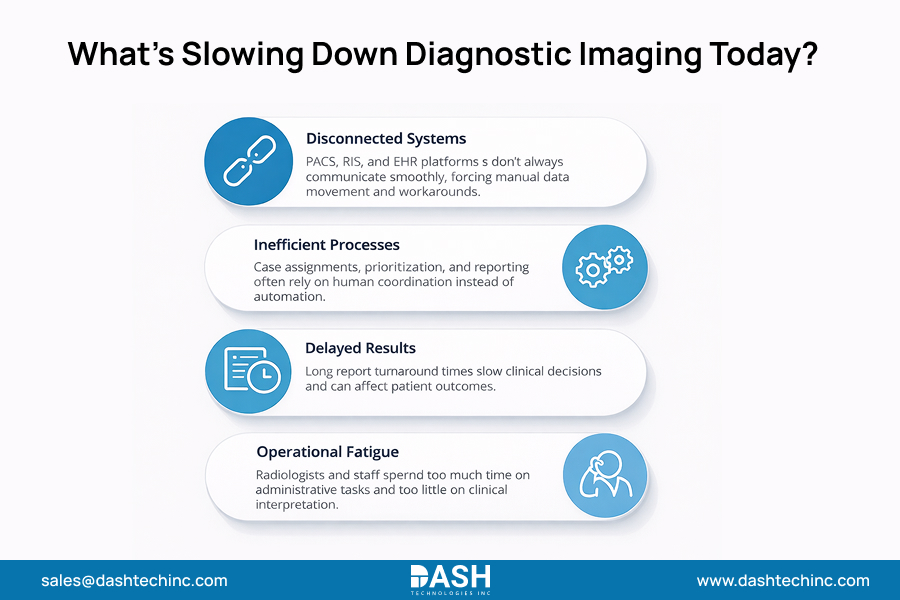
What’s Slowing Down Diagnostic Imaging Today?
Most healthcare organizations already have strong imaging technology. The challenge is how technology functions day to day. Many radiology departments still face:
- Disconnected systems
PACS, RIS, and EHR platforms don’t always communicate smoothly, forcing manual data movement and workarounds. - Inefficient processes
Case assignments, prioritization, and reporting often rely on human coordination instead of automation. - Delayed results
Long report turnaround times slow clinical decisions and can affect patient outcomes. - Operational fatigue
Radiologists and staff spend too much time on administrative tasks and too little on clinical interpretation.
For hospital leaders and imaging directors, this goes beyond IT. It’s an operational challenge. Better technology alone won’t fix it unless it’s supported by intelligent, well-designed workflows.
What “Modern Medical Imaging Solutions” Really Mean Today
Modern imaging is often associated with new equipment or AI models. In practice, real progress comes when technology is built into everyday clinical operations.
The most effective imaging environments today are designed around workflow. That includes:
- AI that helps prioritize urgent cases instead of leaving everything in a single queue
- Worklists that adapt to workload, urgency, and radiologist availability
- Structured, consistent reporting that’s easier to complete and easier to read
- Systems that share data seamlessly across PACS, RIS, and EHR platforms
- Cloud-based access that supports remote reading and teleradiology
In simple terms, modern imaging solutions connect technology and operations so imaging doesn’t just generate data—it delivers timely, actionable clinical insight.
How Better Workflows Improve Diagnostic Efficiency
Efficiency is one of the biggest pressures in radiology today. As demand grows, teams are expected to do more without burning out.
Well-designed workflows make that possible.
Automated case routing ensures urgent studies reach the right radiologist faster. Structured reporting reduces documentation time. Integrated systems eliminate hours spent re-entering data or tracking information.
The result isn’t just faster operations—it’s more predictable ones. Turnaround times improve. Backlogs shrink. Departments can scale without adding unnecessary complexity. For leadership teams, that means less operational strain and better use of resources.
Modernize Your Radiology Workflow
Streamline imaging operations with AI-enabled workflows that improve efficiency, accuracy, and patient care.
Explore Radiology Workflow SolutionsImproving Accuracy Without Replacing Clinical Judgment
Accuracy remains the foundation of diagnostic imaging. AI and automation play an important role—but not by replacing radiologists.
Instead, they support them.
AI can flag potential abnormalities and bring attention to critical findings. Structured reports reduce variability and make results easier to interpret across care teams. Integrated systems ensure radiologists have complete, up-to-date patient information at the point of reading.
Most importantly, these tools keep clinicians in control. Radiologists make the final decisions. Technology helps them work more consistently and confidently, especially in high-volume environments.
What This Means for Patients
Every scan represents a patient waiting for answers. Smarter, more connected workflows directly improve that experience.
Faster reports mean treatment can begin sooner. Better system alignment reduces repeat imaging caused by missing or inconsistent data. Shared information improves coordination across care teams.
Modern workflows also extend care beyond hospital walls. Teleradiology, remote collaboration, and cloud access allow specialists to support patients regardless of location.
Behind every operational improvement is a human outcome: fewer delays, clearer decisions, and a smoother care journey.
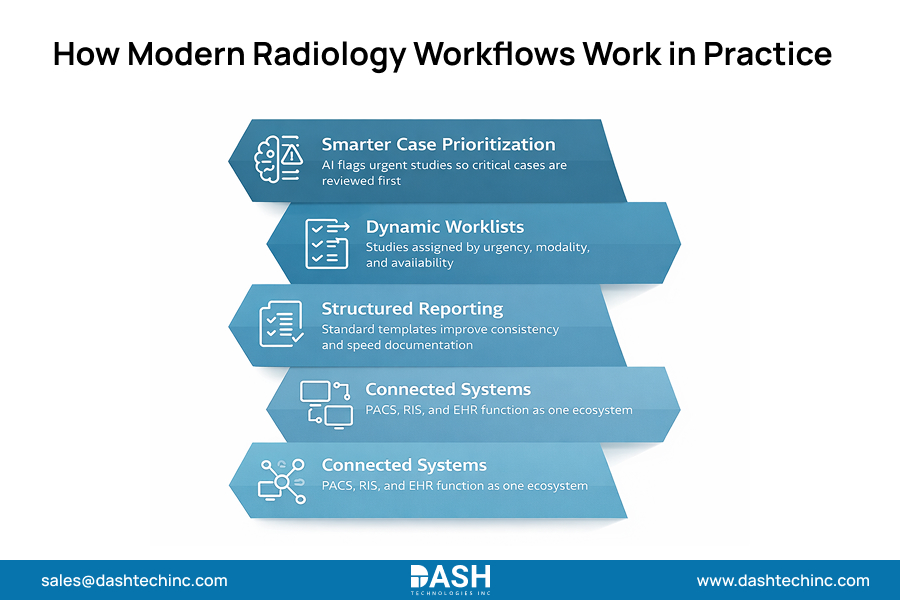
How Modern Radiology Workflows Work in Practice
Across healthcare organizations, workflow-driven imaging is already delivering real results:
- Smarter case prioritization
AI flags urgent studies, such as stroke or trauma, so critical cases are reviewed first. - Dynamic worklists
Studies are assigned based on urgency, modality, and availability, reducing bottlenecks. - Structured reporting
Standard templates improve consistency, speed documentation, and support compliance. - Connected systems
PACS, RIS, and EHR platforms function as a single ecosystem.
Operational insights Analytics reveal delays and capacity gaps, helping teams improve performance over time.
These aren’t theoretical benefits. They’re practical changes that reshape how radiology departments operate every day.
How Dash Supports Modern Diagnostic Healthcare
Dash’s Radiology Workflow Solutions are built with one clear goal: make medical imaging work better for clinicians, operations teams, and patients.
Rather than adding another standalone system, we focus on:
- Seamless integration with existing PACS, RIS, and EHR platforms
- Embedding AI and automation into real-world workflows
- Enabling secure, scalable operations across multiple facilities
- Supporting governance, compliance, and clinical oversight
- Using analytics to drive continuous improvement
We help organizations move from fragmented imaging environments to coordinated, intelligent radiology operations.
– Learn more about our approach on our Radiology Workflow Solutions page.
Practical Steps for Modernizing Imaging Operations
Organizations that successfully modernize imaging workflows tend to focus on a few core principles:
Make sure that imaging systems have the capability to seamlessly share data across different platforms.
- Design for security and compliance
Patient data should be protected through the workflows, and the workflows should be compliant with regulatory standards. - Focus on clinical adoption first
Being transparent, giving proper training, and having a human, in, the, loop design will help create trust. - Be dedicated to continuous improvement
Take the performance data to improve the workflows and make them adaptable to the changes in demand.
Why Workflow Matters in Diagnostic Healthcare
The future of diagnostic imaging isn’t defined by technology alone. It’s defined by how well that technology fits into daily clinical operations.
When radiology workflows are smart, well, integrated, and easily scalable, healthcare organizations can provide rapid diagnoses, consistent results, and satisfying patient experiences all without putting pressure on clinical teams.
That’s what modern diagnostic healthcare looks like in practice.
– Talk to our experts to explore how Dash can help modernize your radiology operations. i have humanize your provided content, so please arrange this content for blog
About Dash

Dash Technologies Inc.
We’re technology experts with a passion for bringing concepts to life. By leveraging a unique, consultative process and an agile development approach, we translate business challenges into technology solutions Get in touch.