AI in Orthopedics : Practical Use Cases Beyond Surgical Robotics
AI in orthopedics use cases reach far beyond surgical robotics. Artificial intelligence is fueling orthopedic digital transformation and care delivery. Flashy robotics get a lot of attention in AI healthcare, but real success is in orthopedic care. AI helps with orthopedic analytics. Orthopedic analytics powered by clinical decisions improves workflows. These changes boost efficiency, outcomes, and margins. Leading orthopedic organizations are implementing these scalable solutions where they count.
Why Surgical Robotics Overshadows Other AI Applications in Orthopedics
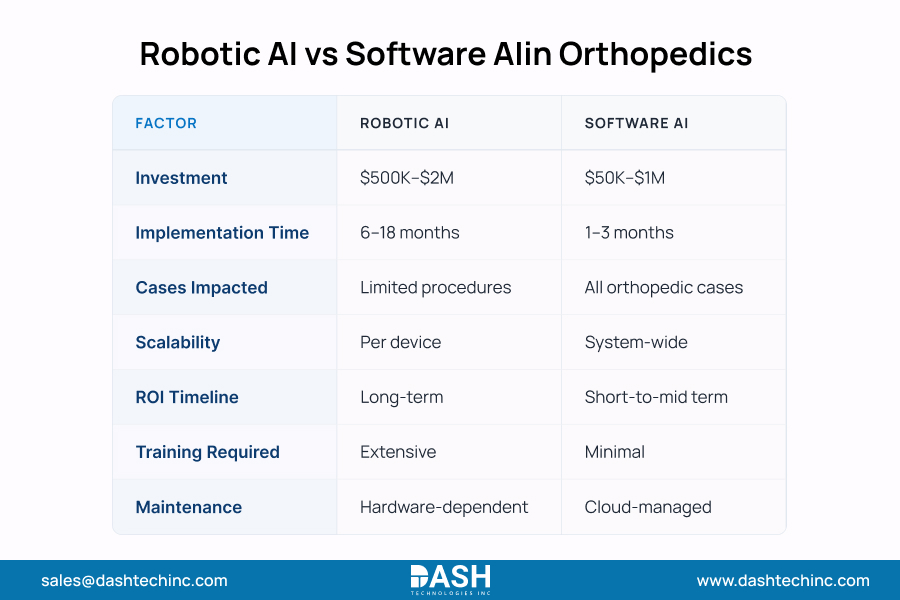
It is no surprise that orthopedic surgical robotics dominates the conversation. Robots are highly visible, tangible, and excellent for hospital marketing. However, the AI perception in orthopedics is often skewed by these machines.
- Capital Intensity: Robotics require massive upfront investment and ongoing maintenance costs. Meanwhile, some of the most impactful orthopedic AI applications are software-based and require far less upfront investment.
- Specialization: They are often limited to specific joint procedures.
- Scalability: Software-driven, AI-focused on analytics and prediction, is far more scalable across an entire service line and requires a fraction of the hardware investment.
Where AI Actually Creates Value in Orthopedic Programs Today
AI-powered orthopedics delivers measurable value in environments characterized by high data volume and significant variability, precisely what defines modern orthopedic practices. A typical orthopedic program generates millions of data points monthly across scheduling, clinical documentation, imaging, supply chain, and outcomes tracking.
This data volume overwhelms manual analysis but provides perfect conditions for AI algorithms. Patterns that would take analysts weeks to identify emerge instantly. Predictions that relied on gut feeling become data-driven forecasts. Orthopedic AI values data because systems learn from each new case. This helps them improve accuracy and relevance over time.
The following AI in orthopedics use cases represent where leading orthopedic programs are deploying AI today, not experimental pilots, but production systems driving operational and clinical improvements.
AI in Orthopedics Use Case #1 – Surgical Planning and Case Complexity Prediction
Precision in orthopedics starts long before the first incision. AI surgical planning orthopedics uses historical patient data to move beyond “best guesses.”
- Predicting Case Duration: AI analyzes patient BMI, comorbidities, and surgeon history to predict exactly how long a case will take, rather than using a standard block average. Orthopedic case prediction algorithms look at patient traits, health issues, procedure types, surgeon habits, and facility factors. They use this information to make accurate estimates.
- Anticipating Resource Needs: Preoperative analytics can predict the specific tray requirements or implant sizes likely to be used, reducing “just in case” sterilization costs.
- Reducing OR Overruns: By identifying high-complexity cases early, managers can schedule them appropriately to prevent the “domino effect” of delays.
AI in Orthopedics Use Case #2 – Improving OR Scheduling and Throughput
Effective AI OR scheduling solves the “Tetris” problem of the surgical suite. By identifying patterns across years of surgical throughput analytics, AI optimizes the day-of-surgery flow.
- Input: Historical turnover times, cancellation reasons, and surgeon block utilization.
- AI Processing: Algorithms identify which blocks are likely to go unused and which surgeons are consistently over-scheduled.
- Outcome: A dynamic schedule that maximizes orthopedic OR optimization and reduces idle time between cases.
AI in Orthopedics Use Case #3 Orthopedic Outcomes Analysis and Risk Stratification
The shift to value-based care makes orthopedic outcomes analytics a necessity. AI excels at AI risk stratification in orthopedics by identifying which patients are most likely to experience complications.
AI can analyze many postoperative journeys. It flags “high-risk” patients, such as those likely to be readmitted or develop infections. This helps with proactive intervention. This level of postoperative outcome prediction helps quality teams standardize care paths across the entire facility.
Turn Orthopedic Data Into Actionable Intelligence
Move beyond robotics. Use practical AI to improve OR efficiency, reduce implant costs, and strengthen margins.
Schedule a Strategy ConsultationAI in Orthopedics Use Case #4 – Implant Cost and Utilization Optimization
Implants are often the largest supply expense in an orthopedic program. AI cost optimization healthcare tools bring much-needed transparency to implant utilization in orthopedics.
AI can correlate the cost of an implant with the patient’s long-term clinical outcome. For eg, if a $2,000 implant has the same 2-year outcome as a $4,000 implant, AI can identify this insight. This supports value-based purchasing. It also helps leaders reduce “unwarranted clinical variation” among surgeons.
AI in Orthopedics Use Case #5 – Real-Time Performance Dashboards
One of the most practical AI in orthopedics use cases is deploying real-time performance dashboards for service-line leaders. Instead of relying on delayed reports, AI-powered dashboards continuously analyze operational, financial, and clinical data to support faster decision-making.
How It Works
- Input: OR utilization, case duration variance, implant cost per case, readmissions, and block utilization.
- AI Processing: Pattern recognition, anomaly detection, and predictive forecasting across historical and real-time data.
- Outcome: Real-time orthopedic analytics with automated alerts when KPIs drift from benchmarks.
What These Dashboards Show
- OR Utilization %
- Case Duration Variance by Surgeon
- Implant Cost Variation
- Readmission Risk Alerts
- Contribution Margin per Case
Why It Matters
AI-powered dashboards extend orthopedic clinical decision support beyond the bedside to operational leadership.
Instead of reacting to last quarter’s results, leaders can identify cost spikes, scheduling risks, and margin gaps in real time — enabling faster, data-driven action.
Why AI Adoption in Orthopedics Often Fails
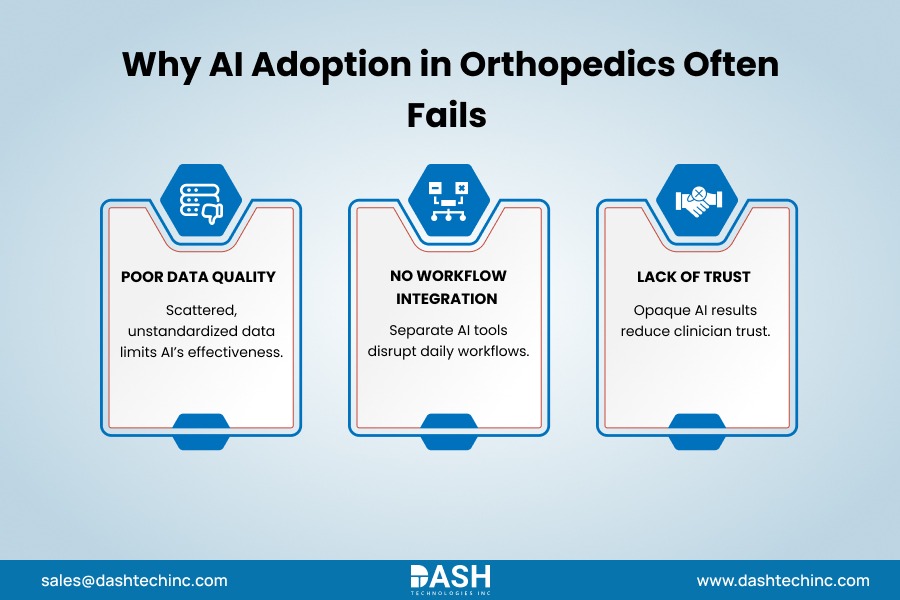
Despite the potential, orthopedic AI implementation faces significant hurdles. AI adoption challenges in healthcare usually fall into three categories:
- Poor Data Quality
AI depends on clean, standardized, and integrated data. Many orthopedic departments still face issues with scattered data. This includes challenges with EHRs, scheduling systems, and implant registries. - Lack of Workflow Integration
AI tools fail when they exist outside daily workflows. If clinicians and administrators must log into separate systems, adoption drops quickly. - Clinician Trust and Usability
AI recommendations must be transparent and explainable. Clinicians are unlikely to trust “black box” tools that do not align with real-world practice.
AI fails when layered on top of broken workflows. Success requires alignment between technology, data, and operational processes.
Preparing Orthopedic Departments for Practical AI Adoption
To create a strong healthcare AI strategy, orthopedic leaders should take these steps for AI readiness:
- Clean the Foundation: Standardize how data is entered into the EHR and scheduling systems.
- Focus on Operations First: Operational use cases, such as scheduling and costs, often provide quicker ROI. They also carry a lower clinical risk than diagnostic AI.
- Embed, Don’t Add: AI should fit easily into scheduling systems. Orthopedic AI applications must also work well with dashboards and current clinical processes.
- Measure Impact: Monitor defined KPIs like decreased TAT to show tangible value created by AI, outside of the hype.
Conclusion: The Future of AI in Orthopedics Is Practical, Not Experimental
The future of AI in orthopedics is not about flashy technology or experimental tools. The real transformation lies in practical AI healthcare applications that improve decision support, operational efficiency, and financial performance.
Orthopedic leaders who focus on analytics, risk stratification, cost optimization, and workflow integration will outperform those chasing technology trends.
However, success begins with strong data foundations. Many orthopedic programs struggle to convert raw surgical and operational data into meaningful insights. If that sounds familiar, explore our detailed breakdown on overcoming these barriers in Why Orthopedic Departments Struggle to Turn Surgical Data Into Actionable Insights.
Frequently Asked Questions
About Dash

Dash Technologies Inc.
We’re technology experts with a passion for bringing concepts to life. By leveraging a unique, consultative process and an agile development approach, we translate business challenges into technology solutions Get in touch.