

Solving the Provider–Payer Information Gap with Intelligent Automation
Introduction: The Cost of the Provider–Payer Information Gap
The provider–payer information gap has quietly become one of the most expensive and destabilizing forces in U.S. healthcare. Even as organizations invest heavily in EHR modernization, digital health platforms, and healthcare automation, payer-provider communication issues continue to slow care delivery, delay reimbursement, and increase operational strain.
In day-to-day operations, this gap shows up in very tangible ways. Clinical and administrative teams spend hours navigating prior authorizations, responding to payer documentation requests, and correcting claims that fail not because care was inappropriate, but because information did not move cleanly between systems. This growing administrative burden healthcare teams face is now widely recognized as a driver of burnout, revenue leakage, and poor patient experience.
What makes this problem particularly challenging is that it sits at the intersection of technology, policy, and process. Fragmented systems, manual workflows, and constantly evolving payer rules compound one another, creating some of the most persistent US healthcare challenges we see today.
What has changed is the maturity of the solution space. Modern healthcare AI solutions, when combined with intelligent automation, are finally capable of addressing the provider–payer information gap at scale—not by adding more staff or more portals, but by fundamentally redesigning how information flows across the ecosystem.
At a high level, the gap persists because:
- Providers and payers operate on different data expectations
- Information is exchanged too late, in the wrong format, or not at all
- Manual processes amplify small mismatches into systemic failures
This is precisely where intelligent automation becomes a strategic enabler rather than a tactical fix.
Why the Provider–Payer Gap Exists: A Breakdown
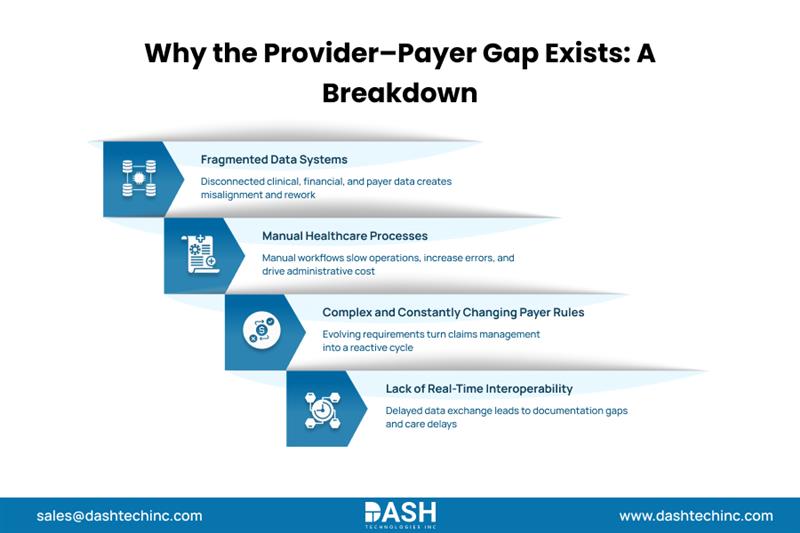
To close the gap, it is important to understand why it exists in the first place. In practice, healthcare interoperability issues and healthcare data fragmentation are reinforced by outdated processes and structural misalignment between provider and payer systems.
Fragmented Data Systems
At the core of the problem lies fragmented healthcare data. Clinical information lives in siloed EHR systems; financial data resides in revenue cycle platforms, and payer requirements are scattered across portals, policy documents, and PDFs. Even when organizations invest in EHR integration, the underlying data models rarely align with how payers adjudicate claims.
Providers document care in clinically rich, narrative formats. Payers, on the other hand, rely on structured data to validate coverage and medical necessity. This disconnect leads to payer data mismatch, unnecessary rework, and avoidable delays. Over time, these inefficiencies fuel payer-provider friction and erode trust across the ecosystem.
Manual, Redundant Processes
Despite years of digitization, many payer-facing workflows remain deeply manual. Manual workflows for healthcare teams depend on—such as fax-based prior authorizations and manual claims processing—are still common across the industry.
These healthcare manual processes do not scale. They introduce inconsistency, slow turnaround times, and increase the likelihood of error. As volume grows, manual handoffs become a primary contributor to prior authorization challenges and rising administrative costs.
Complex and Constantly Changing Payer Rules
Another major driver of the gap is the pace at which payer requirements evolve. Payer rule updates, changes in medical necessity validation, and increasing claims of coding complexity make it nearly impossible for teams to stay current using manual methods.
What I have consistently seen is that organizations discover issues only after a claim is denied. By then, the damage has already been done. These delayed discoveries are among the most common claims of denial root causes, forcing teams into reactive appeals instead of proactive prevention.
Lack of Real-Time Interoperability
While standards such as FHIR have made progress, FHIR interoperability challenges remain widespread. Most organizations still lack true real-time data exchange for healthcare capabilities.
As a result, clinical documentation gaps persist. Payers request additional information; providers respond asynchronously, and patients wait—often unnecessarily. This cycle reinforces inefficiency and delays across the care continuum.
The Case for Intelligent Automation (RPA + AI + NLP)
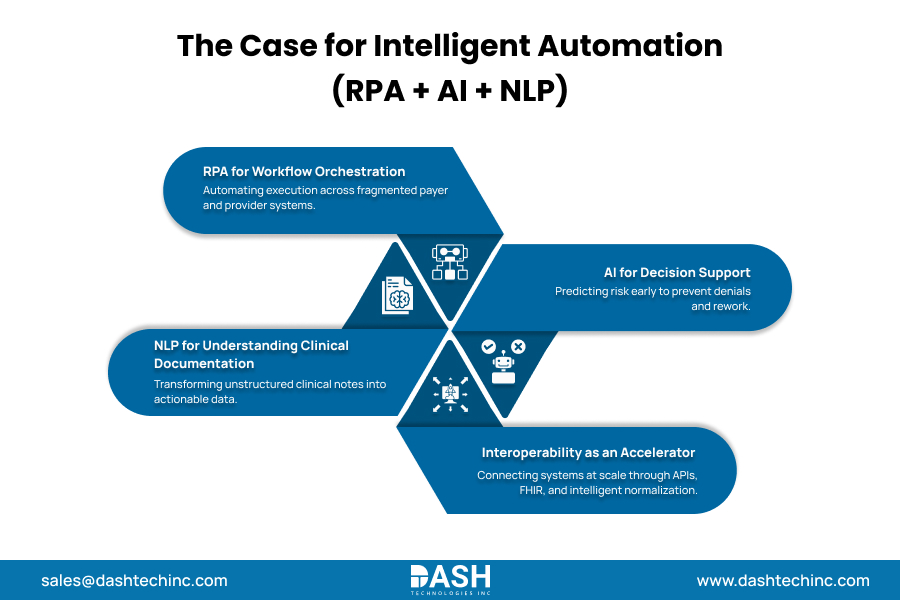
Addressing the provider–payer information gap requires more than incremental improvement. It requires intelligent automation of healthcare strategies that combine execution, intelligence, and understanding into a single operating model.
This is where RPA in healthcare, AI-driven claims automation, and NLP for medical documentation come together to enable end-to-end healthcare workflow orchestration.
RPA for Workflow Orchestration
RPA for claims processing has become a foundational capability for many organizations. It enables automated eligibility checks, payer portal navigation, claims submission, and status monitoring without requiring full system replacement.
More importantly, healthcare robotic process automation acts as connective tissue between systems that were never designed to work together. It ensures information moves consistently and predictably across platforms.
AI for Decision Support
AI adds intelligence where traditional automation stops. Through AI denial prediction, AI claims accuracy, and healthcare predictive analytics, organizations can identify risk before submission rather than reacting after denial.
In real-world implementations I have worked on, AI-driven decision support shifted teams away from constant rework toward proactive prevention—changing not just outcomes, but operating mindset.
NLP for Understanding Clinical Documentation
One of the most persistent barriers in provider–payer workflows is unstructured clinical data. NLP in healthcare enables unstructured data extraction from physician notes, operative reports, and discharge summaries.
By enabling clinical documentation automation, NLP bridges the gap between clinical intent and administrative requirements. In practice, NLP-based clinical matching significantly reduces manual review effort without forcing clinicians to change how they document care.
Interoperability as an Accelerator
Modern automation strategies leverage FHIR APIs healthcare, API-driven data exchange, and AI for data normalization to enable scalable interoperability automation. Instead of building one-off integrations, organizations can create reusable pipelines that support multiple workflows across providers and payers.
Key Use Cases: How Intelligent Autom1ation Bridges the Gap
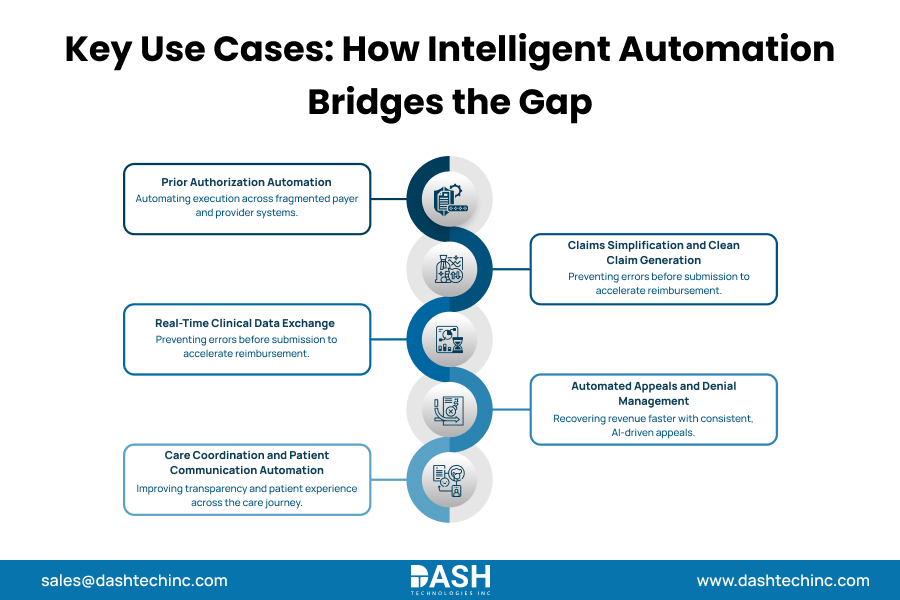
Prior Authorization Automation
Automated prior authorization is one of the most impactful applications of intelligent automation. AI prior auth workflows combine real-time benefits verification with NLP-based clinical matching to submit complete, compliant requests upfront.
The result is faster decisions, fewer resubmissions, and a meaningful reduction in administrative effort.
Claims Simplification and Clean Claim Generation
Claims simplification solutions focus on preventing errors before submission. Clean claims generation relies on claims automation tools, RPA for claims editing, and medical billing automation to ensure payer-specific requirements are met the first time.
This approach directly improves healthcare revenue cycle optimization by reducing rework and accelerating reimbursement.
Real-Time Clinical Data Exchange
Through healthcare data exchange automation, organizations enable real-time healthcare data flow using structured clinical data extraction and interoperability automation. This reduces redundant documentation requests and speeds medical review.
Automated Appeals and Denial Management
When denials do occur, automated denial management systems support AI appeals generation and payer appeals automation. Appeal preparation time drops from hours to minutes, while consistency and recovery rates improve.
Care Coordination and Patient Communication Automation
Automation also strengthens automated patient communication and AI care coordination. Modern payor-provider communication tools improve transparency, reduce missed appointments, and enhance the overall patient experience.
Quantifiable Business Impact for Providers and Payers
When implemented thoughtfully, intelligent automation delivers measurable results:
- Reduced healthcare admin cost
- Improved healthcare operational efficiency
- Lower prior auth turnaround
- Stronger healthcare revenue cycle optimization
- Improved patient throughput
Equally important, reduced friction improves clinician satisfaction and patient experience—outcomes that matter as much as financial performance.
Implementation Framework: How Healthcare Organizations Can Get Started
A successful healthcare automation roadmap begins with focus and discipline.
Organizations should first identify claims bottlenecks, prior to auth delays, and manual RCM tasks that create the most friction. Conducting an automation maturity assessment of healthcare teams trust helps determine workflow automation readiness.
An AI adoption strategy healthcare leaders define should prioritize a phased automation strategy—starting with RPA implementation of healthcare, then scaling AI and NLP capabilities. Scaling healthcare automation requires strong EHR integration, FHIR-based system integration, and payer portal automation.
Finally, effective automation governance healthcare frameworks must address HIPAA automation compliance, AI governance healthcare, and secure RPA deployments to maintain trust and regulatory alignment.
Future Outlook: A Connected, Intelligent Provider–Payer Ecosystem
The future of healthcare automation points toward predictive claims processing, zero-touch claims, and real-time prior authorization decisions. Self-learning bots will adapt to payer rule updates, while automated documentation exchanges reduce friction across organizations.
As payer-provider digital transformation accelerates, an AI-powered healthcare ecosystem will emerge—one where information flows seamlessly and administrative complexity no longer stands in the way of care delivery.
Conclusion: Intelligent Automation as the Bridge to a Better Healthcare System
The provider–payer information gap is not a temporary inefficiency; it is a structural problem that affects cost, access, and trust across U.S. healthcare. Bridging provider-payer gap challenges requires more than incremental fixes—it requires automation-driven efficiency built on intelligent systems.
The healthcare intelligent automation benefits are now clear. By combining RPA, AI, NLP, and interoperability, organizations unlock measurable healthcare AI ROI while building a more resilient, responsive healthcare system.
From where I sit, intelligent automation is no longer optional. It is the strategic foundation for the next phase of U.S. healthcare.
Frequently Asked Questions
About Dash

Dash Technologies Inc.
We’re technology experts with a passion for bringing concepts to life. By leveraging a unique, consultative process and an agile development approach, we translate business challenges into technology solutions Get in touch.