AI-Powered Clinical Dashboards : Streamlining Workflow for Better Healthcare Insights
Today’s hospitals are overwhelmed by data. Each ECG, lab test, prescription, radiology scan, and nursing note accumulates a flood of data. However, the clinicians who require that information more frequently find it difficult to obtain it fast enough to make informed decisions. It should come as no surprise that almost every clinical team reports some degree of cognitive overload while making the decisions between EHR navigation, manual chart reviews, and frequent interruptions.
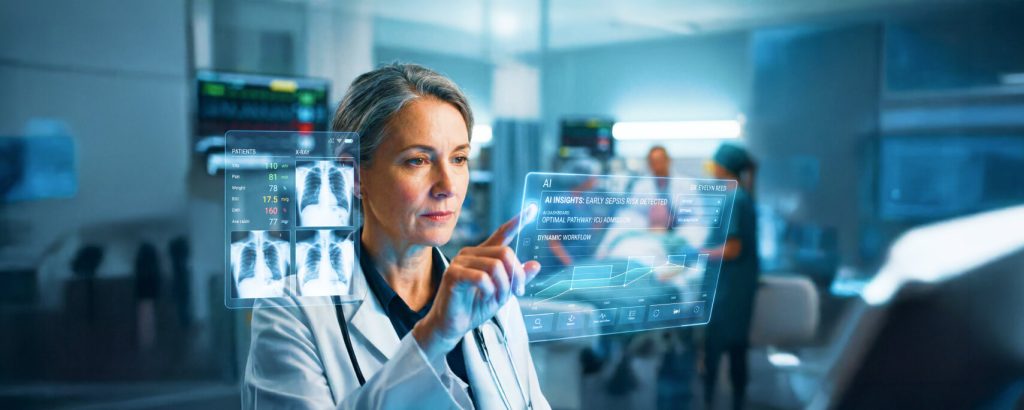
This gap between “data available” and “data usable” is exactly where AI-powered clinical dashboards are changing the game. These dashboards aren’t just prettier versions of traditional charts. They actively interpret data, surface what matters, and remove countless small friction points that slow down care teams.
In this blog, we’ll explore why these dashboards are becoming essential in modern hospitals, which workflows they transform, and how organizations can implement them without disrupting clinical operations.
AI Dashboard Adoption in Healthcare: Key 2025 vs Prior Years
The global AI in healthcare market increased from around $29.01 billion in 2024 to an estimated $39.25 billion in 2025, demonstrating substantial investment and commercialization of clinical AI tools (including dashboards and decision assistance).
Predictive analytics, a core feature of AI clinical dashboards, increased from about $1.806 million in 2017 to an anticipated $8.464 million by 2025, demonstrating the widespread use of forecasting tools among providers. This demonstrates how predictive models are being used more often in operational forecasts, deterioration detection, and triage.
Hospital adoption is inconsistent but accelerating: While smaller and rural hospitals typically stay below 50% of adoption, large urban and multi-hospital systems report substantially higher AI usage (often around 80–90% for at least one AI application). This gap indicates differences in the preparedness and ability to integrate AI-powered clinical dashboards.
Clinical success and real-world impact remain mixed: Survey data indicate that only about 19% of institutions reported a high degree of success for AI used in clinical diagnosis (imaging/diagnostic AI), underscoring that adoption does not always equal effective deployment — careful validation, governance, and workflow integration remain essential.
Why Today’s Clinical Workflows Need a Smarter Approach
Healthcare workflow problems are rarely rooted in a lack of information—there’s more than enough of it. The real challenge is how fragmented it is across EHRs, imaging systems, bedside devices, and handwritten notes.
Clinicians are expected to:
- Jump between 6–10 systems during a single patient encounter
- Reconstruct a patient story from disconnected pieces
- Interpret dozens of alerts and decide which ones matters
- Navigate staffing gaps and unpredictable patient volumes
- Maintain quality and compliance under rising pressure
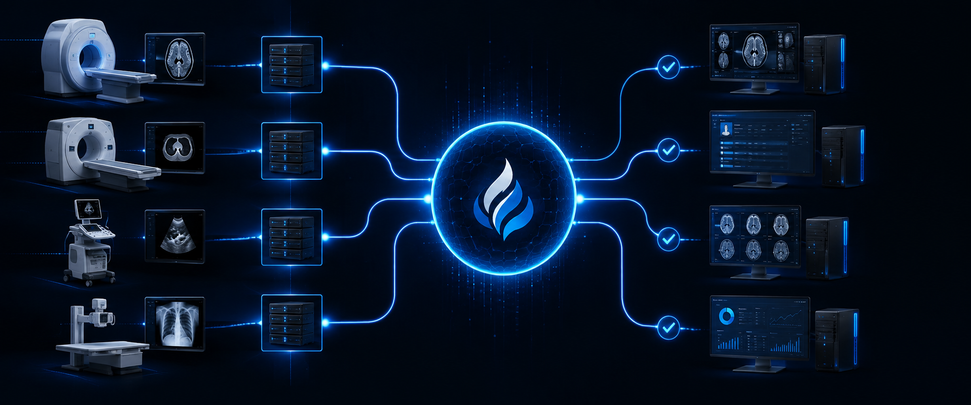
It’s an environment where every second counts, but every second is contested. AI-powered dashboards step in as a unified, intelligent layer on top of these systems. They gather, clean, interpret, and display the right information at the right moment—reducing the cognitive burden on care teams.
AI-Powered Clinical Dashboards: Overview
Think of them as a hospital-wide command center, not just a graph on a screen. They combine:
- Real-time data integration from EHRs, LIS, PACS, RTLS systems, medical devices
- AI models that detect patterns, predict risks, and highlight anomalies
- Visualizations that simplify complex information in seconds
- Workflow automation that routes tasks to the right team member automatically
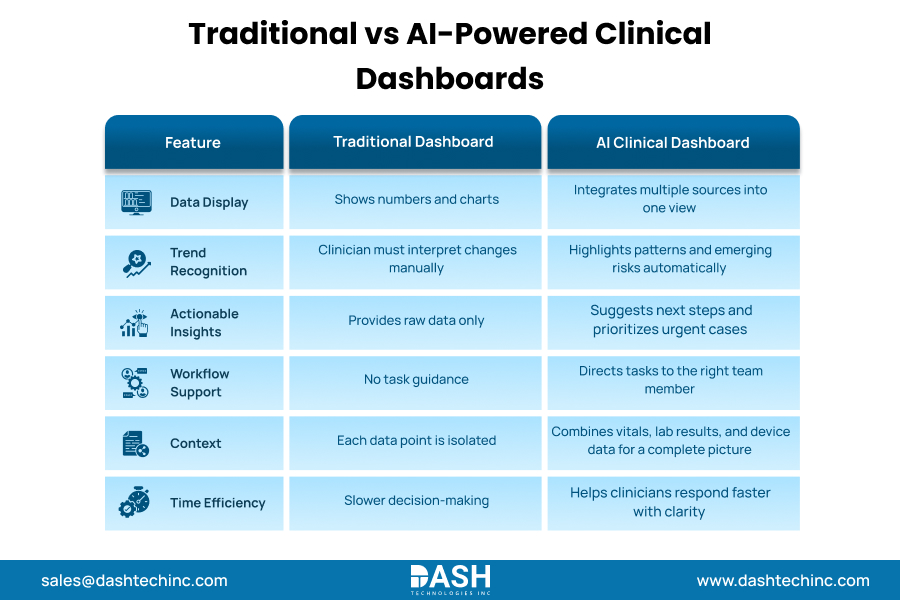
Unlike traditional dashboards—which only display data—AI dashboards interpret it. Here’s how AI clinical dashboards differ from static ones.
Which Clinical Challenges Do AI Dashboards Solve?
- Too many manual charts review
Clinicians spend a huge portion of their day digging through records. AI dashboards pull the most relevant data into a single snapshot. - Delays caused by poor visibility
If ED beds fill up suddenly or labs start getting delayed, downstream teams often find out too late. Dashboards monitor operational patterns and flag issues early. - Alert fatigue
Most alerts are generic. AI models prioritize alerts based on risk and the patient’s history, reducing noise for clinicians. - Slow decision-making in emergency scenarios
Whether it’s rapid triage or ICU crisis management, having real-time, context-rich insights improves decision-making dramatically. - Staff workload imbalance
AI can recommend how to distribute tasks based on acuity, staffing ratios, and current patient load.
These aren’t theoretical benefits—they directly impact efficiency and patient safety.
Engineer Clinical Dashboards for Real-World Care
We design AI-powered clinical dashboards with robust data pipelines, offline resilience, and workflow-aligned UX—built to perform in real hospital environments.
Talk to Our ExpertsKey Features That Make AI Dashboards Effective
Real-Time Data Aggregation
No more bouncing between 10 different systems. Dashboards unify everything:
Vitals
- EHR notes
- Imaging results
- Bed status
- Medication orders
- Lab values
- Device data
For clinicians, that means seeing the whole patient’s story on a single screen.
Predictive Analytics
These are not “future of healthcare” capabilities—they are being deployed right now:
- Risk of deterioration
- Sepsis onset likelihood
- Readmission probability
- OR schedule overruns
- ICU congestion forecasts
Predictive insights help teams stay ahead instead of reacting late.
Smart Notifications
Notifications are ranked by urgency, impact, and patient-specific relevance. No more false alarms drowning out real ones.
Natural Language Summaries
AI can convert structured and unstructured data into a quick summary:
“Patient stable, lactate trending down, next labs due in 2 hours. No new risks identified.”
This alone saves several minutes per patient.
Mobile & Remote Visibility
Care teams don’t need to be tied to a workstation. Critical updates reach them wherever they are—inside or outside the care unit.
How AI Dashboards Improve Everyday Clinical Workflow
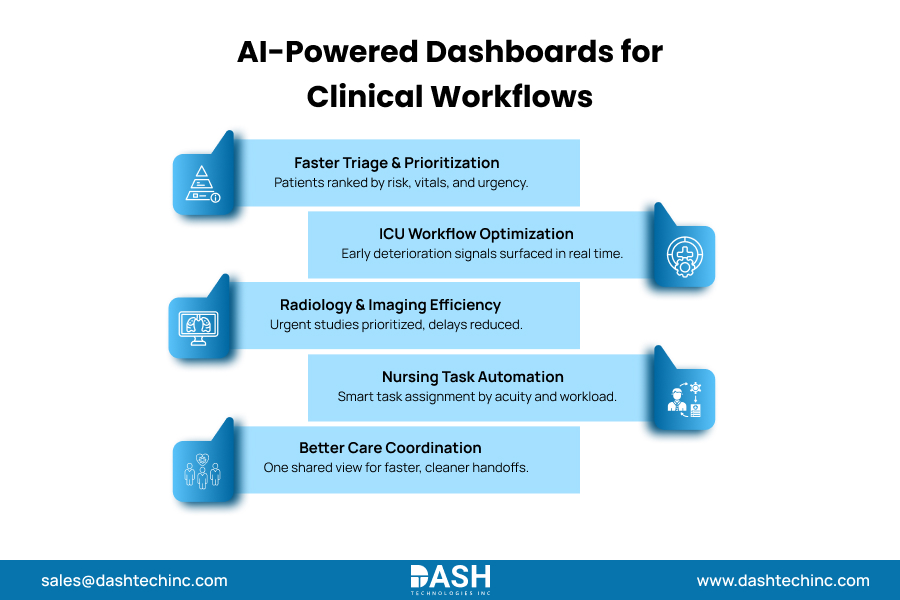
1. Faster Triage & Prioritization
Emergency departments are chaotic by nature. Dashboards evaluate:
- Presenting symptoms – Key indicators of symptoms for quick assessment
- Vital trends – Displaying changes in heart rate, blood pressure
- Risk score – Prioritizes patients by higher risk factors
- Bed availability – Shows available or occupied beds for urgencies
- Waiting room load – Tracks patient queue and flow avoiding overcrowd or long delays
- Patient recommendation – Helping care for patients requiring immediate attention
2. ICU Workflow Optimization
ICUs rely heavily on trendy data. AI surfaces early deterioration patterns that may go unnoticed during busy shifts.
3. Radiology & Imaging Efficiency
Dashboards can:
- flag stat cases
- show modality wait times
- track report turnaround delays
- prioritize studies by clinical acuity
Radiologists see what matters first.
4. Nursing Task Automation
AI can distribute tasks based on:
- Acuity – Assigns tasks based on patient severity
- Location – Directs staff to the right care area
- Skill level – Matches tasks with staff expertise
- Current workload – Balances responsibilities across the team
It reduces back-and-forth communication and ensures nothing gets missed.
5. Better Care Coordination
Surgeons, intensivists, nurses, and administrators get a shared view—a single source of truth. Handoffs become cleaner and faster.
Interoperability: The Backbone of AI Dashboards
A smart dashboard means nothing without clean, connected data.
Integration areas include:
- EHRs (Epic, Cerner, Meditech, Allscripts) via FHIR/HL7
- Imaging systems (PACS)
- Lab Information Systems (LIS)
- Medical devices (ventilators, monitors, pumps)
- Real-time location systems (RTLS)
The goal is not to replace these systems—it’s to orchestrate them, so clinicians don’t have to.
Data Normalization & Governance
Dashboards convert data from different formats into a consistent structure, ensuring accuracy and compliance.
Real-World Use Cases: How Hospitals Are Benefiting
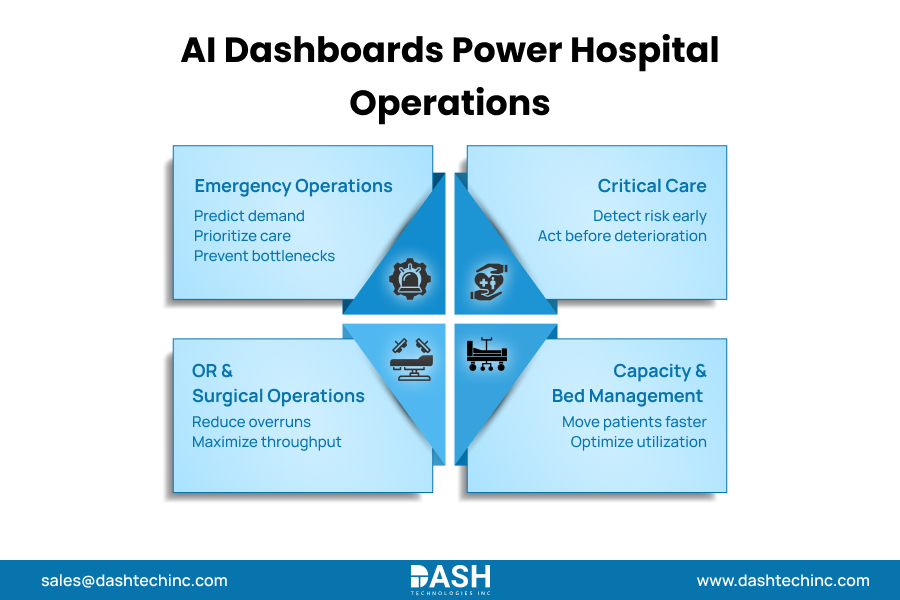
Emergency Department Command Center
- Live patient-in-flow tracking
- Triage prediction
- Average wait time forecasting
- Resource allocation suggestions
ED leaders can see bottlenecks before they escalate.
ICU & Critical Care Dashboard
- Deterioration early warning
- Ventilator and sedation trends
- Nursing workload distribution
- Sepsis and infection alerts
A single screen can replace an hour of manual chart reviews.
Perioperative & OR Management
- Case overrun predictions
- Staff scheduling support
- Equipment availability tracking
- Delays and cancellations forecasting
This translates to fewer delays and better patient throughput.
Hospital Bed Management
- Bed availability
- Discharge likelihood predictions
- Cleaning cycle tracking
- Departmental handoff coordination
Hospitals using AI dashboards report significantly faster patient movement.
Measurable ROI: Why Hospitals Are Making the Shift
AI-powered dashboards are not just “interesting tech”—they’re financially impactful.
Reduced clinician burnout
By cutting documentation time and chart review load.
Higher operational efficiency
Better resource allocation and reduced delays lower overall care costs.
Faster decision-making
Seconds matter in emergency care—and dashboards give teams the clarity they need.
Improved quality metrics
Hospitals typically see improvements in:
- Length of Stay (LOS)
- Readmissions
- ED dwell time
- Sepsis recognition & response
Increased patient throughput
Smarter workflows mean more patients can be treated without expanding staff or infrastructure.
Responsible AI: Data Security & Compliance
Healthcare data demands the highest standards. AI dashboards follow strict protocols:
- End-to-end encryption
- HIPAA-compliant architecture
- Role-based access
- Full audit trails
- Bias monitoring across clinical predictions
- Clinicians remain in control—AI simply provides clarity.
How to Successfully Implement an AI-Powered Dashboard
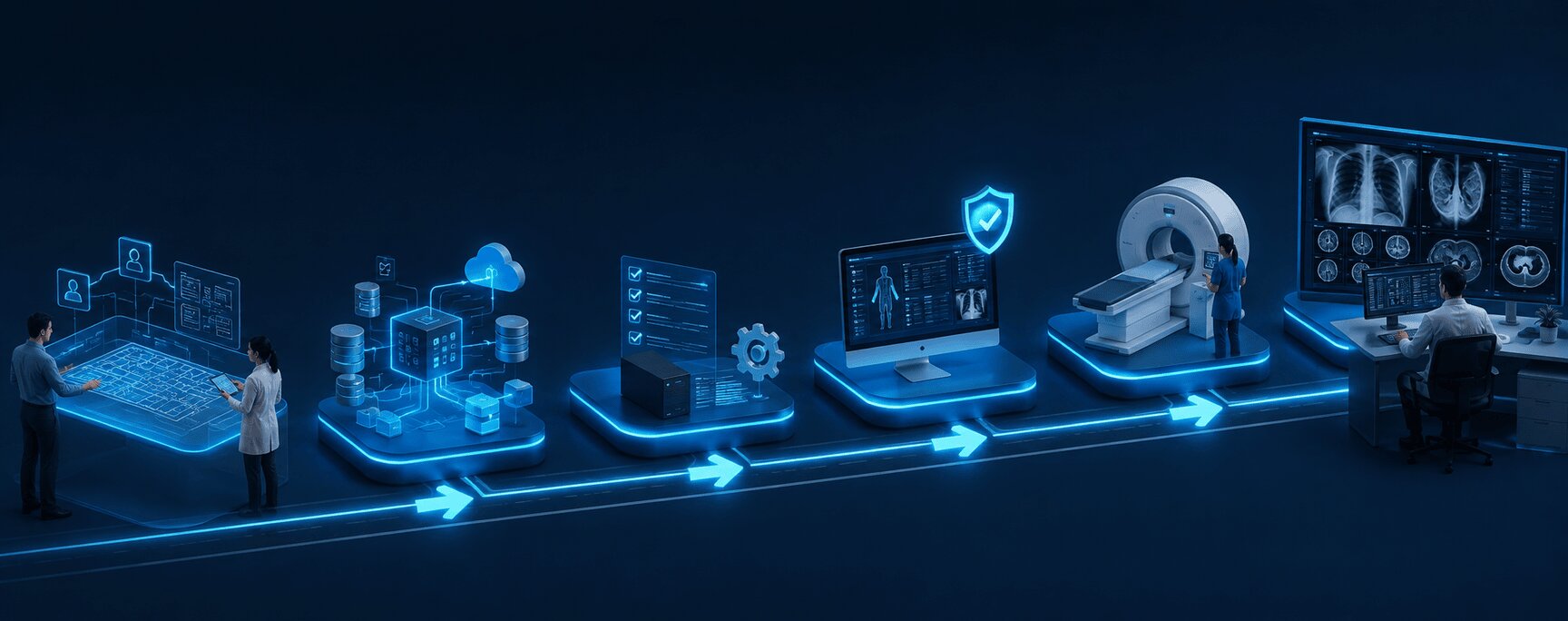
1. Start with a workflow gap analysis
Identify the areas where clinicians feel the most friction.
2. Ensure clean and connected data
Integration is the foundation; dashboards are the layer on top.
3. Choose dashboards that complement workflow
AI tools should reduce clicks without altering EHR workflow, not add more.
4. Train staff in short, role-based sessions
The best dashboards feel intuitive; training accelerates adoption.
5. Measure success with clear KPIs
- reduction in wait times
- clinician satisfaction
- lower LOS
- faster lab-to-action cycles
6. Scale in phases
Start small (ICU, ED, or radiology) and expand based on early wins.
Key Takeaway: The Future Is Insight-Driven Care
Modern healthcare is transforming with the next-gen AI-powered clinical dashboards. They provide hospitals with real-time visibility, enable clinicians to respond faster, and reduce massive amounts of data into insightful conclusions they’ve been lacking. As patient acuity is increasing, staff is under pressure, and expectations are higher than ever. Healthcare organizations need technologies that support clinical decision-making, not to complicate it. Clinicians are meant to be empowered by these dashboards, not displaced. The new benchmark for patient care will be established by the hospitals that embrace them now.
With automated workflows, AI clinical dashboards, and smooth EHR integrations, DASH Technologies assists organizations modernize healthcare. Our cutting-edge solutions enhance care outcomes while reducing clinician workloads. Discover how your clinical ecosystem can benefit from clarity, interoperability, and efficiency with intelligent platforms.
About Dash

Dash Technologies Inc.
We’re technology experts with a passion for bringing concepts to life. By leveraging a unique, consultative process and an agile development approach, we translate business challenges into technology solutions Get in touch.