Digital MedTech : Scaling Remote Care Through Connected Ecosystems
Introduction
Healthcare today feels like living in two different worlds at once. On one side, patients are surrounded by smart devices—watches that track heart rhythms, glucose sensors that send live readings, and home monitoring kits that can detect early deterioration. On the other hand, care teams still struggle with healthcare data silos, inconsistent workflows, and systems that were never designed to talk to each other.
Every hospital leader and MedTech founder has experienced this frustration:
“We have data everywhere… so why does our care still feel disconnected?”
The truth is that innovation hasn’t failed. It’s simply fragmented. Devices are improving faster than the infrastructure connecting them.
This is where connected care ecosystems finally enter the picture—not as big, expensive transformations but as practical, incremental steps toward real integration. This is the heart of digital MedTech transformation: turning isolated devices into integrated digital health systems that are scalable, sustainable, and genuinely useful.
Remote monitoring doesn’t need to overwhelm teams. With the right ecosystem approach, remote patient monitoring scalability becomes achievable—even for small teams or emerging MedTech companies.
What’s Shaping Connected Care in 2025
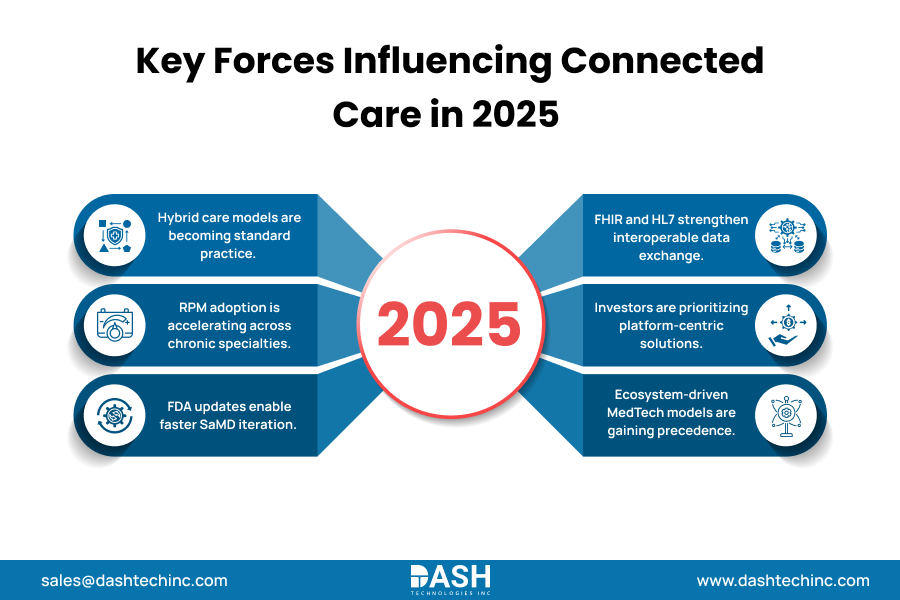
Remote care is no longer experimental. It’s becoming the industry baseline—and several major healthcare industry trends in 2025 are accelerating that shift.
Hybrid care is the new norm.
Patients now move fluidly between in-clinic visits and at-home monitoring. This rise in hybrid care trends is pushing every care delivery model to become more continuous and less episodic.
RPM adoption is exploding in chronic care.
Cardiac, pulmonary, oncology, and post-surgical care are leading the way. Hospitals adopting structured RPM workflows see lower readmissions and smoother care coordination, aligning with broader RPM adoption trends across the industry.
Regulations are evolving faster.
The FDA’s updated stance on SaMD regulation (Software as a Medical Device) now encourages iterative updates and continuous performance improvement—giving MedTech companies more flexibility to innovate.
Interoperability is no longer optional.
FHIR and HL7-based data exchange are shaping interoperability in MedTech, making it easier for device data to flow directly into provider workflows.
Investment patterns are shifting.
Investors now prefer platform-first companies over device-only models. Anything that reduces integration time or simplifies hospital onboarding earns immediate attention.
The message is clear:
MedTech companies that build ecosystems—not standalone products—will lead to the future of hybrid and remote care.
MedTech’s Role in Digital Health — Why Ecosystems Matter
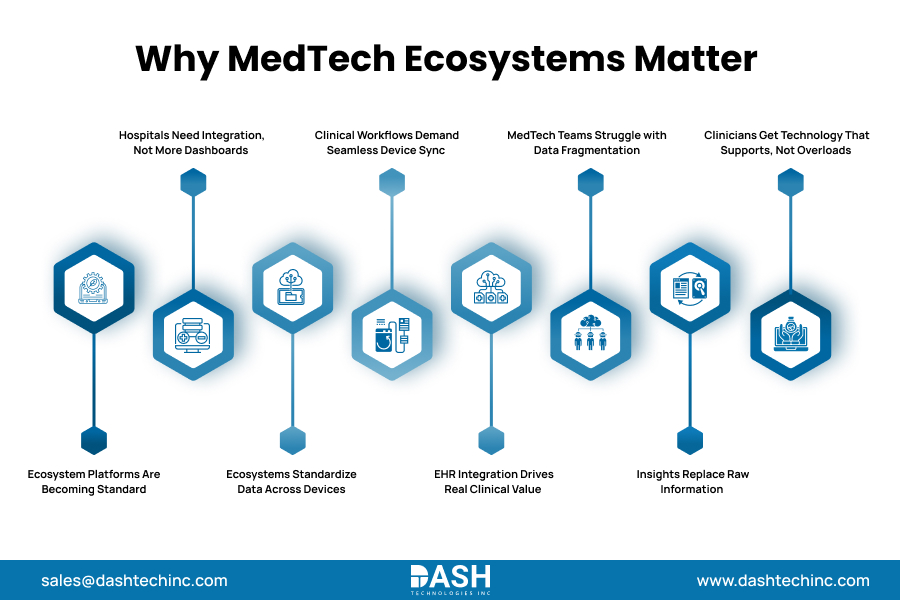
If the last decade of MedTech was about building smarter devices, this decade is about making those devices work together.
Hospitals aren’t asking for more dashboards or more data—they’re asking for clinical workflow integration that reduces the chaos. They want connected medical devices that automatically sync, flag risks, and fit into their daily routines without extra clicks.
Many MedTech teams quietly admit the same struggles:
- Long integration timelines
- Fragmented data formats
- Limited analytics
- Increasing pressure to demonstrate ROI
This is exactly why ecosystem-based MedTech platforms are becoming the industry standard.
A connected MedTech ecosystem does three things exceptionally well:
- Standardizes data across devices
- Integrates smoothly into EHRs and clinical workflows
- Delivers insights, not just information
This shift requires MedTech software enablement, not just hardware innovation. And the emotional benefit is powerful:
clinicians finally get technology that supports them, instead of overwhelming them.
Building a Connected MedTech Ecosystem — Practical, Realistic Steps
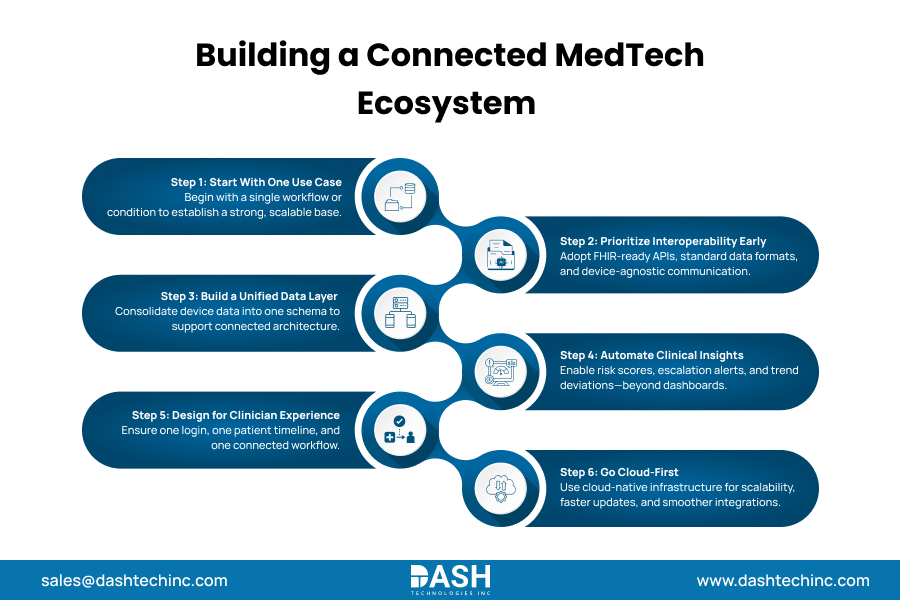
Most teams think building a connected ecosystem is a massive, multi-year project. In reality, it’s much more manageable when you break it down into smaller steps.
Here’s how MedTech teams can start:
Step 1: Start with one use case.
Don’t try to build a full ecosystem on day one. Pick one condition, one workflow, or one device. Solve it exceptionally well.
This sets the foundation for scalable remote care solutions later.
Step 2: Prioritize interoperability from day one.
Follow simple MedTech interoperability steps:
- FHIR-ready APIs
- Standard data formats
- Device-agnostic communication
This reduces integration headaches by 70–80%.
Step 3: Create a unified data layer.
Bring device data into a single schema.
This is the backbone of any connected MedTech architecture.
Step 4: Automate clinical insights.
Go beyond dashboards. Provide risk scores, escalation alerts, and trend deviations.
This turns devices into decision-support tools.
Step 5: Focus on user experience for clinicians.
One login.
One patient timeline.
One connected workflow.
This is the difference between adoption and abandonment.
Step 6: Build cloud first.
Cloud-native medical devices scale faster, update easier, and integrate more smoothly with hospital infrastructure.
These steps sound simple, but they are exactly how the most successful companies build digital health ecosystems—slowly, consistently, and with purpose.
Build Connected MedTech Solutions That Scale
Deliver seamless remote care with Dash’s expertise in interoperability, data integration, and digital health platforms.
Let's ConnectWhy Connected Ecosystems Actually Work
Connected ecosystems aren’t just a technology upgrade—they deliver a measurable impact.
For clinicians:
- Up to 60% reduction in review time thanks to consolidated dashboards
- Fewer manual data exports
- Better visibility into long-term trends
These improve digital health efficiency across teams.
For patients:
- Faster interventions
- Fewer hospital visits
- More confidence in self-management
All contributing to improved patient monitoring outcomes.
For MedTech companies:
- Faster deployments mean faster revenue generation
- Lower integration costs
- Clearer MedTech ROI to justify investment
For hospitals:
- Reduced readmissions
- Better remote care outcomes
- More predictable staffing and utilization
This is the real promise of connected care benefits—technology that makes care feel seamless for everyone involved.
Future of Connected MedTech
The next wave of digital health innovation will be defined by smarter, safer, and more modular systems.
AI will support—not replace—clinicians.
Expect AI-enabled remote care that prioritizes cases, detects early deterioration, and helps teams manage overwhelming patient volumes.
Security will be central.
Zero-trust networks encrypted data flows, and stronger authentication will define MedTech cybersecurity trends.
Ecosystems will become more modular.
Hospitals will buy systems for the way they buy apps—plug-and-play.
This shift toward modular MedTech ecosystems will reward companies that build flexible, interoperable solutions.
The MedTech landscape will become more connected.
The future of MedTech is not device-first or software-first—it’s ecosystem-first.
Final Thought
If there’s one truth in this entire journey, it’s this: You don’t need complexity to scale remote care—you need consistency.
- Start with one use case.
- Build one integration.
- Create one standardized workflow.
- Then expand.
This steady approach creates consistent digital health adoption and sets the foundation for a truly scalable MedTech strategy. The organizations that win will be those that commit to simple, continuous remote care implementation—not overnight transformations.
And if you’re ready to build this future with confidence, let’s partner together and accelerate your connected care strategy.
About Dash

Dash Technologies Inc.
We’re technology experts with a passion for bringing concepts to life. By leveraging a unique, consultative process and an agile development approach, we translate business challenges into technology solutions Get in touch.